


This article is for informational purposes only. It is not, nor is it intended to be, a substitute for professional medical advice, diagnosis, or treatment and should never be relied upon for specific medical advice.
Choose Kushae for OB/GYN-developed vulvovaginal care products if your priority is external cleansing, skin comfort, or discussing boric acid with your clinician; choose Intimate Rose for pelvic rehabilitation tools if your clinician recommends a dilator or pelvic wand. This 2026 comparison separates those needs so you do not buy an odor product for a pelvic-floor problem—or a rehabilitation tool for recurring vaginal symptoms.
TL;DR
- Kushae vs Intimate Rose is primarily a care-products-versus-pelvic-rehabilitation decision, not a contest over treating BV.
- Kushae suits shoppers seeking OB/GYN-developed vulvovaginal care, including external washes and vaginal suppositories.
- Intimate Rose suits shoppers seeking dilators or pelvic wands for a clinician-directed rehabilitation plan.
- Neither brand replaces evaluation for recurring odor, unusual discharge, pelvic pain, or persistent irritation.
Why this matters
Vulvar skin irritation, vaginal odor, and pelvic-floor pain are different problems. The vulva is external anatomy; the vagina is the internal canal. A product intended for one location does not automatically belong in the other.
Buy for the problem and the intended body site, not the broad label “feminine wellness.” For example, Gentle 2-N-1 Foaming Wash belongs in an external-cleansing discussion, not a BV treatment plan.
Recurring symptoms deserve a diagnosis before another purchase. CDC guidance on bacterial vaginosis and vulvovaginal candidiasis describes different diagnostic and treatment approaches; odor or itching alone does not establish either condition.
At a glance
| Dimension | Kushae | Intimate Rose |
|---|---|---|
| Best for | Shoppers seeking vulvovaginal care products | Shoppers seeking pelvic rehabilitation tools |
| Standout feature | OB/GYN-developed care line | Dilators and pelvic wands |
| External cleansing | Washes and external skin-care options | Not the reason to choose its rehabilitation tools |
| Pelvic rehabilitation | Care products do not substitute for rehabilitation tools | More directly matched to a prescribed tool-based plan |
| Boric acid decision | Boric Acid Suppositories + Probiotics & Aloe are a named option | Compare the exact current product, not the brand alone |
| Sensitive-skin fit | Assess the complete ingredient list and directions | Assess materials, cleaning instructions, and intended contact |
| Pricing model | Individual products and named kits | Assess the individual tool and any required accessories |
| Medical limits | Does not replace diagnosis or prescribed treatment | Does not replace diagnosis or individualized rehabilitation |
Care products win for care; rehabilitation tools win for rehabilitation
The clearest difference is what you are trying to accomplish. External cleansing and managing friction on surrounding skin are shopping questions about topical care. A clinician-directed plan involving vaginal dilators or a pelvic wand is a rehabilitation question.
Intimate Rose is the more relevant starting point for the second scenario. Its dilators and pelvic wands belong to a different product category from washes, balms, and deodorants. That distinction is useful, but it is not evidence that any tool will resolve unexplained pain.
The limitation runs both ways. A care-product range does not supply a pelvic-floor assessment. A rehabilitation tool does not identify why vaginal odor keeps returning.
The winner is the brand whose product category matches your diagnosed need. If the need is still unclear, the next step is an appointment rather than a larger basket.
OB/GYN-developed care is a meaningful distinction, not outcome evidence
An OB/GYN-developed line gives you a specific development credential to consider. It does not establish that every formula outperforms competing products, suits every sensitive-skin condition, or produces a particular clinical result.
For this 2026 comparison, keep three questions separate:
- Development: Who helped create the product?
- Formula: What ingredients or materials will contact your body?
- Evidence: What research supports the exact claim being made?
General research about boric acid is not a clinical trial of a particular suppository containing additional ingredients. Likewise, general evidence supporting pelvic-floor therapy does not prove that an independently purchased tool is appropriate for your symptoms.
Intimate Rose's practical distinction is its rehabilitation-tool category. Choose that category when it matches your care plan, not because a device looks more medical than a wash bottle.
Neither a development credential nor a product format guarantees personal suitability. Both require you to read beyond the front label.
Kushae offers the more direct route to external care
For external cleansing and surrounding skin-care needs, the supplied range includes washes, protective balms, and deodorant products. Those are distinct product types. You do not need to combine them simply because they sit within one brand.
Start with the smallest relevant routine. If your concern is sensitivity, review the full wash ingredient list and its directions before adding another topical product. The American College of Obstetricians and Gynecologists' patient guidance on vulvovaginal health advises avoiding irritating products and distinguishes external care from vaginal cleansing.
The travel wash is listed at 1.33 oz. That is a packaging detail, not evidence that the formula is suitable for a particular skin condition. A smaller bottle changes what you carry, not what your skin tolerates.
The tradeoff is straightforward: a broader care range creates more choices, but more choices do not mean more products are necessary. Intimate Rose's rehabilitation tools are not substitutes for external cleansing, and they should not be assessed as though they are.
Intimate Rose is the better fit for a prescribed tool-based plan
If your pelvic-health clinician recommends a vaginal dilator or pelvic wand, Intimate Rose is the more directly relevant brand in this comparison. The purchase should follow the purpose of your rehabilitation plan.
Ask your clinician what the tool is intended to help you practice, how to use it, and what symptoms mean you should stop. Do not select a device simply because penetration hurts; pain needs assessment, and treatment is individualized.
A wash, balm, or suppository cannot perform the same mechanical role as a rehabilitation tool. That is a category distinction, not a criticism of topical care.
The drawback of a tool-based purchase is the need for appropriate selection and technique. Ownership alone is not therapy. American Physical Therapy Association patient education describes pelvic-floor physical therapy as individualized care, rather than a single device purchase.
Choose rehabilitation tools for a rehabilitation plan—not for unexplained odor, discharge, or itching.
Neither brand wins boric acid on its name alone
A boric acid comparison needs to happen at the product level. Read the complete label, including active and additional ingredients, route of use, warnings, and directions. Do not assume two products are interchangeable because both mention boric acid.
The supplied range includes a version with 10 applicators. Applicators are a handling accessory; their inclusion does not establish a more effective formula or a better treatment outcome.
For a 2026 buying decision, the important distinction is between a product's contents and the evidence for its intended use. CDC guidance discusses vaginal boric acid in particular recurrent or difficult-to-treat situations. It is not a blanket recommendation to self-treat every episode of odor or irritation.
Probiotics and aloe in a product name do not establish that the finished formula prevents recurrence. That requires evidence about the specific formula and outcome.
There is no justified brand-level winner for BV treatment here. A clinician's diagnosis and treatment plan take priority over a comparison page.
Sensitive-skin suitability is a tie until you assess the exact product
“Natural,” “gentle,” and “intimate” do not tell you whether a product will agree with your skin. For a cleanser, assess the complete ingredient list and external-use directions. For a rehabilitation tool, assess its materials, intended contact, and cleaning instructions.
Use this distinction when comparing the two categories:
- External care: A wash or skin product intended for its specified external area.
- Intravaginal care: A product expressly intended for vaginal insertion.
- Rehabilitation tools: Devices selected for a defined rehabilitation purpose.
- Medical evaluation: The next step for persistent, recurrent, or unexplained symptoms.
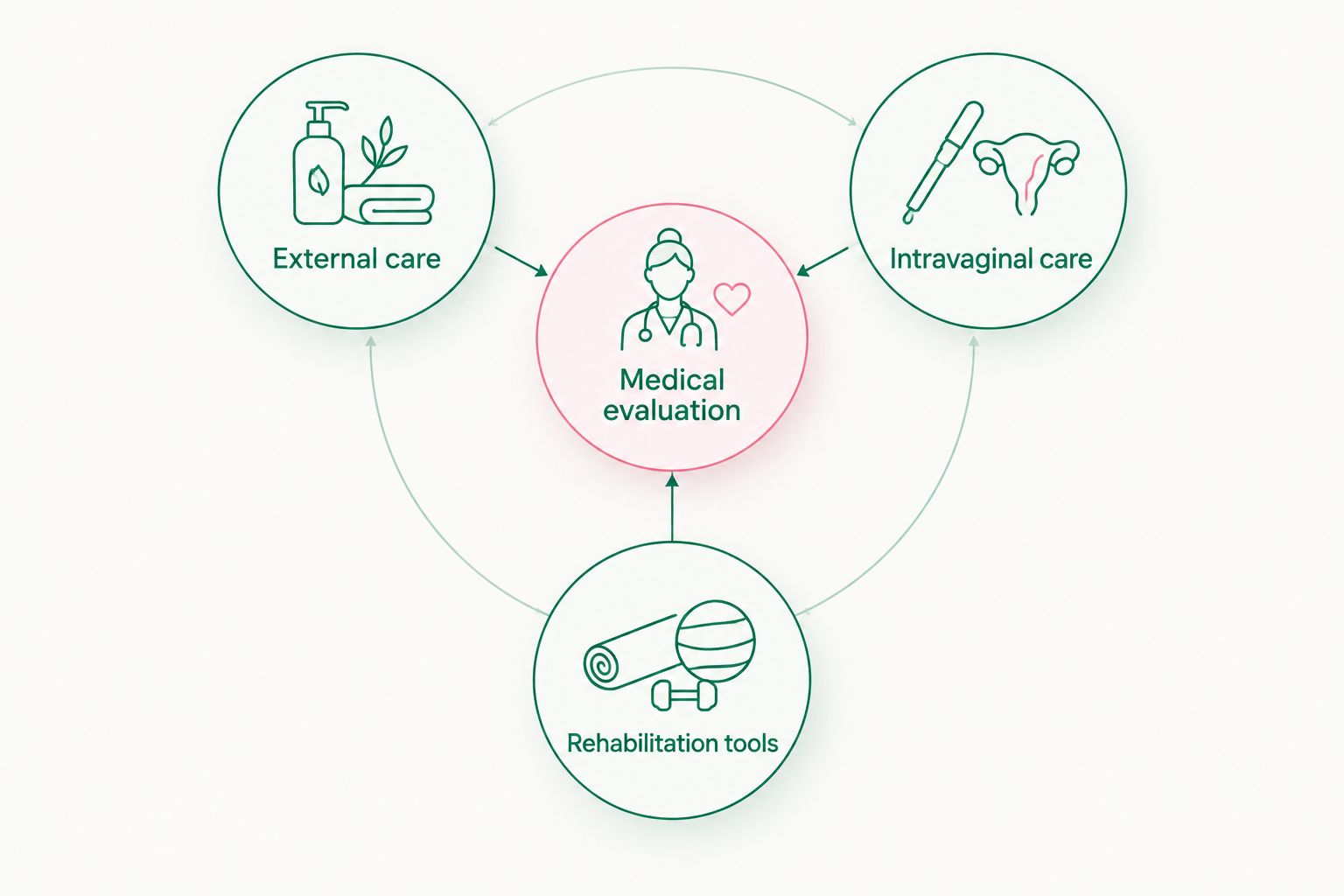
Stop using a product that causes burning or worsens irritation. Do not keep layering products to counteract a reaction from an earlier one.
Both categories have limits. Neither a topical product nor a device becomes suitable merely because another person tolerated it well.
Pricing: compare the complete purchase, not unlike products
Comparing a wash with a pelvic wand does not produce a meaningful value ranking. They serve different purposes. First establish what you need, then compare the complete purchase within that category.
The care range includes individual products, kits, and refill formats. An individual item keeps the purchase focused; a kit only makes sense when each included product serves an actual need. A refill format is relevant when you already know the wash suits you.
For a rehabilitation purchase, establish which tool your clinician recommends and whether your plan requires additional items. Review the current purchase terms before deciding; do not assume a recurring commitment or a particular accessory is included.
There is no defensible “cheaper winner” across these categories. In 2026, value means buying the appropriate item and understanding its ongoing requirements—not comparing unrelated checkout totals.
Both brands lose to medical evaluation when symptoms recur
Persistent odor is not evidence that you need stronger cleansing. BV is a vaginal condition, while sweat and friction involve external skin; distinguishing bacterial vaginosis from other causes of symptoms changes the treatment decision, not just the product choice.
CDC's bacterial vaginosis guidance identifies vaginal pH above 4.5 as one component of clinical diagnostic criteria. That finding alone does not establish BV. A home reading cannot tell you which brand or treatment you need.
Seek medical assessment for recurring odor, unusual discharge, persistent itching, or pain. Pelvic pain with fever, severe symptoms, or symptoms during pregnancy warrants prompt medical attention.
Boric acid requires additional caution:
- Use vaginal boric acid only as directed; never swallow it.
- Keep it away from children and pets.
- Do not use boric acid vaginal suppositories during pregnancy.
- Ask your clinician before use if you are planning pregnancy or are unsure whether you are pregnant.
CDC treatment guidance supports distinguishing BV from candidiasis and other causes of symptoms. It does not establish clinical results for either brand's complete product range. That boundary matters more than a marketing comparison.
Final verdict: choose by your care goal
Choose Kushae for a focused vulvovaginal-care purchase
Best for: A shopper seeking OB/GYN-developed care products who understands the distinction between external cleansing and intravaginal products.
Start with the product type that addresses your actual care need. Keep external wash outside the vagina, assess ingredients carefully, and discuss boric acid with your clinician when symptoms recur. The advantage is a relevant care range; the limitation is that products cannot diagnose the cause of symptoms.
Choose Intimate Rose for clinician-directed pelvic rehabilitation
Best for: A shopper whose pelvic-health clinician has recommended a dilator or pelvic wand.
Select the tool around the rehabilitation plan, including technique and cleaning instructions. The advantage is a directly relevant tool category; the limitation is that a device cannot replace assessment or individualized instruction.
One-glance scorecard
| Dimension | Winner |
|---|---|
| Best for routine care-product shopping | Kushae |
| Standout development distinction | OB/GYN-developed care line; not proof of better outcomes |
| External cleansing | Kushae |
| Clinician-directed rehabilitation tools | Intimate Rose |
| Boric acid effectiveness | No brand-level winner established |
| Sensitive-skin suitability | Tie: assess the exact product |
| Pricing and value | No like-for-like winner established |
| Persistent symptoms | Medical evaluation, not either brand |
FAQ
Is Kushae better than Intimate Rose?
Kushae is the more relevant choice for its OB/GYN-developed vulvovaginal care range; Intimate Rose is the more relevant choice for pelvic rehabilitation tools. Choose by product purpose rather than treating the brands as interchangeable.
Which brand should I choose for recurring vaginal odor?
Recurring vaginal odor calls for medical evaluation before choosing another product. External cleansing does not treat BV, and odor alone cannot identify its cause.
Can a feminine wash treat bacterial vaginosis?
No. An external feminine wash does not treat bacterial vaginosis. CDC guidance describes diagnosis and condition-specific treatment, not external cleansing as BV therapy.
Are boric acid suppositories safe during pregnancy?
Do not use boric acid vaginal suppositories during pregnancy. Contact your clinician for appropriate evaluation and treatment of vaginal symptoms.
Does vaginal pH above 4.5 mean I have BV?
No. Vaginal pH above 4.5 is one component of clinical BV criteria, not a diagnosis by itself. Other findings and clinical assessment are needed.
Should I buy a pelvic wand for vaginal pain?
Get vaginal or pelvic pain assessed before buying a pelvic wand. A pelvic-health clinician can determine whether a tool belongs in your treatment plan and explain appropriate use.
How should I compare the cost of these brands in 2026?
Compare products serving the same purpose and assess the complete purchase. A cleanser and a rehabilitation tool are not direct substitutes, so their checkout totals do not establish which brand offers better value.
One last thing
Before buying, write down two things: where the symptom occurs and what you want the product to do. External friction, vaginal discharge, and pain with penetration lead to different decisions. That simple distinction makes a 2026 comparison more useful than a universal brand ranking.


