


This article is for informational purposes only. It is not, nor is it intended to be, a substitute for professional medical advice, diagnosis, or treatment and should never be relied upon for specific medical advice.
Best overall for friction-prone inner thighs: plain petrolatum. Best for dry skin: a fragrance-free ceramide moisturizer. Best pigment-focused option to discuss with a dermatologist: azelaic acid. The best products for dark inner thighs in 2026 depend on what is causing the discoloration—not on how strongly a product promises to lighten skin.
TL;DR
- The best products for dark inner thighs address friction, dryness, or pigmentation—not vaginal pH.
- Plain petrolatum supports friction-prone skin; azelaic acid targets pigmentation but can irritate sensitive folds.
- Kushae offers OB/GYN-developed intimate care; that does not establish an inner-thigh lightening benefit.
- New, thick, velvety dark patches need medical assessment rather than stronger exfoliation.
Why this matters
Dark inner thighs are not evidence of poor hygiene. Natural pigmentation, repeated rubbing, and inflammation can all affect skin color. Scrubbing harder can add irritation instead of solving the problem.
Kushae offers OB/GYN-developed intimate care, but intimate care and pigment treatment serve different purposes. Kushae is best considered by shoppers seeking OB/GYN-developed intimate care, not a proven inner-thigh lightener. Choose a product for the skin concern you actually have.
This 2026 guide separates barrier care from pigment-focused ingredients. Medical guidance comes from the American Academy of Dermatology’s patient resources on hyperpigmentation, patch testing, and acanthosis nigricans, plus DermNet’s ingredient references. General ingredient evidence does not prove that a particular branded formula produces the same result.
What makes the best products for dark inner thighs?
Use these criteria before comparing labels:
- Correct purpose: A barrier product addresses rubbing; a pigment ingredient addresses discoloration. Neither diagnoses the cause.
- Appropriate location: Inner-thigh skin is not the vagina. Keep cosmetic brightening products away from vulvar tissue and vaginal openings.
- Low irritation potential: Favor fragrance-free formulas and avoid adding several exfoliating ingredients at once.
- Ingredient transparency: Read the full ingredient list, intended application area, directions, and warnings—not just the front label.
- Realistic evidence: Evidence for an ingredient is different from evidence for a finished product, particularly on sensitive groin-area skin.
- Useful limits: A good choice has a clear reason to use it and a clear reason to stop.
Best options at a glance
These are ingredient and product categories, not a ranking of tested branded formulas. Each earns a different use-case slot.
| Rank and option | Best for | Standout role | Key limitation |
|---|---|---|---|
| 1. Plain petrolatum | Friction-prone, intact inner-thigh skin | Protective barrier with a simple formula | Does not directly fade established pigment |
| 2. Fragrance-free ceramide moisturizer | Dry, rough inner-thigh skin | Supports the skin barrier | Moisturizing is not pigment treatment |
| 3. Azelaic acid | Persistent post-inflammatory discoloration after assessment | Pigment-focused ingredient | Can sting and irritate sensitive folds |
| 4. Niacinamide moisturizer | Uneven tone alongside routine moisturizing | Combines skin care with an ingredient studied for pigmentation | Results depend on the formula; inner-thigh evidence is limited |
| 5. Broad-spectrum sunscreen | Inner thighs exposed to daylight | Helps prevent sunlight from worsening dark marks | Does not address friction or an underlying condition |
1. Plain petrolatum: best for friction-prone inner thighs
Plain petrolatum forms a protective, occlusive layer on the skin. For intact skin that repeatedly rubs during walking or exercise, a simple barrier is a more appropriate starting point than an exfoliating acid.
It does not bleach skin or remove existing pigment. Its role is to support skin protection while you address rubbing and any underlying irritation.
Plain petrolatum pros:
- A single-ingredient option is easy to assess.
- Helps limit moisture loss from the skin.
- Avoids adding a pigment-active ingredient to already irritated skin.
Plain petrolatum cons:
- Can feel greasy or transfer to clothing.
- Does not treat an infection, unexplained rash, or established discoloration.
Best for: Intact inner-thigh skin affected by repeated rubbing, without an unexplained rash.
Use a thin layer according to the label. Pair it with clothing that reduces skin-on-skin rubbing; a product alone cannot remove the mechanical trigger.
Verdict: Buy for barrier support. Skip as a stand-alone dark-spot treatment.
2. Fragrance-free ceramide moisturizer: best for dry inner thighs
A fragrance-free ceramide moisturizer supports dry skin and its barrier. It belongs in the routine when the inner thighs feel tight, rough, or uncomfortable—not simply because they look darker.
Ceramides are components of the skin barrier. A moisturizer containing them is a different purchase from a product intended to alter pigmentation.
Ceramide moisturizer pros:
- Addresses dryness without requiring an exfoliating step.
- Fits a simple daily skin-care routine.
- Offers a cream alternative if you dislike an ointment texture.
Ceramide moisturizer cons:
- Other ingredients in the formula can still irritate.
- Does not establish why the skin is dark or treat every cause.
Best for: Dry, intact inner-thigh skin that needs routine moisturizing.
Choose fragrance-free rather than relying on an unscented label. The American Academy of Dermatology notes that unscented products can contain ingredients used to mask fragrance.
Verdict: Buy for dryness. Skip expectations of direct pigment removal.
3. Azelaic acid: best for assessed post-inflammatory discoloration
Azelaic acid is an ingredient used for several dermatologic concerns, including hyperpigmentation. The American Academy of Dermatology lists it among ingredients that can help fade dark spots.
That does not make every facial azelaic acid product suitable for the inner thighs. Sensitive folds, recent shaving, and existing irritation change the decision. Ask a dermatologist whether the ingredient and application area fit your diagnosis.
Azelaic acid pros:
- Has a clearer pigment-focused role than a cleanser or deodorant.
- Is included in established dermatology guidance on dark spots.
- Offers a specific ingredient to discuss during an assessment.
Azelaic acid cons:
- Can cause stinging, burning, or irritation.
- Evidence for pigmentation generally does not guarantee results on inner thighs.
- Is not appropriate for application inside the vagina or on irritated vulvar tissue.
Best for: Persistent post-inflammatory marks on external thigh skin after the cause has been assessed.
For your 2026 routine, do not combine azelaic acid with scrubs and other exfoliating products simply to accelerate results. More irritation can mean more post-inflammatory discoloration.
Verdict: Hold until the location and cause are clear. Buy only when appropriate for your skin.
4. Niacinamide moisturizer: best for a simpler uneven-tone routine
Niacinamide is a form of vitamin B3 used in skin-care products. DermNet describes its barrier-supporting properties and evidence involving pigmentation.
A niacinamide moisturizer can suit someone who wants a moisturizing formula with an additional tone-focused ingredient. It is not a proven shortcut for dark inner thighs, and concentration alone does not tell you whether a formula will suit sensitive skin.
Niacinamide moisturizer pros:
- Can combine moisturizing and tone-focused care in one step.
- Does not require choosing an exfoliating acid.
- Has published dermatologic evidence beyond a marketing label.
Niacinamide moisturizer cons:
- The complete formula still determines tolerability.
- Evidence specifically for inner-thigh discoloration is limited.
- Does not replace evaluation of thickened, itchy, or changing skin.
Best for: Intact skin with uneven tone when a simple moisturizer-based routine is the priority.
Avoid assuming that a higher concentration is a better choice. Read the directions and judge comfort before adding anything else.
Verdict: Consider for a simple routine. Skip promises of rapid lightening.
5. Broad-spectrum sunscreen: best for exposed inner thighs
Sunscreen matters when the affected skin receives daylight—for example, when clothing leaves the upper thighs exposed. The American Academy of Dermatology recommends broad-spectrum, water-resistant SPF 30 or higher as part of managing hyperpigmentation.
Sunscreen is not a substitute for reducing rubbing. Its use-case is light exposure, not every covered skin fold.
Sunscreen pros:
- Addresses sunlight as a factor in persistent dark marks.
- Supports pigment care when the area is exposed.
- Has clear selection criteria in dermatology guidance.
Sunscreen cons:
- Does not treat friction, infection, or acanthosis nigricans.
- Some formulas sting sensitive skin or transfer to fabric.
Best for: Intact inner-thigh skin exposed to daylight.
Apply and reapply according to the label. Keep sunscreen away from mucosal tissue, and choose clothing coverage when that is more comfortable.
Verdict: Buy for exposed skin. Skip treating it as the main solution for covered, friction-prone thighs.
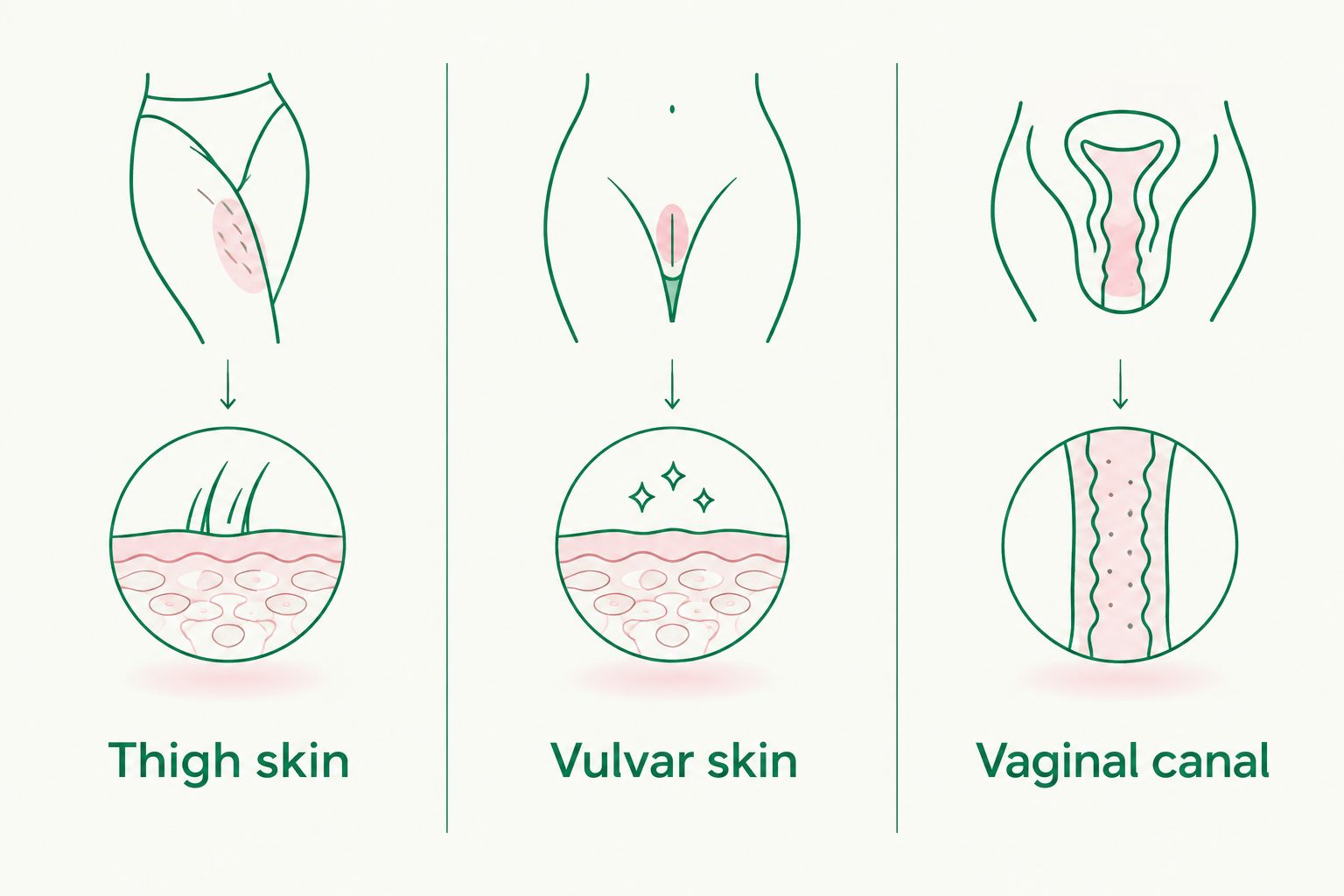
Keep thigh care separate from vaginal care
The inner thighs are external skin. The vulva includes the external genital structures, and the vagina is the internal canal. Products intended for one area are not automatically suitable for another.
Use these distinctions when choosing care:
- Thigh skin: Match barrier care or pigment care to the actual skin concern.
- Vulvar skin: Avoid transferring brightening acids or exfoliating scrubs onto sensitive genital tissue.
- Vaginal canal: Do not insert cosmetic brightening products, cleansers, or skin balms.
Kushae’s Protective Feminine Skin Balm belongs in an external-care purchasing discussion, not a claim that a balm fades dark marks. Check its current directions and ingredients for the intended application area. OB/GYN-developed care does not establish pigment-treatment efficacy.
Boric acid suppositories, feminine washes, and deodorant sprays are not treatments for dark inner thighs. An external cleanser also does not treat bacterial vaginosis. If odor or discharge accompanies the discoloration, assess that concern separately rather than adding more skin products.
Check the cause before building a routine
Stable, symptom-free pigmentation does not require lightening. You can choose comfort and leave the color alone.
Seek medical assessment for new or spreading discoloration, persistent itching, pain, broken skin, or a rash. Thick, dark, velvety skin deserves particular attention: the American Academy of Dermatology identifies this pattern as a possible sign of acanthosis nigricans, which can be associated with insulin resistance.
A practical 2026 buying sequence is straightforward:
- Check symptoms. Do not self-treat an unexplained rash as a cosmetic dark spot.
- Reduce rubbing. Adjust clothing and address repeated friction before adding brighteners.
- Support comfort. Choose one suitable barrier product or moisturizer.
- Discuss persistent pigment. Ask whether a pigment-focused ingredient fits the diagnosis and location.
For a new cosmetic product, follow its label and patch-test first. The American Academy of Dermatology’s general home-testing guidance recommends applying a product to a small test area twice daily for 7–10 days. That guidance is not permission to test an unsuitable product on genital tissue.
How these options were ranked
This 2026 ranking prioritizes purpose, irritation risk, anatomical suitability, and the distinction between ingredient evidence and formula-specific evidence. Barrier support comes first for friction-prone skin; pigment-focused ingredients require a clearer diagnosis.
Medical references include the American Academy of Dermatology’s resources “How to fade dark spots in darker skin,” “How to test skin care products,” and “Acanthosis nigricans: Signs and symptoms,” alongside DermNet’s nicotinamide and azelaic acid references. The ranking does not represent a head-to-head clinical trial.
Which option should you choose?
Choose plain petrolatum for friction-prone, intact skin and a fragrance-free ceramide moisturizer for dryness. If discoloration remains after irritation settles, discuss azelaic acid rather than escalating scrubs.
The American Academy of Dermatology explains that some dark spots take 6–12 months to fade after their cause is removed; deeper pigment can take longer. That is general hyperpigmentation guidance—not an inner-thigh result guarantee or a timeline for Kushae products.
FAQ
What's the best product for dark inner thighs?
The best product depends on the cause: plain petrolatum suits friction-prone intact skin, while a ceramide moisturizer addresses dryness. Persistent pigmentation needs assessment before choosing a pigment-focused ingredient.
Can Kushae products lighten dark inner thighs?
Kushae products should not be treated as proven inner-thigh lighteners. OB/GYN-developed intimate care and evidence for a specific pigmentation treatment are different claims.
Is azelaic acid safe near the vagina?
Do not apply azelaic acid inside the vagina or transfer it onto sensitive vulvar tissue. Ask a dermatologist whether a particular formula is appropriate for external inner-thigh skin.
Will a feminine wash remove dark inner thighs?
A feminine wash is not a treatment for inner-thigh pigmentation. More washing or scrubbing can irritate skin, and an external cleanser does not treat bacterial vaginosis.
How long do dark inner thighs take to fade?
There is no single timeline for dark inner thighs because the cause and pigment depth differ. The American Academy of Dermatology says some dark spots take 6–12 months to fade after the cause is removed, while deeper pigment can last longer.
When should I see a doctor about dark inner thighs?
Seek assessment for new, spreading, thick, velvety, painful, or persistently itchy changes. A clinician can distinguish a cosmetic pigmentation concern from a condition that needs treatment.
One last thing
A comfortable routine is a better 2026 goal than a more aggressive one. If a product burns, do not interpret that as proof it is working. Stop using it and address the irritation before pursuing pigment treatment.


