


This article is for informational purposes only. It is not, nor is it intended to be, a substitute for professional medical advice, diagnosis, or treatment and should never be relied upon for specific medical advice.
BV can go away on its own without treatment, but waiting is not the recommended approach when you have symptoms. Vaginal odor and discharge can ease without confirming that the bacterial imbalance has resolved, and similar symptoms can come from conditions that need different treatment. If you have new, persistent, or recurring symptoms, get evaluated rather than treating odor alone.
TL;DR
- Can BV go away on its own without treatment? Yes, but symptomatic bacterial vaginosis needs evaluation and usually prescription antibiotics.
- CDC guidance recommends treatment for women with BV symptoms; odor alone cannot confirm the diagnosis.
- Kushae external vulvar care does not treat BV inside the vagina.
- Avoid douching and do not use boric acid during pregnancy.
Why this matters
Waiting feels reasonable when symptoms are mild or familiar. The problem is that familiar symptoms do not establish a diagnosis: BV, yeast infections, trichomoniasis, and irritation can overlap.
This 2026 guide separates treatment from everyday care. Kushae offers OB/GYN-developed vulvovaginal care products, but choosing a care product is a different decision from determining whether you have an infection. You do not need to cover up vaginal odor or feel ashamed of asking about it.
Can BV go away on its own without treatment?
Yes, spontaneous improvement happens, but there is no dependable waiting period that tells you BV is gone. The CDC's bacterial vaginosis information explains that BV sometimes resolves without treatment. Its clinical guidance recommends treatment for women with symptoms.
The distinction is symptoms versus a confirmed diagnosis without symptoms. If a clinician finds BV when you feel well, the next step depends on your clinical circumstances, including pregnancy. That is not the same situation as noticing fishy odor or unusual discharge and deciding to wait indefinitely.
| Approach | Best for | Benefit | Limit or drawback |
|---|---|---|---|
| Clinician-guided observation | People without symptoms whose clinician recommends no treatment | Avoids unnecessary medication | Does not establish that new symptoms are safe to ignore |
| Prescription treatment | People with diagnosed, symptomatic BV | Treats BV using recommended medications | Side effects and recurrence remain possible |
| Gentle external care | People managing vulvar sweat or surface irritation | Supports comfort outside the vagina | Does not treat BV inside the vagina |
| Clinician-directed boric acid | Selected people with multiple recurrences | Has a role in certain combination regimens | Is not routine first-line treatment and is unsafe during pregnancy |
If symptoms disappear before your appointment, tell the clinician what changed. Include whether you used antibiotics, vaginal products, or an over-the-counter yeast treatment. That history helps the clinician decide whether examination or testing is still appropriate.
Medical source for this 2026 guide: CDC, About Bacterial Vaginosis and STI Treatment Guidelines, Bacterial Vaginosis. Scope: spontaneous resolution, symptomatic treatment, and recurrent BV management.
What should you do if you think you have BV?
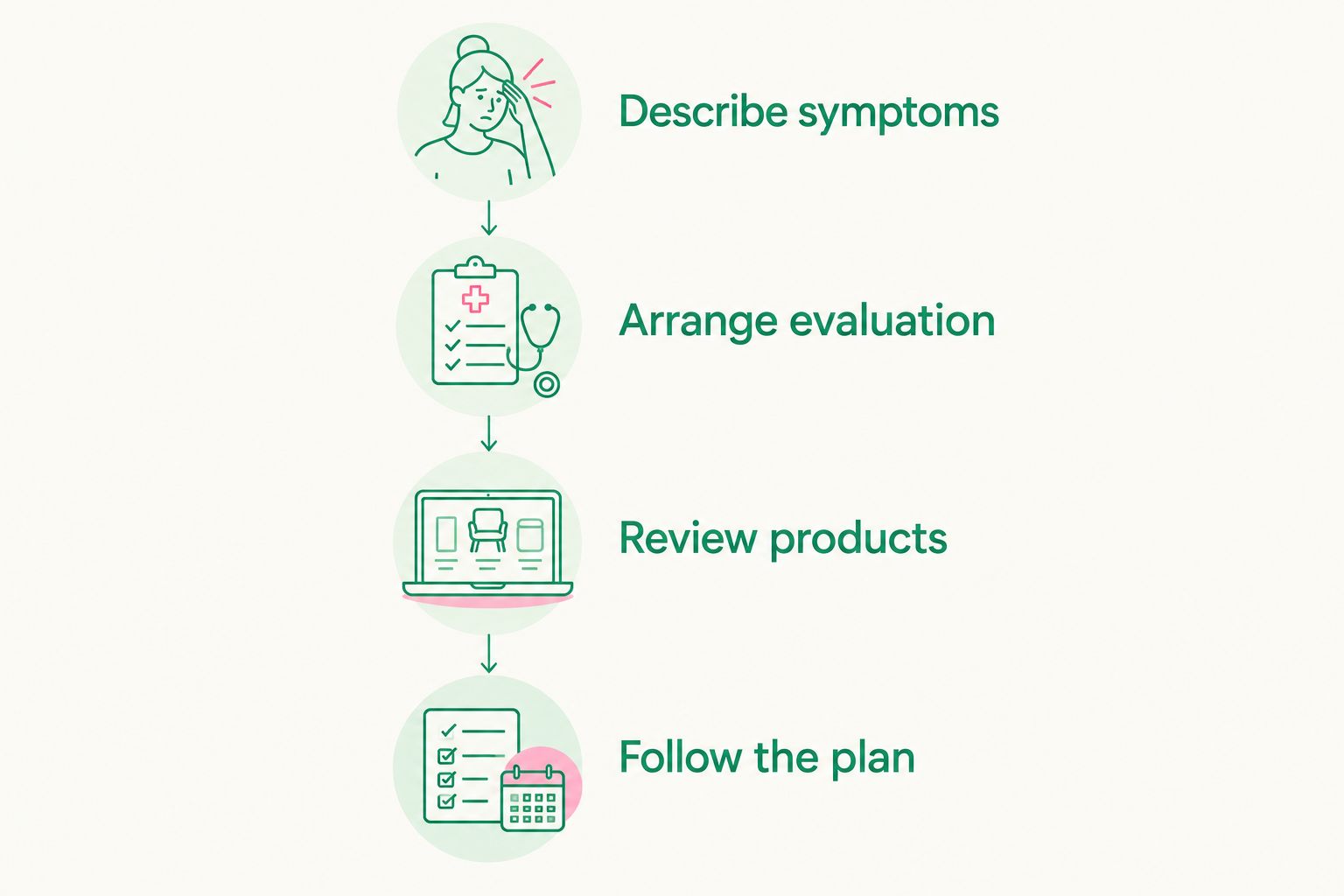
You do not need to identify the cause yourself before seeking care. Describe the change, rather than arriving with a diagnosis you feel you must defend. Use this sequence to make the visit more useful.
- Describe symptoms. Note odor, discharge, itching, burning, pain, and when each started. Tell the clinician whether symptoms are new or resemble a previously confirmed episode.
- Arrange evaluation. Ask about an examination or vaginal testing. Mention a new sexual partner, possible STI exposure, pregnancy, or a chance of pregnancy.
- Review products. Bring the names of vaginal suppositories, washes, lubricants, and medications you have used. Explain whether symptoms started before or after using them.
- Follow the plan. If medication is prescribed, use it as directed. Contact the clinician if symptoms persist or return rather than repeatedly restarting leftover treatment.
These steps help distinguish an infection from external irritation. They also prevent an incomplete history from hiding something useful, such as burning that began immediately after a new product.
What treatment does a clinician usually recommend?
Prescription antibiotics are the standard treatment for symptomatic BV. The CDC lists oral metronidazole, vaginal metronidazole gel, and vaginal clindamycin cream among recommended regimens. Your clinician chooses based on your medical history, preferences, tolerability, and other relevant factors.
The following are reference regimens, not instructions to start medication yourself. A clinician must confirm the diagnosis and prescribe the appropriate treatment.
| CDC-listed regimen | Best for | Practical benefit | Important limitation |
|---|---|---|---|
| Oral metronidazole, 500 mg twice daily for 7 days | People who prefer oral treatment when clinically appropriate | Does not require vaginal application | Systemic side effects, including nausea, can occur |
| Metronidazole vaginal gel, 0.75%, for 5 days | People who prefer a local option when clinically appropriate | Delivers medication vaginally | Requires vaginal application and can cause local effects |
| Clindamycin vaginal cream, 2%, for 7 days | People for whom a clinician selects vaginal clindamycin | Provides another recommended vaginal option | Oil-based cream can weaken latex condoms and diaphragms |
Do not substitute a yeast medication because the package mentions vaginal symptoms. Antifungal medicines target yeast, not BV. Likewise, a wash, deodorant, or moisturizer does not replace prescription treatment for a diagnosed vaginal infection.
Ask your pharmacist about medication-specific precautions, including contraception and sexual activity. Finish the prescribed course even if odor improves before treatment ends, unless your clinician tells you to stop or change it.
Medical source, referenced for this 2026 treatment overview: CDC, STI Treatment Guidelines, Bacterial Vaginosis. Scope: recommended antibiotic regimens and vaginal clindamycin precautions.
Why the right next step varies
The important question is not simply whether spontaneous improvement is possible. It is whether waiting fits your symptoms, diagnosis, and medical circumstances.
- Symptoms: Odor, abnormal discharge, burning, or irritation support getting evaluated. The CDC recommends treatment for symptomatic BV.
- Pregnancy: Symptomatic BV during pregnancy needs clinical treatment because it is associated with pregnancy complications. Do not self-treat with boric acid.
- Recurrence: Repeated episodes need a management discussion, not an assumption that the same over-the-counter product will solve each one.
- Possible STI exposure: BV symptoms overlap with other conditions. A sexual history helps determine which tests you need.
- Pain or systemic illness: Pelvic pain, fever, or feeling unwell changes the urgency. Do not assume those symptoms are uncomplicated BV.
- Recent product use: Douching and irritating products can complicate vaginal or vulvar symptoms. Explain what you used and where you applied it.
There is no need to blame yourself for an episode. BV reflects a change in the vaginal bacterial community; it is not evidence that you are dirty. Washing more aggressively is not the answer.
Can boric acid replace antibiotics for BV?
Boric acid is not a routine first-line replacement for prescription BV treatment. The CDC describes a possible role for vaginal boric acid within a clinician-directed sequence for people with multiple recurrences, alongside antibiotic treatment and subsequent suppressive therapy.
That is different from inserting a suppository whenever odor appears. It is also different from evidence that a particular retail formula treats BV. General clinical guidance about boric acid does not establish the effectiveness of added ingredients or prove results for a specific product.
Boric acid is for vaginal use only and must never be swallowed. Keep it away from children and pets. Avoid it during pregnancy; if you are planning pregnancy or pregnancy is possible, discuss an appropriate treatment plan with your clinician before using it.
If you develop burning after inserting a suppository, stop using it and contact your clinician. Do not assume discomfort means the product is working. Irritation can add another problem without resolving the original cause of your symptoms.
Can feminine wash help while you arrange care?
A feminine wash can clean external skin, but external cleansing does not treat BV. The vulva is the outside genital area; the vagina is the internal canal. Products intended for one location do not automatically belong in the other.
For people shopping for an optional external cleanser, the Kushae Gentle 2-N-1 Foaming Wash belongs in the vulvar-care conversation, not the BV-treatment plan. Kushae's OB/GYN-developed vulvovaginal care is for women choosing care products, not a substitute for diagnosing recurring odor.
The benefit of external cleansing is removing surface sweat and residue. The limitation is equally important: a cleanser does not establish why you have vaginal odor, eliminate the need for testing, or guarantee that sensitive skin will tolerate it.
Use gentle external care and avoid scrubbing. Do not douche or put cleanser inside the vagina. If a product stings or worsens irritation, stop using it rather than adding more products to counteract the reaction.
How long should you wait before getting checked?
There is no evidence-based home countdown that confirms suspected BV is safe to leave untreated. Arrange an appointment for new, persistent, or recurring odor or discharge, especially if you have never had the same symptoms diagnosed.
Seek prompt care for pelvic pain, fever, significant pain, unusual bleeding, or symptoms during pregnancy. Severe pain or feeling seriously unwell warrants urgent assessment. These symptoms need evaluation beyond an assumption of BV.
If access is difficult, contact a primary care clinic, sexual health clinic, or gynecology service and describe your symptoms when booking. Ask what evaluation options are available. Waiting for access is not a reason to insert household remedies or take someone else's antibiotics.
What if your BV keeps coming back?
BV recurrence is common, and a returning symptom does not mean you failed at hygiene. Contact your clinician when symptoms recur. The next step can involve confirming the diagnosis, reviewing prior treatment, and discussing a recurrent-BV regimen.
Keep a brief record of confirmed diagnoses, prescriptions, symptom improvement, and return of symptoms. Add relevant details such as new products or sexual exposures. This record is more useful than repeatedly buying treatments based only on odor.
For a 2026 appointment, ask directly: Do I need repeat testing? Is this confirmed recurrent BV? Does my history support suppressive treatment? Should we discuss partner-related management? Recommendations can change, so your clinician should apply current guidance to your circumstances.
FAQ
Can BV go away on its own without treatment?
Yes, BV sometimes goes away without treatment, but symptomatic BV generally needs prescription treatment. New, persistent, or recurring odor or discharge needs evaluation because symptoms alone cannot confirm BV.
If the fishy smell disappears, does that mean BV is gone?
No, disappearance of fishy odor does not confirm that BV has resolved. Tell your clinician about the change, especially if discharge, irritation, or repeated episodes continue.
Can I treat BV with an over-the-counter yeast medicine?
No, yeast medicines do not treat BV. Yeast infections and BV need different treatment, so get evaluated if you are unsure which condition is causing symptoms.
Will washing more often get rid of BV?
No, washing more often does not treat BV inside the vagina. Avoid douching and aggressive washing, which can irritate sensitive tissue.
Is boric acid the best first treatment for BV?
No, boric acid is not routine first-line BV treatment. A clinician can consider it within selected recurrent-BV regimens; never swallow it or use it during pregnancy.
Should I get checked for BV while pregnant?
Yes, vaginal symptoms during pregnancy need clinical evaluation. Symptomatic BV requires treatment, and boric acid is not an appropriate pregnancy self-treatment.
Do I need another appointment if BV comes back?
Yes, contact your clinician if symptoms return after treatment. Repeated symptoms can require confirmation of the diagnosis and a different management plan.
One last thing
Less odor is a symptom change, not a test result. That distinction matters whether you waited, washed, used a suppository, or finished medication. Judge the next step by the diagnosis and your clinician's plan—not by whether you can temporarily cover the smell.
Keep your routine simple while you seek answers. Avoid adding several vaginal or vulvar products at once; a clear account of what you used makes irritation and symptom changes easier to discuss.


