


This article is for informational purposes only. It is not, nor is it intended to be, a substitute for professional medical advice, diagnosis, or treatment and should never be relied upon for specific medical advice.
Yes, feminine deodorant spray can cause irritation, including burning, itching, redness, or swelling on external genital skin. A reaction can come from an irritating ingredient or an allergy, and even a product you previously tolerated can become a problem. Stop using the spray if symptoms develop; persistent odor, discharge, sores, or pain need medical evaluation rather than another odor-control product.
TL;DR
- Can feminine deodorant spray cause irritation? Yes. Burning, itching, redness, or swelling mean you should stop using it.
- ACOG advises avoiding deodorants on vulvar skin; external odor control does not treat BV or yeast infections.
- Kushae feminine care includes OB/GYN-developed products, but that does not guarantee individual skin tolerance.
- Persistent symptoms, unusual discharge, or genital sores need medical evaluation, not stronger fragrance or repeated spraying.
Why this matters
Irritation does not mean you are unclean. Vulvar skin can react to products, friction, and moisture, while vaginal infections can cause overlapping symptoms. Treating every change in smell as a hygiene problem can delay the right care.
The American College of Obstetricians and Gynecologists’ patient guidance, Vulvovaginal Health, advises avoiding deodorants and other irritating products on the vulva. That distinction also matters when choosing a feminine wash for sensitive skin: external cleansing is not treatment for a vaginal infection.
For your 2026 care routine, comfort matters more than eliminating every trace of natural scent. A healthy vulva and vagina do not need to smell like perfume.
Can feminine deodorant spray cause irritation?
Yes. Feminine deodorant spray can trigger irritant contact dermatitis or allergic contact dermatitis on external genital skin. Irritant dermatitis results from direct skin irritation; allergic dermatitis involves an immune response to an ingredient. You cannot reliably distinguish them from an infection by reading symptoms alone.
ACOG’s Disorders of the Vulva patient guidance identifies contact dermatitis as a cause of vulvar itching, burning, and skin changes. The American Academy of Dermatology’s contact dermatitis guidance also identifies fragrances and preservatives as potential allergens. These are general clinical findings, not evidence that a particular spray caused your symptoms.
| Possible explanation | Clues you might notice | Best next step | Important limit |
|---|---|---|---|
| Irritant reaction | Burning or stinging after application, especially on already irritated skin | Stop the product and simplify external care | Timing alone does not confirm the diagnosis |
| Allergic reaction | Itching, rash, or swelling after exposure | Avoid the suspected product and arrange evaluation if symptoms persist | A previously tolerated product can still cause an allergy |
| Vaginal infection | Changed discharge, persistent odor, itching, or discomfort | Seek assessment and appropriate testing | A deodorant spray does not treat BV or yeast |
| Friction-related irritation | Soreness where clothing or skin rubs | Reduce rubbing and remove irritating products | Friction and a product reaction can occur together |
These are possibilities, not a self-diagnosis checklist. Bring the spray container or a photograph of its ingredient list to your appointment.
What should you do if feminine spray burns?
Stop applying it. Burning is a reason to stop, not a sign that the product is working. Do not add another spray, wash, or suppository to counteract the reaction.
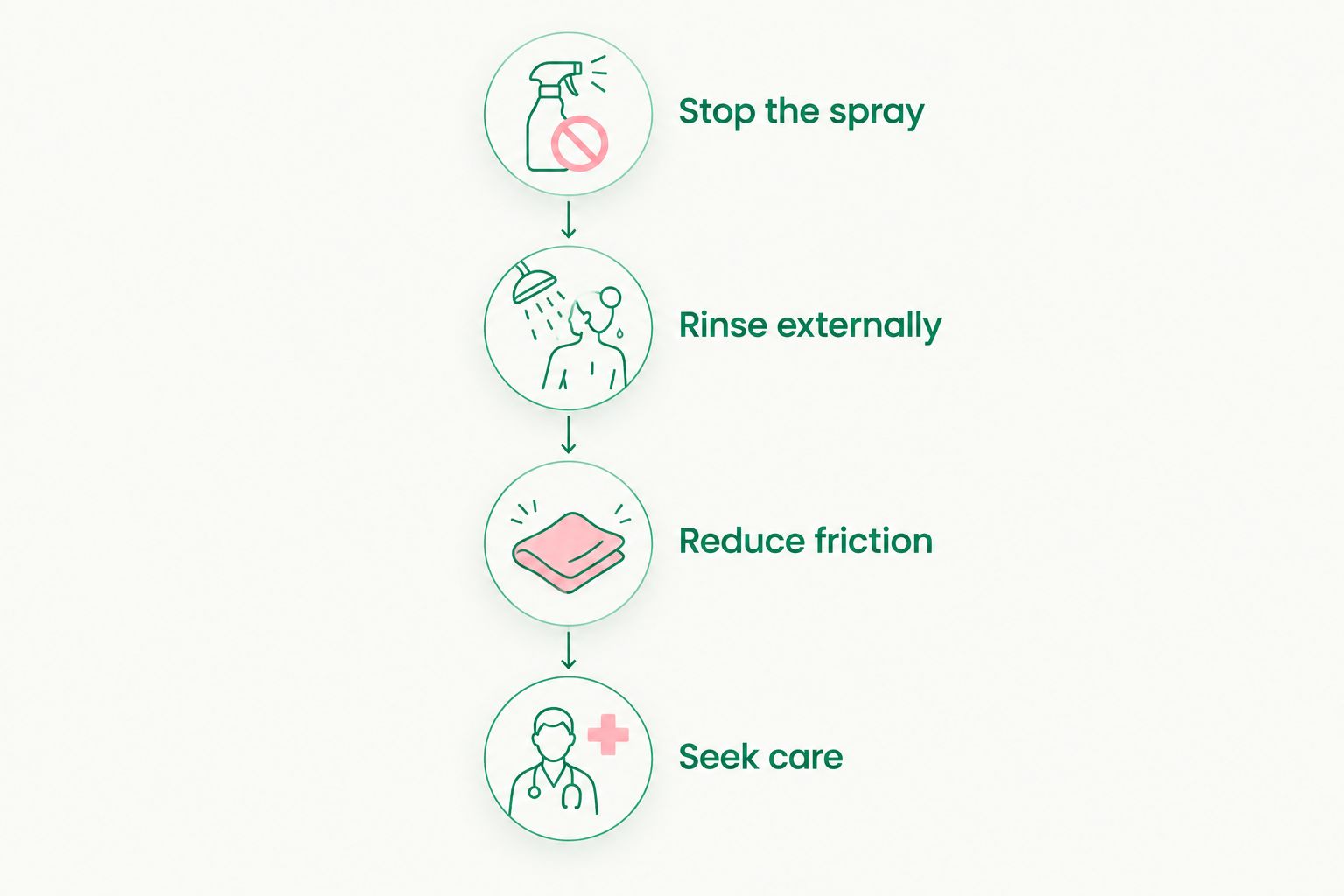
- Stop the spray. Set it aside so you can identify the product and ingredients later. Do not keep testing it on sore genital skin.
- Rinse externally. Gently rinse exposed external skin with lukewarm water. Do not scrub, douche, or direct water inside the vagina.
- Reduce friction. Pat dry rather than rubbing. Choose loose clothing and change out of damp workout clothes.
- Seek care. Contact a healthcare professional for persistent, worsening, or recurring symptoms, or symptoms accompanied by unusual discharge, sores, or pain.
Do not try to neutralize a spray with vinegar, baking soda, essential oils, or other home mixtures. Adding substances to irritated skin can make the problem harder to assess.
Seek urgent medical care for severe pain, rapidly increasing swelling, fever with pelvic pain, or difficulty urinating. Trouble breathing or swelling of the lips or tongue after product use requires emergency help.
Why reactions to feminine deodorant spray vary
Not every reaction has the same cause. A clinician considers both what touched your skin and the condition of that skin before exposure.
- Ingredients. Fragrances, preservatives, and other ingredients can irritate skin or trigger contact allergy. An ingredient’s presence does not prove it caused your reaction.
- Skin condition. Shaving irritation, scratching, eczema, or existing soreness can make product application more uncomfortable.
- Application site. Groin skin, vulvar tissue, and the vagina are different sites. Permission to use a product on one area does not mean it belongs on another.
- Repeated exposure. Reapplying a product that stings continues the exposure. More spray is not a solution to persistent odor.
- Moisture and friction. Sweat, tight clothing, and rubbing can contribute to discomfort alongside a product reaction.
The practical rule for 2026 is simple: judge a product by how your skin responds, not by how reassuring the label sounds. “Natural,” “gentle,” and “pH-balanced” do not establish that a formula is suitable for every person.
Is external vulvar care different from vaginal care?
Yes. The vulva is the external genital area; the vagina is the internal canal. A product intended for external use should not be inserted or sprayed inside the vagina.
ACOG’s Vulvovaginal Health guidance explains that the vagina cleans itself and discourages douching. Washing or deodorizing inside the vagina is not necessary for routine hygiene. External cleansing also cannot diagnose or treat the cause of internal symptoms.
If your concern is sweat on surrounding groin skin, that is a different question from a new fishy vaginal odor or changed discharge. Location matters. Tell your clinician whether the discomfort is on the outer skin, around the vaginal opening, or feels internal.
You do not need to scrub more aggressively because you notice a smell. Overwashing can add irritation to an already uncomfortable situation.
Can feminine spray cause BV or a yeast infection?
A reaction after spraying does not establish BV or a yeast infection. Burning and itching overlap across contact dermatitis, infections, and other vulvar conditions. An examination and appropriate testing help separate them.
The CDC’s bacterial vaginosis guidance describes BV as an imbalance in vaginal bacteria and identifies douching as a risk factor. That does not establish that every external deodorant spray causes BV. Avoid turning a general concern about vaginal products into a diagnosis about one specific formula.
The CDC’s vulvovaginal candidiasis guidance also explains that yeast symptoms are not specific to yeast infection. Repeatedly treating presumed yeast without evaluation can delay recognition of another cause.
A useful appointment note includes when you started the spray, where you applied it, when symptoms began, and whether discharge changed. List washes, wipes, lubricants, menstrual products, and medications too. The spray might be relevant without being the only exposure that matters.
What if you notice blisters, ulcers, or sores?
New genital blisters, ulcers, or sores deserve medical evaluation rather than an assumption that deodorant caused them. Avoid putting spray on the affected skin, and tell your clinician about recent products and sexual exposures without trying to decide which one explains everything.
Some genital herpes symptoms overlap with other causes of genital discomfort, so appearance alone cannot confirm or exclude herpes. The CDC’s genital herpes guidance supports evaluation and appropriate testing when lesions are present. Not every sore is herpes, and a product reaction does not rule out an infection.
For a 2026 symptom record, note whether pain started before or after the skin changes. A photograph can help document changes for your clinician, but it does not replace an examination.
How should you evaluate a feminine deodorant spray?
Choosing not to use a genital deodorant is a valid option, especially when your skin is sensitive or already irritated. ACOG’s advice to avoid vulvar deodorants should carry more weight than a product’s scent, packaging, or popularity.
If you are considering an external odor-control product, read the full label before applying it. Confirm the intended body site, directions, warnings, and ingredients. Do not assume a product labeled “feminine” is suitable for all genital tissue.
Kushae offers an OB/GYN-developed vulvovaginal care line, including the Natural Feminine Deodorant Spray. That development background does not establish that the spray cannot irritate your skin or treat a vaginal infection. Kushae feminine care is best considered by women seeking OB/GYN-developed options, not a substitute for evaluation of recurring odor or irritation.
Before purchasing, separate the decision into clear questions:
- Is the concern external sweat odor, or a change in vaginal odor or discharge?
- Does the label permit application to the exact area you intend to treat?
- Have you reacted to similar products or ingredients before?
- Are you trying to cover a symptom that keeps returning?
If you are already burning or itching, postpone the purchase. Your next move is to identify the cause, not build a larger routine.
How can you discuss recurring odor without feeling embarrassed?
Use direct language. “I have a new vaginal odor,” “the outer skin burns after spraying,” and “my discharge has changed” give a clinician more useful information than saying you do not feel fresh.
Explain what keeps recurring and what you have tried. Mention whether symptoms follow sex, menstruation, exercise, shaving, or a new product. These details guide the discussion; they do not prove a diagnosis.
For recurring symptoms in 2026, ask whether testing is appropriate before repeating an over-the-counter treatment. If an infection is confirmed, follow the prescribed plan rather than substituting a deodorant, external cleanser, or borrowed treatment.
FAQ
Can feminine deodorant spray cause irritation even if I have used it before?
Yes. A previously tolerated spray can still cause irritation or an allergic reaction. Stop using it when burning, itching, redness, or swelling develops, and seek evaluation if symptoms persist or worsen.
Is burning after feminine spray normal?
Burning is a reason to stop using the spray, not an effect you should push through. Gently rinse exposed external skin with lukewarm water and avoid adding more products.
Can I spray feminine deodorant inside my vagina?
No. Do not spray feminine deodorant inside the vagina. The vagina cleans itself, and ACOG advises avoiding douching and vulvar deodorants.
Does a fragrance-free feminine spray guarantee no irritation?
No. Fragrance-free labeling does not guarantee that a product will not irritate your skin. Other ingredients, existing skin irritation, and individual allergies still matter.
Can feminine deodorant spray treat BV or yeast?
No. Feminine deodorant spray is not treatment for BV or a yeast infection. Persistent odor, changed discharge, itching, or burning needs assessment rather than odor masking.
How long does irritation from feminine spray last?
There is no single recovery time that applies to every reaction. Severity, continued exposure, and the underlying cause affect recovery; seek medical advice for persistent, worsening, or recurring symptoms.
Should I use boric acid if a deodorant spray makes me itch?
Do not start boric acid simply because a spray caused itching. Boric acid is an intravaginal product, not treatment for an external contact reaction, and the cause of your symptoms needs to be established.
One last thing
A product-free pause can be more informative than switching immediately to another spray. Keep the packaging, note the symptoms, and avoid repeatedly exposing sore skin while arranging care when needed.
The most useful change to your 2026 routine is not a stronger deodorant. It is separating normal scent, external skin irritation, and vaginal symptoms so each gets the right response.


