


This article is for informational purposes only. It is not, nor is it intended to be, a substitute for professional medical advice, diagnosis, or treatment and should never be relied upon for specific medical advice.
You can use vaginal boric acid suppositories during your period when your product’s instructions allow it and your clinician has recommended that treatment. Menstrual bleeding alone does not automatically require you to stop, but irritation, unexpected bleeding, or possible pregnancy changes the decision. This 2026 guide explains how to handle menstrual protection, missed doses, and symptoms that need medical care.
TL;DR
- Can you use boric acid suppositories during your period? Follow your product’s instructions and your clinician’s treatment plan.
- Kushae vaginal boric acid is not routine period hygiene or a substitute for a BV diagnosis.
- Pads or period underwear avoid placing another product inside the vagina during treatment.
- Never swallow boric acid, and do not use vaginal boric acid during pregnancy.
Why this matters
Period odor, vaginal discharge, and vulvar irritation do not all have the same cause. Treating every change with a suppository risks delaying the right diagnosis or irritating already sensitive tissue. You do not need to make your vagina odorless.
Kushae boric acid suppositories are an option for women whose clinician recommends vaginal boric acid, not a period-hygiene step. The Kushae Vaginal Boric Acid Suppositories + Probiotics & Aloe! carry a pregnancy warning; that warning still matters when bleeding looks like a period.
Keep the anatomy clear. A suppository goes inside the vagina according to its instructions; a feminine wash belongs on external skin and does not treat bacterial vaginosis, or BV.
Can you use boric acid suppositories during your period?
Yes, menstruation does not automatically rule out vaginal boric acid. The decision depends on why you are using it, the exact product directions, and whether the bleeding is your usual period rather than unexplained bleeding.
For your 2026 care routine, use this order:
- Check the reason for treatment. A clinician-directed course for a diagnosed condition is different from starting boric acid because menstrual blood smells different.
- Read the package instructions. Look for directions about menstruation, insertion, menstrual protection, and missed doses. Do not transfer instructions from another brand.
- Confirm whether to continue. If your period begins during a prescribed or recommended course and the instructions are unclear, ask your prescriber or pharmacist before changing the schedule.
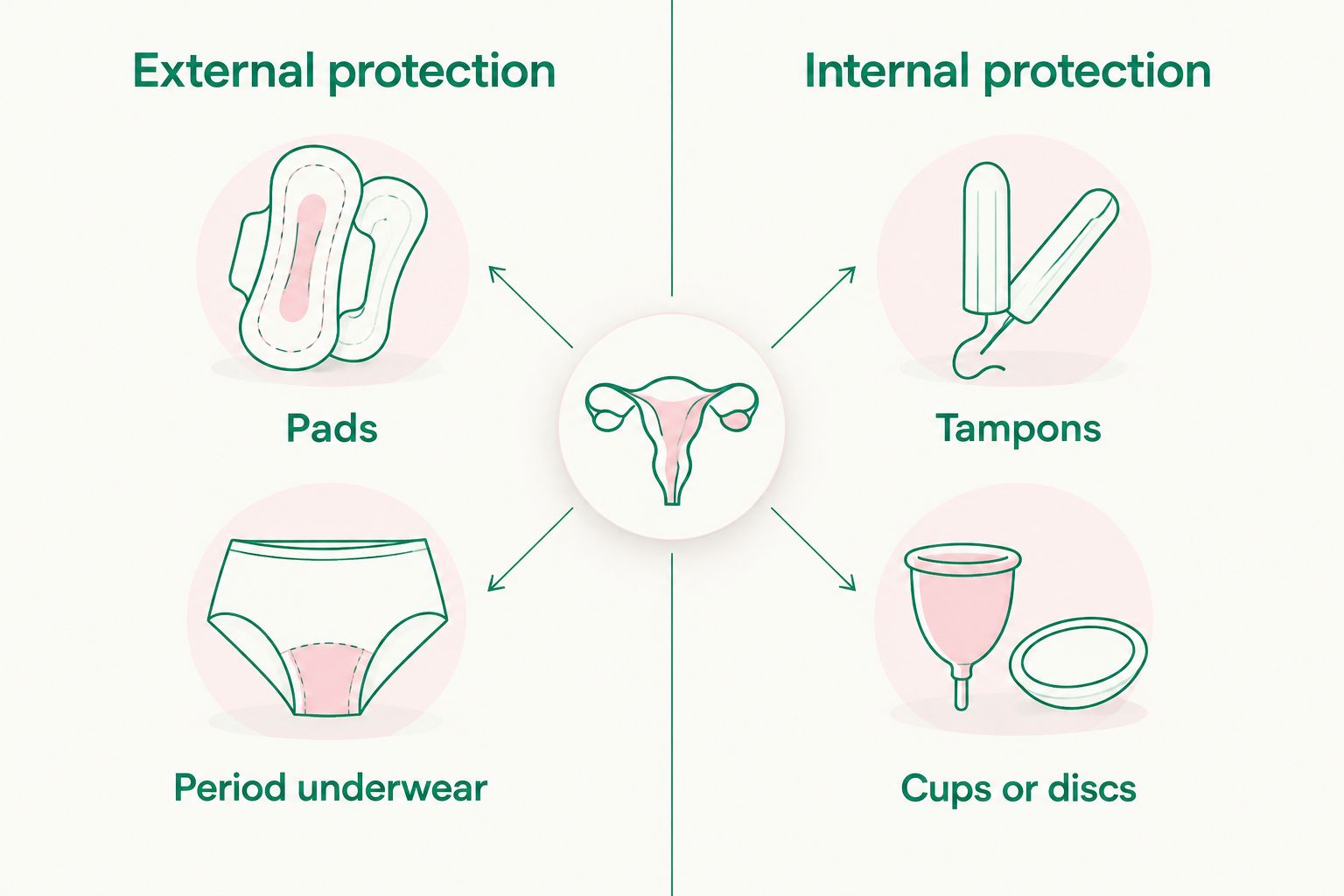
- Choose compatible menstrual protection. An external option avoids placing a tampon, cup, or disc alongside the dissolving suppository.
- Watch how you feel. Stop using the product and seek advice if it causes significant burning, pain, swelling, or worsening irritation.
Do not add an extra suppository to compensate for menstrual flow or visible residue. You cannot judge the amount absorbed or retained by looking at a pad, and an extra dose is not a reliable correction.
Which menstrual protection makes sense during treatment?
The practical advantage of external menstrual protection is simple: it does not share space inside the vagina with the medication. Cleveland Clinic’s patient instructions for vaginal boric acid advise using pads rather than tampons during treatment.
| Menstrual protection | Best for | Practical advantage | Limitation during vaginal treatment |
|---|---|---|---|
| Pads | Keeping menstrual protection external | No vaginal insertion; collects bleeding and leakage | Surface moisture or friction can bother sensitive vulvar skin |
| Period underwear | An external alternative to pads | No vaginal insertion | Requires changing when damp and following garment-care instructions |
| Tampons | Menstrual management outside the treatment window | Absorbs menstrual blood internally | Boric acid patient instructions advise against use during treatment |
| Menstrual cups or discs | Menstrual management when compatible with your care plan | Collects menstrual blood internally | Do not assume compatibility with a dissolving vaginal medication |
Choose an external option you tolerate, and change it when wet or soiled. If adhesive, fragrance, or prolonged dampness irritates your skin, change the menstrual product rather than adding more intimate-care products.
Why advice about boric acid during a period varies
Different advice does not necessarily mean one instruction is wrong. The product and treatment context matter more than a blanket rule about menstruation.
- Reason for treatment: Recurrent BV, certain yeast infections, and unexplained odor are not interchangeable diagnoses.
- Product instructions: Directions apply to the product in your hand, not every capsule sold as vaginal boric acid.
- Treatment schedule: Interrupting a clinician-directed course requires different advice from deciding whether to start an optional product.
- Menstrual protection: Pads remain outside the vagina; tampons, cups, and discs do not.
- Symptoms and pregnancy possibility: New pain, unusual bleeding, severe irritation, or possible pregnancy requires reassessment rather than routine continuation.
Your flow also affects comfort and how much discharge you notice. It does not give you a reliable way to calculate whether a dose worked, so do not change the dose based on bleeding alone.
What medical evidence actually supports
The medical evidence behind vaginal boric acid concerns specific infections and treatment situations—not a general need to reset the vagina during menstruation. This distinction matters when you compare product claims in 2026.
The CDC’s STI Treatment Guidelines describe vaginal boric acid in selected recurrent-infection regimens. For women with multiple BV recurrences, the guidelines describe limited data supporting a clinician-directed sequence that includes antibiotics, 600 mg of vaginal boric acid daily for 21 days, and subsequent suppressive medication.
That is context, not a self-treatment schedule. Boric acid is not the CDC’s standard first-line treatment for a new episode of symptomatic BV, and the recurrent-BV sequence is not simply a standalone suppository course.
The CDC also discusses boric acid for selected recurrent non-albicans yeast infections. That does not establish that boric acid is appropriate for every episode of itching, discharge, or odor—or that symptoms identify the organism involved.
General evidence for vaginal boric acid does not prove the effectiveness of a particular Kushae formula. Added probiotics or aloe do not establish better results during menstruation, and this article does not claim product-specific clinical outcomes.
Should you start boric acid just because your period smells different?
No. A change in odor during menstruation is not enough to diagnose BV or justify vaginal treatment. Blood, sweat, menstrual products, and vaginal discharge can contribute to what you notice.
Start with ordinary external care: change menstrual protection, gently clean the vulva, and avoid douching. The vagina does not need an internal wash, and a pH-balanced external cleanser is not a treatment for infection.
If odor is new, persistent, or accompanied by unusual discharge, itching, burning, or pain, arrange an assessment. An article cannot distinguish BV from yeast, an STI, contact irritation, or another cause based on smell alone.
For a 2026 symptom record, note when the change began, whether it persists after your period, and what products you used. That information gives your clinician more useful context than repeatedly switching suppositories.
What should you do if your period starts halfway through treatment?
Do not automatically stop, restart, or double the course. Check your written instructions and ask your prescriber or pharmacist whether to continue through bleeding or adjust the schedule.
Be specific when you ask. Give the product name, the reason you are using it, when the course began, and whether the bleeding matches your usual period. Mention any new pain or irritation.
If you already missed a dose, use the product’s missed-dose instructions or request advice. Adding extra capsules creates a different exposure; it does not recreate the original treatment plan.
Does menstrual blood mean BV is coming back?
No. Menstrual bleeding and a change in odor do not establish that BV has returned. Diagnosis depends on clinical assessment and appropriate testing, not your cycle date alone.
BV involves changes in the vaginal bacterial community. The relationship between Gardnerella and bacterial vaginosis is not a simple rule that finding one bacterium proves the cause of your symptoms; BV is a broader microbial imbalance.
The CDC identifies several ways clinicians diagnose BV, including clinical criteria and laboratory methods. A home pH result or a familiar smell cannot replace that assessment, particularly when symptoms keep returning.
If you have repeated episodes, ask for a recurrence plan that covers diagnosis, prescribed treatment, and what to do when bleeding begins. A written plan is more useful than treating every period as a new infection.
What if you have itching or burning during your period?
Itching and burning do not automatically mean yeast or BV. Menstrual products, friction, moisture, and topical products can irritate external skin, while vaginal infections require a different assessment.
Notice where the discomfort is. Burning on the vulva where a pad rubs is not the same description as internal vaginal discomfort with unusual discharge, although symptoms can overlap.
Do not keep inserting boric acid through worsening irritation. Contact a clinician, especially if symptoms began after starting a product or remain after stopping it.
The CDC advises clinical evaluation and testing when symptoms persist after an over-the-counter yeast treatment or return within 2 months. That advice is about avoiding repeated misdiagnosis, not setting a waiting period before you are allowed to seek help.
When should you get medical care instead of continuing?
For this 2026 safety checklist, separate urgent symptoms from problems that still need a scheduled assessment. Period timing should not delay care.
Seek prompt medical assessment for:
- Pelvic or lower abdominal pain, particularly with fever.
- Severe burning, swelling, sores, or rapidly worsening symptoms.
- Bleeding that is unusual for you, especially with pain or possible pregnancy.
- A suspected retained tampon or another vaginal object you cannot remove.
- Persistent odor, discharge, or irritation despite treatment.
If pregnancy is possible, do not use vaginal boric acid until you have discussed it with your clinician. Bleeding alone does not rule out pregnancy, and the product information explicitly warns against use during pregnancy.
Boric acid is for vaginal use only and is toxic if swallowed. Keep it away from children and pets, and obtain immediate poison-control or emergency advice if someone swallows it. Avoid oral sexual contact that could expose a partner to the product.
What should you ask before buying another suppository?
Before purchasing vaginal boric acid, establish what you are treating. A familiar symptom does not confirm a familiar diagnosis, particularly when previous treatment has not resolved the problem.
Ask your clinician or pharmacist:
- Is vaginal boric acid appropriate for my diagnosed condition?
- Should I continue this exact product during menstrual bleeding?
- What should I do if I miss a dose or develop irritation?
- Which menstrual products and sexual activities should I avoid during treatment?
- When do persistent symptoms require testing or a different treatment?
Then read the current label, including route of use and pregnancy warnings. OB/GYN-developed care is a relevant product attribute, but it does not replace an individual assessment or make every formula suitable for every person.
FAQ
Can I use boric acid suppositories while I’m on my period?
Menstruation alone does not automatically prevent vaginal boric acid use, but follow your exact product instructions and clinician’s plan. Ask before changing a treatment course when the directions do not address periods.
Can I wear a tampon after inserting boric acid?
Use a pad rather than a tampon during vaginal boric acid treatment, consistent with Cleveland Clinic’s patient instructions. Ask your pharmacist about your exact product and treatment schedule.
Should I take another suppository if some leaks out with period blood?
Do not insert an extra suppository because you notice leakage. Visible residue cannot tell you how much treatment was retained; follow the label or your prescriber’s advice.
Should I wait until my period ends to start boric acid?
Follow the timing your clinician recommends for the condition being treated. If you are considering boric acid only because of menstrual odor, seek advice rather than assuming you have BV.
Is boric acid safe if I’m bleeding but might be pregnant?
Do not use vaginal boric acid if you are pregnant or pregnancy is possible without discussing it with your clinician. Bleeding does not reliably exclude pregnancy.
Can feminine wash treat BV during my period?
No, an external feminine wash does not treat BV. Keep external vulvar care separate from vaginal treatment, and seek assessment for persistent odor or abnormal discharge.
Can boric acid cure recurring BV on its own?
Do not rely on boric acid alone to cure recurring BV. CDC guidance discusses it within selected clinician-directed recurrent-BV regimens, not as a universal replacement for prescribed treatment.
One last thing
The most useful period-related distinction is not light flow versus heavy flow. It is your usual menstrual bleeding versus bleeding you cannot explain.
Keep a brief record of symptoms, bleeding, and products used before your appointment. Kushae vaginal care belongs within a clear care plan—not a cycle of treating odor, adding products, and hoping the next period feels different.


