


This article is for informational purposes only. It is not, nor is it intended to be, a substitute for professional medical advice, diagnosis, or treatment and should never be relied upon for specific medical advice.
Boric acid suppositories do not have a reliable, universal time to symptom relief; the treatment schedule depends on the diagnosis, and feeling better does not confirm that an infection has cleared. For recurring BV or yeast symptoms, use a clinician-directed plan rather than treating a change in odor as proof that boric acid worked.
TL;DR
- How long does it take for boric acid suppositories to work? There is no universal symptom-relief timeline.
- CDC guidance reserves vaginal boric acid for specific situations involving recurrent BV or non-albicans yeast infections.
- Kushae offers OB/GYN-developed vaginal care; product ingredients do not establish a faster treatment response.
- Never swallow boric acid suppositories or use them during pregnancy. Persistent vaginal odor needs evaluation.
How long does it take for boric acid suppositories to work?
There is no established countdown that applies to every vaginal infection or boric acid formula. Clinical guidance describes treatment courses for selected diagnoses, not a guaranteed hour when itching, discharge, or odor will disappear.
The distinction matters when comparing boric acid suppositories by dose. A dose describes how much an individual suppository contains. It does not tell you how quickly your symptoms will improve or whether boric acid is appropriate for their cause.
The CDC's Sexually Transmitted Infections Treatment Guidelines, in its bacterial vaginosis and vulvovaginal candidiasis sections, describes these specific uses:
| Clinical situation | What CDC guidance describes | What the schedule does not establish |
|---|---|---|
| Recurrent non-albicans vulvovaginal candidiasis | After recurrence following a recommended azole regimen, 600 mg vaginal boric acid daily for 3 weeks | A guaranteed time to itching relief or evidence for every commercial formula |
| BV with multiple recurrences | Limited data support an option involving oral antibiotic treatment, then 600 mg vaginal boric acid daily for 21 days, followed by suppressive vaginal metronidazole | Boric acid alone as standard initial BV treatment |
| New, unexplained vaginal symptoms | Evaluation to identify the cause before selecting treatment | A reason to start either regimen without medical advice |
These are clinical reference schedules, not personal dosing instructions. Your clinician must account for your diagnosis, pregnancy possibility, previous treatment, and current symptoms.
Why this matters in 2026
An odor change can feel like a clear answer. It is not a diagnostic test. BV, yeast infections, sexually transmitted infections, and irritation can produce overlapping symptoms, and they require different care.
The CDC's vaginal discharge guidance explains that medical history alone is insufficient to diagnose vaginitis accurately. Examination and appropriate testing help identify what needs treatment.
That means your next move is not always another suppository. If symptoms keep returning, the useful question is: What diagnosis explains the recurrence, and what treatment addresses it?
Recurrent non-albicans yeast: a 3-week clinical regimen
For recurrent non-albicans vulvovaginal candidiasis, the CDC describes 600 mg of boric acid in a vaginal capsule daily for 3 weeks. That recommendation follows an initial, longer course of a non-fluconazole azole medication; it is not the starting treatment for every suspected yeast infection.
The organism matters. Non-albicans Candida is a different clinical situation from an uncomplicated infection caused by Candida albicans, and persistent symptoms deserve confirmation rather than repeated assumptions.
Best for: a clinician-selected case of recurrent non-albicans candidiasis. The benefit is a guideline-described option for a specific problem; the limitation is that itching alone cannot identify that problem.
If symptoms recur after this treatment, the CDC recommends specialist referral. Repeating courses indefinitely can postpone the evaluation you need.
Recurrent BV: 21 days within a longer treatment plan
For women with multiple BV recurrences, the CDC describes an option that includes 600 mg of vaginal boric acid daily for 21 days. That boric acid phase sits between an oral antibiotic course and suppressive vaginal metronidazole treatment.
The CDC explicitly describes the supporting data as limited. This is not evidence that an over-the-counter suppository, used alone, replaces recommended BV antibiotics.
Best for: selected patients with multiple BV recurrences under clinical supervision. The advantage is a structured option for recurrence; the drawback is that it requires a longer, coordinated treatment plan rather than an isolated product purchase.
A shorter period of noticeable odor is not the same as lasting control of recurrent BV. Ask your clinician how the plan will be assessed and what to do if symptoms return.
Why the response to boric acid varies
The reason boric acid was recommended matters more than a general promise of fast results. These factors change how your clinician interprets improvement or persistent symptoms:
- The actual diagnosis. BV, candidiasis, irritation, and sexually transmitted infections are not interchangeable conditions.
- The yeast species. CDC guidance distinguishes non-albicans candidiasis from more common uncomplicated yeast infections.
- The recurrence history. A first episode and multiple recurrences call for different clinical decisions.
- The full treatment plan. The recurrent-BV option includes treatments before and after boric acid.
- Local irritation. Burning or discomfort during use can reflect an adverse effect rather than progress.
- Pregnancy status. Boric acid should not be used during pregnancy; possible pregnancy changes the next step.
Do not interpret a stronger sensation as a stronger effect. Burning is not evidence that a suppository is working. Stop using a product that causes significant irritation and contact your clinician.
How should you assess progress in 2026?
Use the follow-up instructions attached to your actual diagnosis. There is no universal home test that proves boric acid has cleared an infection.
A simple symptom record helps you describe what changed without turning every fluctuation into a treatment decision:
- Confirm the diagnosis. Record what your clinician diagnosed and which testing supported it.
- Follow the plan. Keep the prescribed schedule separate from claims on shopping pages or social media.
- Track symptoms. Note odor, discharge, itching, burning, and whether symptoms are improving or worsening.
- Report problems. Contact your clinician about adverse effects, persistent symptoms, or recurrence.
These steps support a medical conversation. They do not replace an examination or justify extending treatment yourself.
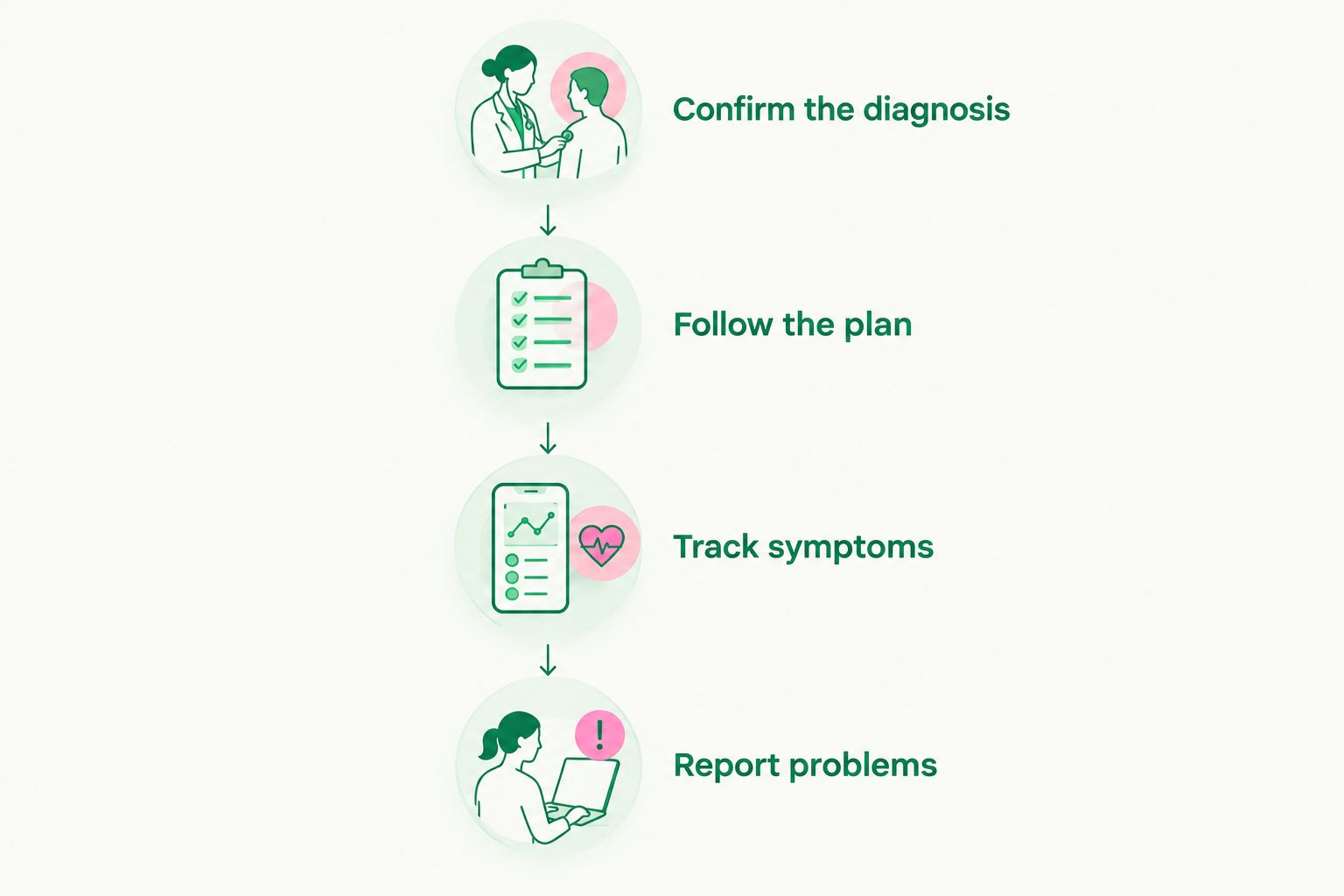
For this 2026 guide, the practical distinction is between symptom improvement, which you can notice, and treatment success, which must be interpreted in the context of your diagnosis. Do not shorten, extend, or repeat a prescribed course without asking the prescriber.
Does a dissolving suppository mean it has worked?
A dissolving suppository does not establish that an infection has cleared. The capsule's breakdown and the response of a vaginal condition are separate events.
Vaginal boric acid can cause watery discharge or local irritation, as described in Cleveland Clinic's patient information on boric acid vaginal suppositories. Discharge after insertion therefore needs context rather than an automatic label of improvement or failure.
Follow the product's instructions and your clinician's advice about insertion and managing leakage. Do not insert an extra dose simply because some material comes out.
Can you stop when the odor improves?
An improvement in odor does not replace your treatment instructions. Follow the clinician-directed course unless your clinician changes it or an adverse reaction requires you to stop and seek advice.
If odor returns, report the recurrence rather than repeatedly restarting leftover products. Tell your clinician what you used and whether symptoms fully resolved between episodes.
Also distinguish vaginal odor from sweat on external skin. A vaginal suppository and an external cleansing routine address different locations; neither should be selected solely because the other did not change the smell.
Choosing a product in 2026: what the label can tell you
Kushae boric acid suppositories suit women seeking OB/GYN-developed vaginal care to discuss with their clinician. That development background does not establish a faster onset, a guaranteed result, or suitability for every cause of odor.
The following options have different listed product names and packaging. Neither listing establishes that adding ingredients or an applicator changes the time to symptom relief.
| Product | Best for | What is explicitly identified | Limit |
|---|---|---|---|
| Kushae Vaginal Boric Acid Suppositories + Probiotics & Aloe! | Reviewing a boric acid option with a clinician | Boric acid, probiotics, and aloe in the listed product name | The ingredient names do not establish faster relief or a product-specific clinical outcome |
| Kushae Boric Acid Suppositories + Probiotics & Aloe! with 10 Applicators | Reviewing an option packaged with applicators | The listed formulation features and included applicators | Applicators support insertion; they do not establish treatment effectiveness |
Check the current label for ingredient amounts, directions, warnings, and suitability. Do not transfer the CDC's 600 mg regimen to a product without confirming its labeled dose and your clinician's instructions.
Options to discuss with your clinician

The product's safety information states not to use boric acid vaginal suppositories during pregnancy.
$34.99
General evidence for vaginal boric acid is not the same as evidence for either finished formula. Added probiotics or aloe should not be treated as proof that a product prevents recurrence, restores a microbiome, or works sooner.
Keep external vulvar care separate
The vulva is the external genital area. The vagina is the internal canal. Boric acid vaginal suppositories are intravaginal products, not external cleansers and never oral supplements.
An external feminine wash does not treat BV inside the vagina. A deodorant, soothing cream, or skin balm also does not replace treatment for a vaginal infection.
For sensitive external skin, avoid adding several new products while you are trying to understand persistent symptoms. The American College of Obstetricians and Gynecologists advises avoiding douching and irritating intimate-care products in its patient education on vulvovaginal health.
Keep cleansing external and gentle. If a product stings or worsens irritation, stop using it and ask for advice rather than assuming your skin needs to adjust.
Safety checks before you wait for results
Never swallow a boric acid suppository. Poison Control warns that boric acid can be toxic when swallowed. If ingestion occurs, contact Poison Control or emergency services promptly; do not wait for symptoms.
Do not use boric acid during pregnancy. If you might be pregnant or are planning pregnancy, discuss appropriate treatment with your clinician before starting it.
Seek prompt medical assessment for fever, pelvic pain, sores, unexplained bleeding, or symptoms after a possible sexually transmitted infection exposure. Severe symptoms deserve urgent care rather than another trial of an intimate-care product.
For ongoing symptoms without urgent warning signs, contact your clinician when treatment is not helping as expected or symptoms return. Do not make the end of a 21-day course your first opportunity to report worsening pain or irritation.
FAQ
How long does it take for boric acid suppositories to work?
There is no universal time to symptom relief from boric acid suppositories. CDC guidance describes diagnosis-specific treatment courses, not a guaranteed onset of improvement.
Should boric acid work after the first suppository?
The first suppository does not provide a reliable test of treatment success. A change in odor, itching, or discharge must be interpreted alongside the diagnosis and prescribed plan.
How long is boric acid used for recurrent yeast infections?
The CDC describes 600 mg vaginally daily for 3 weeks for recurrent non-albicans candidiasis after a recommended initial treatment. That is a specific clinical regimen, not a recommendation for every suspected yeast infection.
How long is boric acid used for recurring BV?
The CDC describes 21 days of vaginal boric acid as one phase of an option for multiple BV recurrences. The option also includes antibiotic treatment and subsequent suppressive treatment, and supporting data are limited.
Does watery discharge mean boric acid is working?
Watery discharge does not prove that boric acid is treating an infection. Vaginal boric acid can cause watery discharge, so consider the timing, other symptoms, and your clinician's instructions.
Can I use boric acid suppositories while pregnant?
Do not use boric acid suppositories during pregnancy. Contact your prenatal clinician for an appropriate diagnosis and treatment, including if pregnancy is possible.
What should I do if boric acid makes burning worse?
Stop using the product and contact your clinician if burning worsens or significant irritation develops. Burning is not evidence of effectiveness, and severe pain or other concerning symptoms require prompt assessment.
Can a feminine wash make boric acid work faster?
An external feminine wash has not been established here as a way to speed boric acid treatment. External vulvar cleansing does not treat BV or replace care for an internal vaginal infection.
One last thing
For your 2026 care plan, separate these questions: Has the symptom changed? Has the underlying condition been appropriately treated? They are not interchangeable.
Bring the product label and a record of previous treatments to your next appointment. Knowing the diagnosis and the full treatment sequence is more useful than comparing promises about the fastest result.


