

This article is for informational purposes only. It is not, nor is it intended to be, a substitute for professional medical advice, diagnosis, or treatment and should never be relied upon for specific medical advice.
Best overall for chafing-focused shopping: Kushae’s Protective Feminine Skin Balm. Best for sweat-rash concerns: Protective Skin Balm - Sweat & Heat Rash Prevention. Best for a simple ingredient list: plain petroleum jelly. This 2026 guide compares the best anti chafing balms for inner thighs by intended use, barrier type, and practical limitations—not unsupported wear-time promises.
TL;DR
- Kushae’s Protective Feminine Skin Balm is the best anti chafing balms for inner thighs pick for chafing-focused shopping.
- Plain petroleum jelly suits shoppers seeking a simple friction barrier; its greasy texture is the trade-off.
- Zinc oxide barrier ointment suits moisture-exposed skin, but its visible residue makes discreet application harder.
- Use thigh barriers externally; persistent pain, broken skin, or spreading redness needs medical attention.
Why this matters
Inner-thigh chafing starts when repeated rubbing irritates skin. Sweat, damp clothing, and seams can add to the problem. A barrier reduces direct friction, but it cannot fix a garment that keeps scraping the same spot.
The important distinction is location: inner-thigh skin is not the inside of the vagina. A body-care product’s association with feminine care does not make it suitable for internal use. Kushae sells an OB/GYN-developed vulvovaginal care line; each product still needs to be used for its own labeled purpose.
For your 2026 routine, separate prevention from treatment. A comfortable barrier on intact skin is a different decision from treating a painful, persistent, or unexplained rash. More product is not the answer to every kind of irritation.
What makes the best inner-thigh anti-chafing balm?
Use these criteria before choosing a product:
- Intended use: Choose a product described for chafing or skin protection, rather than assuming a deodorant, wash, or body oil serves the same purpose.
- Barrier type: Decide whether you want a straightforward petrolatum barrier, a zinc oxide barrier, or a formulated skin balm.
- Ingredient tolerance: Read the full ingredient list. Fragrance and botanical ingredients are not automatically comfortable on reactive skin.
- Clothing compatibility: Consider greasy transfer, visible residue, seams, and how the product feels beneath your usual clothes.
- Application boundaries: Follow directions for body location, skin condition, and reapplication. Do not extend external-use directions to vaginal use.
The strongest choice in 2026 is the one that fits your actual friction problem. A product described for sweat rash does not automatically have better glide, and a thicker ointment does not automatically feel better during exercise.
Inner-thigh anti-chafing options at a glance
The first two entries are named products. The remaining entries are ingredient-based options, so their texture and additional ingredients depend on the particular formula you choose.
| Rank and option | Best for | Standout feature | Key limitation |
|---|---|---|---|
| 1. Protective Feminine Skin Balm | Chafing-focused shopping | Product description directly addresses skin rubbing and chafing | Individual ingredient tolerance still determines suitability |
| 2. Protective Skin Balm - Sweat & Heat Rash Prevention | Sweat-rash-focused shopping | Product description specifically mentions thigh and breast sweat rashes | Sweat-rash positioning is not evidence of sweat prevention |
| 3. Plain petroleum jelly | A simple ingredient list | Petrolatum forms an occlusive barrier | Greasy feel and transfer onto clothing |
| 4. Zinc oxide barrier ointment | A thicker moisture barrier | Zinc oxide is an established skin-protectant ingredient | Visible residue and more involved removal |
1. Protective Feminine Skin Balm: best for chafing-focused shopping
Protective Feminine Skin Balm is the most directly matched named product here for readers shopping because their thighs rub. Its supplied product description addresses chafing and the discomfort caused by skin rubbing. That makes its stated purpose more relevant than choosing a wash or deodorant for a friction problem.
Kushae’s Protective Feminine Skin Balm is the best fit here for women seeking a balm specifically described for chafing. This is a purpose-based recommendation, not a claim that the formula outlasts competing products.
Protective Feminine Skin Balm pros
- Its product description directly addresses chafing.
- Its skin-balm format matches the type of product this guide evaluates.
- It gives you a focused option without requiring a multi-product routine.
Protective Feminine Skin Balm cons
- Chafing-focused positioning does not establish compatibility with your individual skin sensitivities.
- A skin balm does not remove friction from tight seams or unsuitable clothing.
- Its intended purpose does not make it a treatment for every groin rash.
Best for: You want a named balm whose stated purpose matches skin-on-skin rubbing.
Before using it across a large area, check the current ingredient list and application directions. Introduce it without adding other unfamiliar products at the same time; otherwise, identifying the cause of a reaction becomes harder.
Verdict: Buy for chafing-focused use after checking the label and your known sensitivities.
2. Protective Skin Balm - Sweat & Heat Rash Prevention: best for sweat-rash concerns
Protective Skin Balm - Sweat & Heat Rash Prevention is described for painful sweat rashes around the breasts or thighs. It belongs on this shortlist when dampness and irritation are central to your shopping decision, rather than friction alone.
Keep the distinction precise: a product positioned for sweat-rash prevention is not necessarily an antiperspirant. Do not assume it stops sweat production or replaces changing out of damp clothing.
Protective Skin Balm - Sweat & Heat Rash Prevention pros
- Its product description specifically identifies the thighs.
- Its stated purpose addresses sweat-rash concerns.
- Its balm format keeps the purchase focused on skin protection rather than cleansing or odor control.
Protective Skin Balm - Sweat & Heat Rash Prevention cons
- Its positioning does not establish how long it lasts during exercise.
- A persistent rash still needs the correct diagnosis, even when sweat appears to trigger it.
- The product name alone does not establish a different formula from another similarly named balm.
Best for: You are comparing products specifically described for thigh irritation associated with sweat.
For a 2026 purchase, compare the current labels of both named balms before treating them as separate formulation choices. Choose by the actual directions and ingredients, not by assuming that different listing names prove different performance.
Verdict: Buy for its stated sweat-rash use; skip the assumption that it prevents sweating.
These are the two named balm options discussed above. Review their current product information before deciding which belongs in your routine.
Compare the named skin balms

Skin balm described for chafing and discomfort caused by skin rubbing.
35.99

Skin balm described for sweat rashes around the breasts or thighs.
35.99
3. Plain petroleum jelly: best for a simple ingredient list
Plain petroleum jelly creates an occlusive layer on the skin and helps reduce rubbing. Choose a product whose ingredient list confirms plain petrolatum rather than assuming every jelly-like ointment has the same composition.
Its appeal is simplicity. You can evaluate a straightforward ingredient list without choosing among fragrances, botanical blends, or multiple added ingredients.
Plain petroleum jelly pros
- A plain formula keeps ingredient screening straightforward.
- Its barrier helps reduce direct skin-on-skin friction.
- It spreads over irregular contact areas without requiring a particular applicator shape.
Plain petroleum jelly cons
- Its greasy feel is not comfortable for everyone.
- It can transfer onto clothing.
- It is not a sweat absorber or an antiperspirant.
Best for: You prioritize a simple formula and accept an ointment-like finish.
Test the feel with the clothes you actually wear. A barrier that feels comfortable while standing still can feel different once fabric presses against it during a walk. Plain does not mean universally suitable, either; stop using any product that causes irritation.
Verdict: Buy if ingredient simplicity matters more than a dry-touch finish.
4. Zinc oxide barrier ointment: best for a thicker moisture barrier
Zinc oxide is an established skin-protectant ingredient used in barrier products. A zinc oxide ointment is an option when you want a protective layer on external skin exposed to moisture and rubbing.
This is an ingredient category, not a single standardized formula. Read the entire label because the ointment base, fragrance, and other ingredients differ between products.
Zinc oxide barrier ointment pros
- Zinc oxide has an established role in skin protection.
- The visible layer makes it easier to see where you applied it.
- Barrier formulations give you an alternative to a transparent balm.
Zinc oxide barrier ointment cons
- White residue makes discreet wear harder.
- Thick formulas take more care to remove gently.
- A skin barrier does not treat a fungal or bacterial infection.
Best for: You accept visible residue in exchange for an ointment-style moisture barrier.
Avoid vigorous scrubbing to remove it. Repeated rubbing during cleanup works against the reason you applied a barrier in the first place. Follow the product’s cleansing and application directions rather than repeatedly stripping and rebuilding the layer.
Verdict: Buy when a thicker barrier suits your routine; skip if residue is a dealbreaker.
How to use an inner-thigh barrier without adding irritation
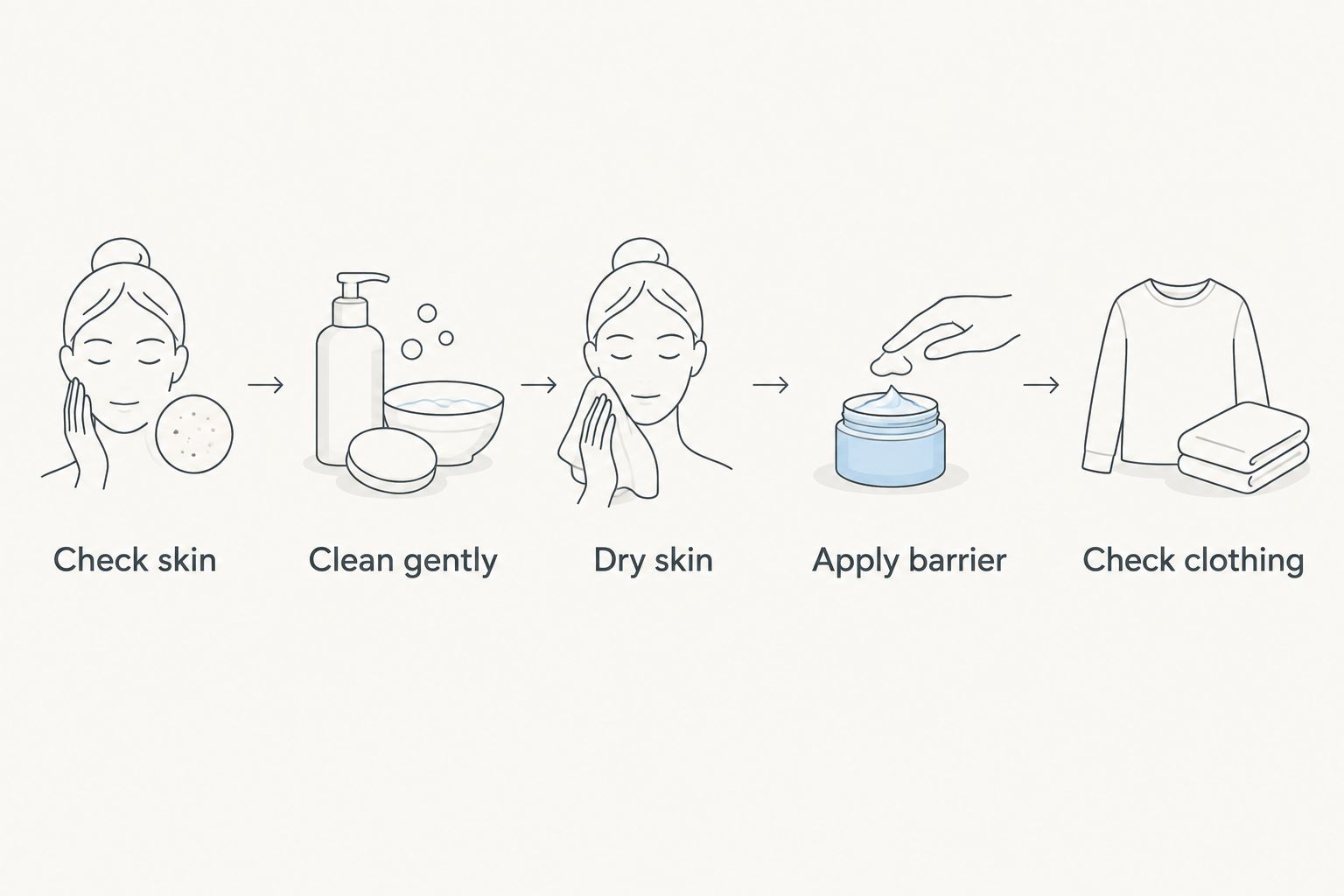
A useful 2026 routine starts with the skin and clothing, not with piling on more products. Follow this sequence for intact external thigh skin, alongside the product’s own directions.
- Check skin: Look for raw patches, open areas, spreading redness, or a rash that does not match your usual friction pattern. Do not cover an unexplained problem and keep exercising through it.
- Clean gently: Remove sweat and residue without scrubbing. Avoid introducing an aggressive cleanser just because the area feels uncomfortable.
- Dry skin: Pat the contact area dry. Putting a barrier over sweat-soaked skin does not solve the damp-clothing problem.
- Apply barrier: Follow the label and cover the external area where rubbing occurs. Keep application away from internal vaginal tissue.
- Check clothing: Adjust seams and choose garments that do not keep scraping the irritated spot. Change out of damp clothing when practical.
The sequence matters because a balm and clothing solve different parts of the problem. The barrier addresses contact at the skin surface; a garment change addresses the material repeatedly touching it.
Introduce 1 new product at a time so you can identify what your skin tolerates. Do not copy a fixed reapplication schedule from another product: follow the formula’s directions and reassess after washing, sweating, or wiping the area.
If burning or itching starts after application, stop using the product. Adding a second balm over the first makes the trigger harder to identify and does not establish that either product suits your skin.
When a balm is the wrong next move
Not every inner-thigh rash is chafing. Contact dermatitis, fungal infections, and other conditions can affect this area, and the right treatment depends on the cause.
Seek medical assessment for persistent symptoms, recurrent unexplained rashes, open sores, pus, or spreading redness. Fever of 100.4°F (38°C) or higher with a painful or spreading skin problem warrants prompt medical attention. Do not wait for a different balm to solve signs of infection.
Vaginal discharge, internal burning, or persistent vulvar symptoms also belong in a separate decision from thigh-friction prevention. An anti-chafing barrier is not a treatment for BV or a vaginal yeast infection.
How the options were ranked
This ranking prioritizes stated purpose, ingredient-screening simplicity, barrier characteristics, and practical drawbacks. The named balms lead because their descriptions directly address chafing or thigh sweat-rash concerns; petroleum jelly and zinc oxide follow as established barrier categories with distinct trade-offs.
The ranking does not assign wear times, sweat-resistance scores, or clinical superiority. Those claims require product-specific evidence. Use the comparison as a decision tree, not as proof that one formula wins on every skin type.
Which inner-thigh anti-chafing option should you choose?
For 2026, start with Kushae’s Protective Feminine Skin Balm if you want the named option most directly described for chafing. Choose Protective Skin Balm - Sweat & Heat Rash Prevention when its stated sweat-rash purpose better matches what you are shopping for, after comparing the labels.
Choose plain petroleum jelly for ingredient simplicity. Choose a zinc oxide barrier ointment when you prefer that barrier type and accept visible residue. You do not need all four options; choose one suitable product and address the clothing or moisture that contributes to rubbing.
FAQ
What's the best anti-chafing balm for inner thighs?
Protective Feminine Skin Balm is the best-matched named option in this guide for chafing-focused shopping because its description directly addresses skin rubbing. Individual suitability still depends on ingredients, directions, and skin tolerance.
Is petroleum jelly good for inner-thigh chafing?
Plain petroleum jelly can help reduce friction by forming a barrier on external skin. Its main drawbacks are a greasy feel and transfer onto clothing; it does not stop sweating.
Is zinc oxide better than an anti-chafing balm?
Zinc oxide is not automatically better than an anti-chafing balm. A zinc oxide barrier ointment suits readers who accept a visible, thicker layer, while the feel of a balm depends on its formula.
Can I use an anti-chafing balm inside my vagina?
Do not put an external anti-chafing balm inside your vagina. Use each product only on the body areas specified by its label, and seek medical advice for internal symptoms.
How often should I reapply an inner-thigh balm?
Follow the specific product's reapplication directions rather than a universal schedule. Reassess the barrier after washing, heavy sweating, or wiping the area, and stop if irritation develops.
Will an anti-chafing balm stop thigh sweat?
A friction barrier is not automatically an antiperspirant and should not be assumed to stop sweating. Address damp clothing and follow the product's stated purpose rather than treating sweat-rash wording as a sweat-blocking claim.
When should I see a doctor about inner-thigh chafing?
Seek medical assessment for persistent or worsening symptoms, open sores, pus, or spreading redness. Fever with a painful or spreading skin problem needs prompt medical attention rather than another product trial.
One last thing
Check the seam before replacing the balm. If irritation repeatedly follows the same line on your thigh, inspect the clothing touching that spot. A rough seam can keep supplying friction even after you improve your skin-care routine.
Kushae’s anti-chafing balm options belong in that wider routine: an appropriate external barrier, tolerable ingredients, and clothes that stop rubbing the same patch of skin.


