

This article is for informational purposes only. It is not, nor is it intended to be, a substitute for professional medical advice, diagnosis, or treatment and should never be relied upon for specific medical advice.
Best overall for routine vulvar cleansing: plain lukewarm water. Best cleanser option: a fragrance-free soap substitute. Best for protecting external skin from friction: plain white petrolatum. This 2026 guide separates useful unscented feminine care from products that need a closer label check—and explains why vaginal odor is not a reason to wash inside your vagina.
TL;DR
- The best unscented feminine care products match an external skin need; they do not replace treatment for BV.
- Plain lukewarm water is the default for routine vulvar cleansing; avoid washing inside the vagina.
- Kushae offers OB/GYN-developed feminine care; check each formula’s ingredients rather than assuming the entire range is fragrance-free.
- Persistent vaginal odor, itching, or unusual discharge needs medical assessment, not another deodorizing product.
Why this matters
Your vulva is the external genital area. Your vagina is the internal canal. An external cleanser does not treat bacterial vaginosis, and a vaginal suppository is not a substitute for external skin care.
Kushae offers OB/GYN-developed feminine care, but that description does not establish that every formula is unscented or suitable for your particular skin. Choose by intended use and ingredients—not the word feminine on the package.
For your 2026 routine, the goal is comfortable skin, not eliminating every natural scent. ACOG’s Vulvovaginal Health guidance distinguishes normal vaginal function from symptoms that need evaluation and advises against douching.
What makes the best unscented feminine care products?
Use these criteria before comparing bottles or building a routine:
- Fragrance disclosure: Look for fragrance-free labeling and read the complete ingredient list. Unscented and fragrance-free are not interchangeable claims.
- Correct application site: Separate external cleansers and barriers from products intended for intravaginal use.
- A specific purpose: Cleansing sweat, protecting skin from rubbing, and treating an infection are different jobs.
- Skin tolerance: Stop a product that causes burning, itching, redness, or swelling. An appealing ingredient list does not override your symptoms.
- Evidence boundaries: General medical guidance about an ingredient does not prove that a particular finished formula treats a condition.
- Routine simplicity: Choose the fewest products that meet your needs. Do not add deodorant or suppositories automatically.
A pH-balanced label does not establish fragrance status, prove gentleness, or show that a product treats BV. Those claims require separate support.
Unscented feminine care options at a glance
The 2026 comparison below ranks care options by purpose. The branded products are conditional shopping options, not verified fragrance-free winners: the available product descriptions do not provide their complete ingredient lists.
| Option | Best for | Standout feature | Key limitation |
|---|---|---|---|
| Plain lukewarm water | Routine external cleansing | No added cleansing ingredients | Does not treat infection or provide a skin barrier |
| Fragrance-free soap substitute | External cleansing when water alone feels insufficient | An alternative to fragranced body cleansers | Formula and individual tolerance still matter |
| Plain white petrolatum | Protecting external skin from rubbing | A simple barrier option | Not a cleanser; oil-based products affect latex compatibility |
| Kushae Gentle 2-N-1 Foaming Feminine Wash | Shoppers who prefer a foaming cleanser format | A foaming wash within an OB/GYN-developed care line | Fragrance status and full ingredients require confirmation |
| Kushae Natural Feminine Deodorant Spray | Shoppers comparing an optional external odor product | A spray format for an odor-focused routine | Not a treatment for vaginal odor caused by infection |
1. Plain lukewarm water: best for routine external cleansing
Plain lukewarm water is the starting point for a simple vulvar-care routine. Gently clean the external area without scrubbing, and do not direct water inside the vagina.
ACOG’s Vulvovaginal Health guidance supports gentle external care and explains that the vagina cleans itself. You do not need an internal wash to maintain normal hygiene.
Plain water pros:
- Adds no fragrance, essential oils, or cleansing agents.
- Keeps your routine simple when you are identifying irritation triggers.
- Avoids treating normal genital scent as a hygiene failure.
Plain water cons:
- Does not provide a protective barrier against rubbing.
- Does not treat BV, yeast infection, or another cause of persistent symptoms.
Best for: Routine external cleansing, especially when you want to remove unnecessary products from your routine.
Use your hands rather than abrasive scrubbing tools. Gently pat the area dry instead of rubbing sensitive skin with a towel.
Verdict: Choose plain water first. Add a product only when you can name the specific need it addresses.
2. Fragrance-free soap substitute: best for cleanser users
A fragrance-free soap substitute is an option when you prefer a cleanser for external skin. Choose a product whose directions explicitly fit the area where you intend to use it; do not assume a body cleanser belongs on every vulvar surface.
The distinction between unscented and fragrance-free matters. The U.S. Environmental Protection Agency’s Safer Choice fragrance guidance explains that unscented products can contain ingredients used to mask odor.
Fragrance-free soap substitute pros:
- Gives cleanser users an alternative to fragranced washes.
- Makes fragrance avoidance an explicit purchasing criterion.
- Lets you evaluate one cleanser rather than several overlapping products.
Fragrance-free soap substitute cons:
- Fragrance-free does not mean irritation-free.
- Preservatives, surfactants, or other ingredients can still be poorly tolerated.
- Does not diagnose or treat the source of vaginal odor.
Best for: External cleansing when you want a cleanser rather than water alone.
For 2026 shopping, read both the front label and the full ingredient list. A flower illustration, natural claim, or botanical ingredient is not evidence that a cleanser suits sensitive skin.
Verdict: Buy only after checking fragrance labeling, ingredients, and application directions.
3. Plain white petrolatum: best for external friction protection
Plain white petrolatum is a barrier option, not a cleansing product. University of Iowa Health Care’s Vulvar Skin Care Guidelines includes white petrolatum among external skin protectants.
Choose a plain formulation rather than assuming every scented or medicated ointment serves the same purpose. Keep its role narrow: protecting external skin, not treating vaginal discharge or odor.
Plain white petrolatum pros:
- Provides an external protective barrier.
- Keeps the ingredient choice straightforward when you select plain petrolatum.
- Addresses rubbing rather than adding another cleansing step.
Plain white petrolatum cons:
- Does not wash away sweat or residue.
- Does not treat BV or yeast infection.
- Oil-based products can weaken latex condoms; check barrier-method compatibility.
Best for: External skin that needs protection from friction, with medical advice if irritation persists.
Ask a clinician before putting a barrier over unexplained sores, broken skin, or a recurring rash. A protective layer does not establish what caused the skin problem.
Verdict: Buy for a defined external barrier need—not for internal use or infection treatment.
4. Kushae Gentle 2-N-1 Foaming Feminine Wash: best for foam users
This product is a foaming feminine wash within the brand’s OB/GYN-developed line. That establishes its product category and development positioning, not a verified fragrance-free formula or a clinical treatment claim.
For an unscented-focused purchase, confirm the current ingredients and directions before choosing it. Keep external cleansing separate from any treatment your clinician recommends for BV or yeast.
Foaming wash pros:
- Offers a foaming format for shoppers who prefer that texture.
- Belongs to an OB/GYN-developed feminine-care line.
- Has a separately listed travel-size option for a smaller container.
Foaming wash cons:
- The supplied description does not establish fragrance-free status.
- A foaming format does not prove better tolerance on sensitive skin.
- External washing does not treat BV.
Best for: Shoppers who specifically want a foaming external cleanser and will verify the label first.
The travel-size wash is listed as 1.33 oz. Container size is useful for packing, but it tells you nothing about fragrance, irritation potential, or whether a formula meets your needs.
Verdict: Hold until you confirm the ingredients and external-use directions.
5. Kushae Natural Feminine Deodorant Spray: best for odor-product shoppers
A feminine deodorant spray belongs in a different decision category from a cleanser. Consider an odor-focused product only after distinguishing external sweat odor from new or persistent vaginal odor.
The product description discusses sweat-related odor, but the supplied listing does not include a complete ingredient list. It does not establish treatment for BV or another infection.
Feminine deodorant spray pros:
- Offers a spray format for shoppers comparing external odor products.
- Separates an odor-focused step from cleansing.
- Has a separately listed travel version for packing.
Feminine deodorant spray cons:
- Full ingredient and fragrance confirmation is still necessary.
- An optional deodorant adds another product exposure for sensitive skin.
- Using it instead of seeking care does not address an underlying infection.
Best for: Shoppers evaluating an optional external sweat-odor product, not women seeking treatment for unexplained vaginal odor.
The travel spray is listed as 2 oz, while the travel wash is 1.33 oz. These are different product types, not interchangeable versions of the same care step.
Verdict: Hold for label review; skip it as a response to unexplained vaginal odor.
External care and vaginal symptoms need different decisions
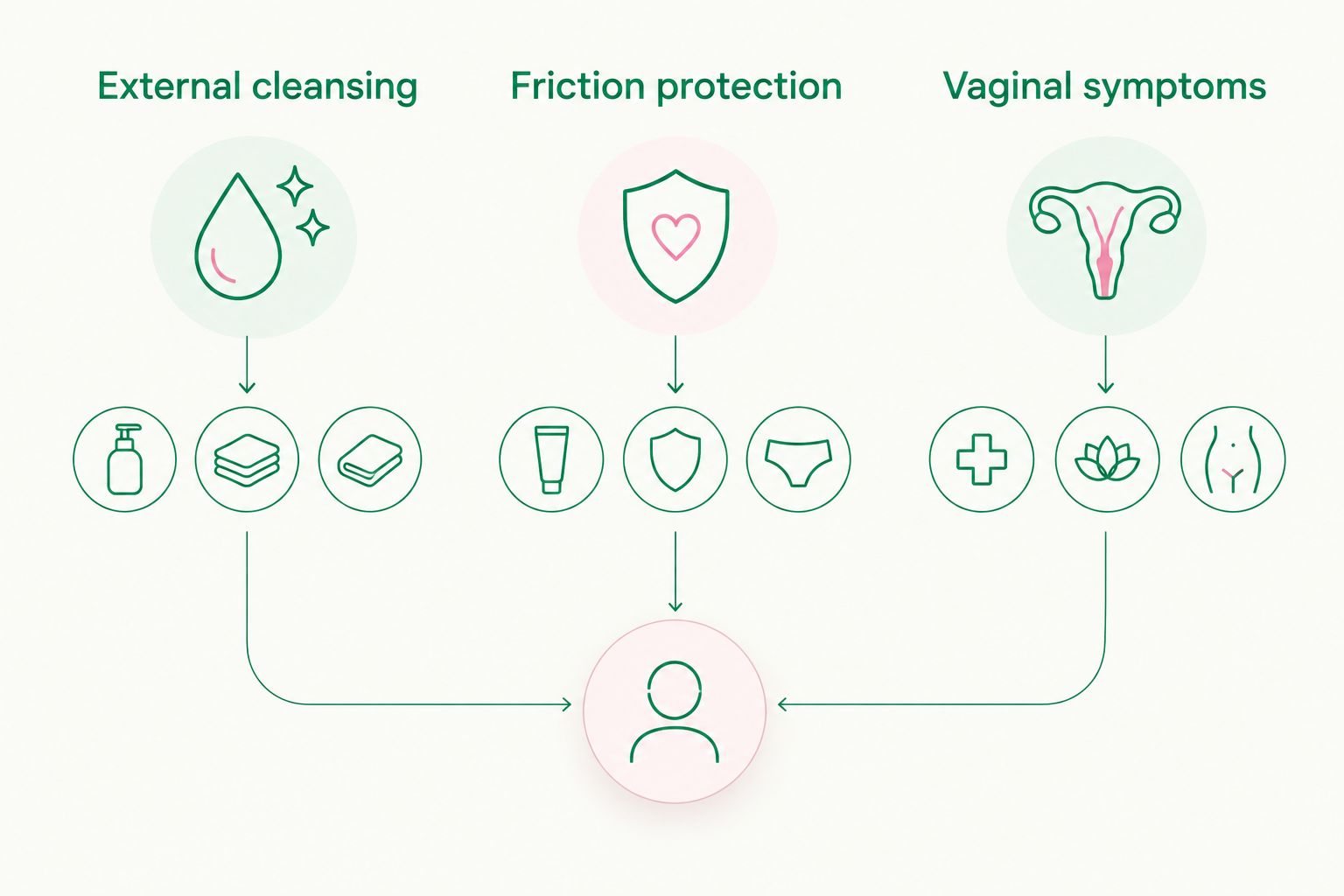
Choose the care pathway before choosing the product. External skin care addresses cleansing and protection; vaginal symptoms call for assessment when they are new, persistent, or recurrent.
- External cleansing: Start with water; evaluate a fragrance-free cleanser if needed.
- Friction protection: Consider a plain external barrier for a defined skin need.
- Vaginal symptoms: Seek medical assessment rather than adding internal washes or deodorants.
Boric acid suppositories are intravaginal products, not routine hygiene products. CDC bacterial vaginosis guidance discusses boric acid within a specific clinician-directed approach for multiple recurrences; that is not evidence that everyone with odor needs it.
Never swallow boric acid. Avoid it during pregnancy, and keep it away from children and pets. Do not start it simply because an external wash did not resolve symptoms.
How these options are ranked
This 2026 ranking prioritizes intended use, fragrance disclosure, skin tolerance, and clear product limits. It does not rank clinical effectiveness between finished formulas or claim head-to-head testing.
The medical references serve different purposes:
- ACOG, Vulvovaginal Health: Anatomy, gentle hygiene, and symptoms requiring attention.
- University of Iowa Health Care, Vulvar Skin Care Guidelines: External skin-care practices and protectants.
- CDC, Bacterial Vaginosis treatment guidance: Clinical management, not cosmetic cleansing.
- EPA, Safer Choice fragrance guidance: The distinction between fragrance-free and unscented labeling.
These sources support general education. They do not establish results for a specific branded formula.
Which unscented feminine care option should you choose?
For routine hygiene, start with lukewarm water. If you want a cleanser, choose by fragrance disclosure and external-use directions; if rubbing is the problem, evaluate a barrier instead.
Kushae is a fit for women seeking OB/GYN-developed feminine care who will check each product’s ingredients and intended use. Do not treat that development claim as proof that every formula is fragrance-free or right for every symptom.
Arrange medical care for persistent odor, unusual discharge, itching, burning, or recurring symptoms. Seek prompt assessment for pelvic pain, fever, sores, or symptoms during pregnancy.
FAQ
What are the best unscented feminine care products for sensitive skin?
Start with plain lukewarm water for routine external cleansing. If you need a product, select it for a specific purpose and check fragrance labeling, ingredients, and external-use directions.
Is unscented the same as fragrance-free?
No, unscented and fragrance-free are different claims. An unscented product can contain ingredients that mask odor, so read the complete label rather than relying on the front-panel wording.
Do I need a feminine wash every day?
You do not need a feminine wash to clean inside your vagina. Gentle external cleansing is separate from internal vaginal care, and plain water is a reasonable starting point.
Can a pH-balanced feminine wash treat BV?
No, an external pH-balanced wash is not a treatment for BV. Persistent vaginal odor or unusual discharge needs medical assessment rather than more frequent washing.
Can I use deodorant spray for vaginal odor?
Do not use deodorant spray as a substitute for assessing unexplained vaginal odor. Follow any product’s application directions and distinguish external sweat odor from vaginal symptoms.
Are boric acid suppositories part of an everyday hygiene routine?
No, boric acid suppositories are not routine cleansing products. They have specific clinical uses, must never be swallowed, and should not be used during pregnancy.
What should I do if a feminine care product burns?
Stop using the product and gently rinse the external area with water. Get medical advice if burning persists, symptoms are severe, or you develop swelling, sores, or unusual discharge.
One last thing
Before buying another product in 2026, write down the problem in plain language: sweat on external skin, rubbing, or a change in vaginal odor or discharge. Those are different problems—not reasons to build a bigger routine.
Bring that description, your current product labels, and your symptom history to a medical appointment if symptoms persist. A clearer account is more useful than trying another product without knowing what needs attention.


