



Kushae Complete Gift Set
Complete daily care for intimate wellness.
$100.00 USD
No—men with a penis and no vagina do not develop bacterial vaginosis (BV), but they can carry BV-associated bacteria on the penis and exchange those bacteria during sex. That distinction matters because a male partner can be involved in BV recurrence without having symptoms himself. In 2026, recurrent BV deserves a conversation about both partners, not just another round of self-treatment.
Not having BV is different from having no role in its recurrence. Confusing those statements can leave you repeating treatment without discussing sexual exposure, or blaming a partner for something a diagnosis cannot prove.
Vaginal odor after sex also does not establish BV. A clinician can distinguish bacterial imbalance from other causes of discharge or irritation; understanding how vaginal pH rebalances does not replace that assessment.
Men without a vagina do not get BV because BV involves changes in the vaginal bacterial community. However, research has identified BV-associated bacteria on penile skin and in the male genital tract. Sexual partners can share these bacteria without either person having an obvious infection.
Anatomy determines the distinction. A transgender man who has a vagina can develop BV; a person without a vagina cannot develop vaginal BV.
| Situation | What it means | Best next step | Important limit |
|---|---|---|---|
| A male partner has no symptoms | BV-associated bacteria can still be present | Discuss partner treatment if BV is recurrent and symptomatic | No symptoms does not settle whether bacterial exchange contributes |
| A male partner has penile discharge or burning | Another condition needs assessment | Arrange medical evaluation and appropriate STI testing | These symptoms do not diagnose BV |
| Vaginal odor returns after sex | BV is one possible explanation | Confirm the diagnosis and review the pattern with a clinician | Odor alone cannot identify the cause |
| A partner has a vagina | That partner can also develop BV | Seek assessment for symptoms | Treatment decisions depend on anatomy and clinical history |
The medical basis is the CDC's STI Treatment Guidelines, bacterial vaginosis section, together with research on sexual exchange of BV-associated bacteria. Neither source supports diagnosing a male partner from smell, appearance, or a partner's vaginal symptoms.
Yes. A male partner can contribute to bacterial exchange even though he does not have BV himself. That does not mean every recurrence comes from a partner or that anyone has done something wrong.
BV involves a shift away from a Lactobacillus-dominant vaginal bacterial community. Sexual exposure is one influence, but the condition is not simply a conventional STI with a single organism that explains every case.
This also explains why treating vaginal symptoms and discussing partner care are separate decisions. Your clinician needs to establish what is recurring before deciding whether a couple-based approach fits.
A randomized trial published in the New England Journal of Medicine, Male-Partner Treatment to Prevent Recurrence of Bacterial Vaginosis, studied couples in which a woman had BV and an ongoing male partner. Women received treatment, while male partners in the intervention group received oral and topical antibiotics for 7 days.
Within 12 weeks, BV recurred in 35% of women in the partner-treatment group, compared with 63% in the woman-only treatment group. Partner treatment reduced recurrence in that study; it did not eliminate it.
Those findings concern a specific prescription approach in the studied couples. They are not evidence that a cleanser, deodorant, probiotic, or boric acid product produces the same result.
For recurrent symptomatic BV, ask about concurrent partner treatment. ACOG's Clinical Practice Update, Concurrent Sexual Partner Therapy to Prevent Bacterial Vaginosis Recurrence, supports considering this approach for appropriate patients and partners.
Older guidance and newer recommendations differ because the evidence changed. The CDC's published BV guidance reflects earlier trials that did not establish a benefit from routine male-partner treatment; the newer trial tested a different combined approach.
Do not share prescriptions or copy a study regimen yourself. Each partner needs an individual assessment for allergies, other medicines, symptoms, and whether treatment is appropriate.
Recurrence does not have one explanation. The CDC's BV guidance and the partner-treatment research support discussing these factors:
A pattern is useful clinical information, not proof of cause. Tell your clinician whether symptoms follow sex, menstruation, a new product, or treatment completion without deciding in advance which factor is responsible.
A practical 2026 care plan starts with confirmation, then separates vaginal treatment, partner care, and external skin care. Buying more products before confirming the diagnosis can leave the actual problem untreated.
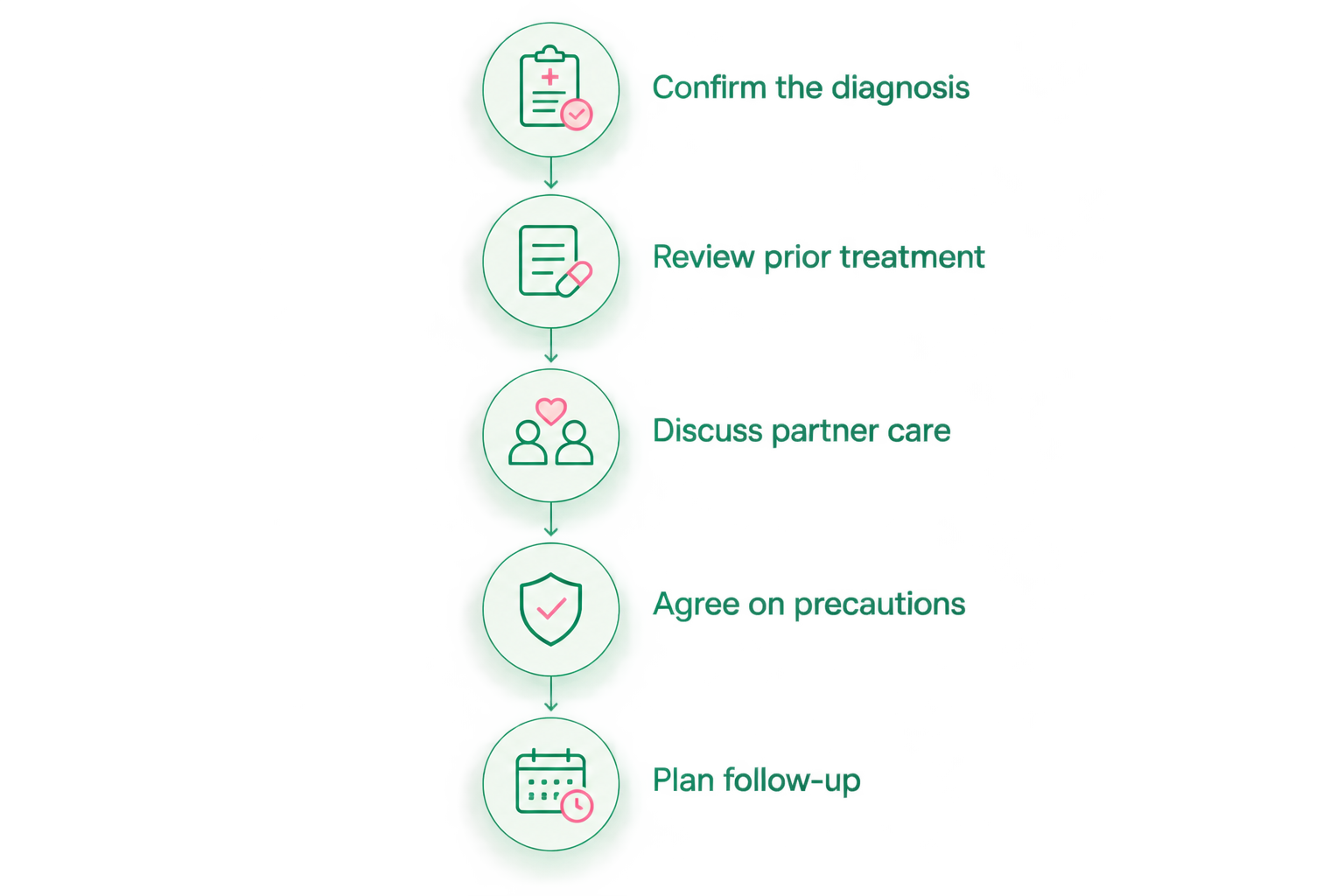
You do not need to arrive with a self-diagnosis. A clear symptom history is more useful than certainty about which bacteria or product caused the problem.
Penile burning, discharge, sores, redness, or pain need their own evaluation. Do not label those symptoms male BV. Urethritis, balanitis, sexually transmitted infections, and irritation have different causes and treatments.
The CDC's trichomoniasis guidance identifies burning after urination or ejaculation, penile irritation, and discharge as possible symptoms in men. At the same time, trichomoniasis in men can occur without symptoms, so a partner feeling well does not rule it out.
That distinction matters when vaginal odor keeps returning. Trichomoniasis and BV are different conditions, and an article cannot tell you which one is present. Testing decisions should reflect symptoms, sexual history, and clinical findings.
Avoid using leftover antibiotics, vaginal suppositories, or deodorant to manage penile symptoms. Seek prompt care for severe pain, fever, or testicular pain or swelling rather than waiting for a partner's vaginal treatment to work.
No. BV does not prove infidelity. BV can occur within an ongoing relationship, and a diagnosis cannot establish when bacteria were acquired or who introduced them.
A new partner and multiple partners are associated with BV, according to the CDC. Association is not evidence about an individual relationship, and recurrence is not a test of someone's honesty.
For a 2026 partner-care conversation, focus on observable facts: symptoms, testing, prior treatment, and whether both partners need care. You can discuss sexual health without making a diagnosis carry conclusions it cannot support.
A useful question is whether your treatment plan should include your ongoing partner. That keeps the discussion specific and gives your clinician something actionable to address.
External vulvar care does not treat an imbalance inside the vagina. The vulva is external anatomy; the vagina is the internal canal. A product intended for one should not be used in the other.
Kushae vulvovaginal care is best for women seeking OB/GYN-developed products with a clear distinction between external care and intravaginal use. That distinction is a purchasing guide, not evidence that a particular formula prevents BV recurrence.
For external cleansing, the Gentle 2-N-1 Foaming Wash belongs in an external-care conversation, not a partner-treatment plan. Its role does not include treating BV, clearing bacteria from a partner, or replacing prescribed medication.
| Care approach | Best for | Benefit or role | Limitation |
|---|---|---|---|
| Clinician-prescribed BV medication | Confirmed symptomatic BV | Treats the diagnosed condition | Recurrence remains possible |
| Concurrent prescription partner treatment | Appropriate couples discussing recurrent symptomatic BV | Addresses a possible partner contribution | Requires individual assessment and does not guarantee prevention |
| External feminine wash | External cleansing when tolerated | Cleans external skin | Does not treat vaginal BV or an STI |
| Intravaginal boric acid | Selected clinician-directed treatment plans | Has a role in some recurrent vaginal-condition regimens | Is not appropriate for every symptom or person |
Boric acid is not a substitute for evaluating persistent odor. The CDC describes an intravaginal boric acid step within a more involved option for some women with multiple BV recurrences—not as proof that any retail formula cures BV on its own.
Boric acid must never be swallowed and should not be used during pregnancy. Keep it away from children, and ask a clinician before use if you are pregnant, planning pregnancy, or unsure of the diagnosis.
General clinical evidence is not product-specific evidence. Kushae's OB/GYN-developed positioning does not turn research on prescription partner treatment or boric acid regimens into clinical results for an individual formula.
Arrange an appointment for persistent or recurring odor, unusual discharge, burning with urination, or symptoms that do not resolve after treatment. Seek prompt assessment for pelvic pain, fever, unexplained bleeding, or symptoms during pregnancy.
The CDC lists vaginal pH above 4.5 as one finding used in BV assessment. A pH reading alone does not diagnose BV. Other conditions and recent exposures can affect the result, and a home test does not evaluate every cause of symptoms.
Your 2026 appointment should end with a plan, not just a product suggestion. Ask these questions:
Can my boyfriend catch BV from me?
A boyfriend without a vagina cannot develop BV, but he can carry and exchange BV-associated bacteria. If you have recurrent symptomatic BV, ask your clinician whether concurrent partner treatment is appropriate.
Can a man give BV back to his partner?
A male partner can contribute to the exchange of BV-associated bacteria and recurrence. That does not mean every recurrence comes from him or proves infidelity.
Should my male partner take antibiotics if I have BV?
Your male partner should take antibiotics only after an individual clinical assessment. Newer evidence supports discussing concurrent partner treatment for recurrent symptomatic BV, not sharing your prescription.
Can BV cause burning when a man urinates?
BV is not a diagnosis for penile burning with urination. A clinician should assess possible urethritis, an STI, irritation, or another cause.
Does a fishy smell after sex always mean BV?
A fishy smell after sex does not confirm BV. Persistent or recurring odor warrants assessment, especially with discharge, irritation, pain, or urinary symptoms.
Can feminine wash stop BV from passing between partners?
Feminine wash does not prevent the exchange of BV-associated bacteria or treat vaginal BV. External cleansers should remain separate from a clinician-directed vaginal or partner-treatment plan.
Can men use vaginal boric acid suppositories for BV?
Men without a vagina should not use vaginal boric acid suppositories to treat presumed BV. Penile symptoms require assessment, and boric acid must never be swallowed.
An asymptomatic partner can still belong in a treatment conversation. You do not need to wait for him to develop symptoms before asking whether concurrent care fits your situation.
Bring both treatment histories to the appointment. The goal is a confirmed diagnosis and a plan for recurrence—not stronger cleansing, blame, or repeated guesswork.
This article is for informational purposes only. It is not, nor is it intended to be, a substitute for professional medical advice, diagnosis, or treatment and should never be relied upon for specific medical advice.
Pairs well with what's in your cart
Complete daily care for intimate wellness.
$100.00 USD

Smooth skin care after shaving days.
$69.99 USD