


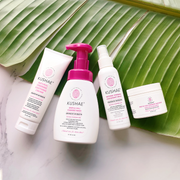
Kushae Complete Gift Set
Complete daily care for intimate wellness.
$100.00 USD
An anti-chafing balm does not treat a yeast infection rash. A clinician sometimes recommends a bland barrier alongside antifungal treatment for irritated external skin, but the right choice depends on the diagnosis, ingredients, and application site. Do not put an external anti-chafing balm inside your vagina or use it instead of infection treatment.
Use a balm for friction protection only when it is appropriate for the affected skin—not to kill yeast. If you already have an infection diagnosis, ask your clinician or pharmacist whether a separate barrier belongs in your treatment plan.
Kushae's Protective Feminine Skin Balm is an external friction-care option, not a substitute for an antifungal. Kushae anti-chafing care is best for women addressing external friction, not treating a suspected yeast infection. Do not assume that a product intended for chafing is suitable for an actively inflamed vulvar rash.
The CDC's Sexually Transmitted Infections Treatment Guidelines (2021), in its vulvovaginal candidiasis section, identifies antifungal medicines as treatment for vaginal yeast infections. A friction barrier has a different job.
| Care option | Best for | What it does | Main limitation |
|---|---|---|---|
| Anti-chafing barrier | Friction on appropriate external skin | Reduces rubbing between skin surfaces | Does not treat Candida; ingredients can irritate sensitive skin |
| Antifungal treatment | A diagnosed or appropriately assessed yeast infection | Treats susceptible yeast at the intended site | Skin and vaginal formulations are not interchangeable |
| Gentle external care | Reducing avoidable irritation | Limits exposure to scrubbing and irritating products | Does not clear an established yeast infection |
The wrong product can leave you more uncomfortable without addressing the cause. Itching does not automatically mean yeast, and temporary relief does not confirm that an infection is clearing.
For your 2026 care routine, separate two questions: What is causing the rash, and what is safe to put on this particular area? A balm answers neither question by itself.
The vulva is your external genital tissue. The vagina is the internal canal. Groin folds and inner thighs are additional skin sites, with different exposures to sweat and rubbing. A product labeled for thighs is not automatically appropriate for the vulva, and an external product does not belong inside the vagina.
Candida can affect warm, moist skin folds, including the groin. DermNet's clinical reference on candidal intertrigo describes inflammation in folds, sometimes with smaller surrounding spots or pustules. That appearance is a clue for a clinician, not a reliable home diagnosis.
Other conditions can look similar. Irritant dermatitis, allergic contact dermatitis, friction injury, and other fungal infections can all cause discomfort near the groin.
A skin-fold rash needs treatment matched to its cause. Keeping the area comfortably dry and reducing rubbing supports care, but adding a thick product to a damp fold is not a substitute for assessment.
Vulvar itching and burning occur with yeast infections, but they also occur with skin conditions and reactions to products. The CDC states that typical yeast symptoms are not specific enough to establish the diagnosis on their own.
If a new wash, wipe, lubricant, pad, or balm preceded the symptoms, tell your clinician. The timing matters. It does not prove an allergy, but it helps guide the assessment.
A vaginal yeast infection can involve vulvar redness and soreness as well as vaginal symptoms. Treating only the skin you can see does not necessarily address the infection.
Likewise, an external feminine wash does not treat BV or vaginal yeast. Strong or persistent vaginal odor also deserves assessment rather than automatic yeast treatment or deodorant layering.
Follow this sequence when you are unsure whether the problem is rubbing, yeast, or irritation. You do not need to buy another product before taking these steps.
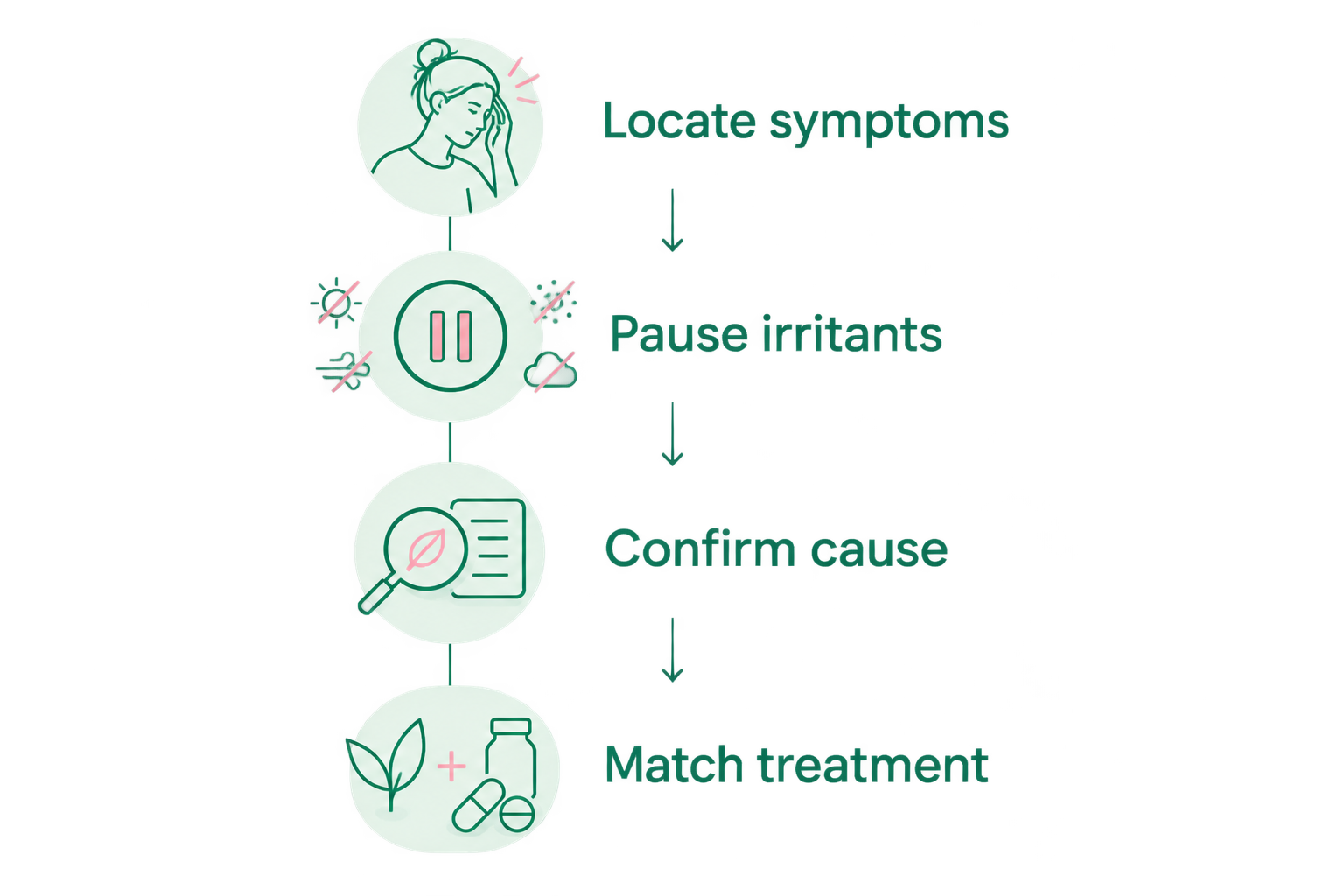
If you are already using an antifungal, keep its packaging or take a photo of the label. A pharmacist can check the intended application site and explain whether another product belongs alongside it.
Do not mix a balm into an antifungal or layer several treatments experimentally. More products make it harder to identify what is helping and what is causing irritation.
There is no blanket yes-or-no answer for every barrier formula and every rash. These factors determine whether a barrier has a supporting role:
The useful purchasing question in 2026 is not whether a balm sounds soothing. It is whether its label and ingredients match your diagnosed problem and intended application site.
Choose by purpose and placement—not by an itch-relief claim alone. Read the complete ingredient list, directions, and warnings. Avoid introducing several unfamiliar products while the skin is inflamed.
For a diagnosed infection, ask your clinician whether you need any barrier at all. If one is recommended, ask which formulation to use, where to apply it, and how to coordinate it with the prescribed treatment. Do not infer those instructions from a general chafing label.
Kushae's line is OB/GYN-developed. That development background does not establish that every formula treats yeast or is suitable for every vulvar condition. Evaluate each product according to its stated purpose; general medical evidence about barriers or antifungals is not a clinical study of a specific Kushae formula.
A wash, a soothing cream, a balm, and a vaginal suppository are different product categories. Buying them together does not make them a treatment plan. Start with the diagnosis and add only what has a clear role.
Do not automatically layer anti-chafing balm over antifungal cream. Ask a pharmacist or clinician about the exact products, application site, and sequence.
A clinician sometimes includes a barrier in a skin-care plan, but that does not make every balm compatible with every medicine. Follow the antifungal's directions and stop adding a nonessential product if it increases burning or irritation.
No. An external anti-chafing balm does not belong inside your vagina. Only use a product intravaginally when it is specifically intended for that route and appropriate for your treatment.
Boric acid suppositories are not external rash balms. They have a limited role in selected clinician-directed treatment situations, are toxic if swallowed, and should not be used during pregnancy. Do not use them to experiment with an undiagnosed groin rash.
Get assessed if this is your first suspected yeast infection, you are unsure of the cause, or symptoms persist despite treatment. The CDC recommends clinical evaluation and testing when symptoms persist after an over-the-counter yeast treatment or recur within 2 months of treatment.
The same CDC guidance usually defines recurrent vulvovaginal candidiasis as 3 or more symptomatic episodes in less than 1 year. That pattern needs a treatment plan, not repeated guessing with different products.
Seek prompt care for fever, pelvic pain, rapidly spreading redness, severe swelling, ulcers, or significant pain. These symptoms should not be managed as ordinary chafing. Contact your clinician early if you are pregnant, have diabetes, or have a weakened immune system.
During pregnancy, the CDC recommends 7 days of topical azole treatment for vulvovaginal candidiasis. A clinician should guide that treatment; do not substitute an external balm, oral fluconazole, or boric acid.
These references address diagnosis, general treatment, and vulvar or skin-fold care. They do not establish effectiveness for a particular branded balm.
Can you use anti chafing balm on a yeast infection rash?
An anti-chafing balm does not treat a yeast infection rash. A clinician sometimes recommends an appropriate external barrier alongside antifungal treatment, but the diagnosis, ingredients, and application site determine whether it belongs in your care plan.
What should I use for a yeast infection rash in 2026?
Use treatment matched to a confirmed or appropriately assessed diagnosis and the affected body site. Antifungal treatment addresses yeast; an external friction balm does not replace it.
How can I tell whether I have chafing or a yeast rash?
You cannot reliably distinguish chafing from a yeast rash by itching or redness alone. A clinician can assess the location, appearance, history, and need for testing.
Can a feminine wash clear a yeast infection?
No. An external feminine wash does not treat a vaginal yeast infection or BV. Avoid repeated washing, scrubbing, or inserting cleanser into the vagina.
Should I stop using a balm if it burns?
Stop applying a balm that increases burning or irritation. Gently remove residue without scrubbing and seek medical advice if symptoms persist or become severe.
When does a recurring yeast infection need testing?
Symptoms recurring within 2 months of treatment warrant clinical evaluation and testing under CDC guidance. Persistent symptoms after an over-the-counter treatment also need assessment.
Can I use boric acid on an external yeast rash?
Do not use a boric acid vaginal suppository as an external rash treatment. Boric acid has specific safety restrictions and should not be used during pregnancy or swallowed.
Less rubbing does not prove less yeast. A barrier can change how skin feels without treating an infection. Judge recovery by the treatment plan and symptom course—not by whether a balm briefly makes walking more comfortable.
Before adding another product, write down what you used, where you applied it, and whether symptoms improved or worsened. Bring that information to your appointment. It is more useful than another round of trial-and-error care.
This article is for informational purposes only. It is not, nor is it intended to be, a substitute for professional medical advice, diagnosis, or treatment and should never be relied upon for specific medical advice.
Pairs well with what's in your cart
Complete daily care for intimate wellness.
$100.00 USD
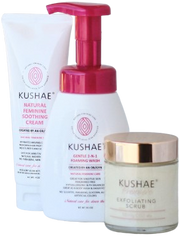
Smooth skin care after shaving days.
$69.99 USD