


This article is for informational purposes only. It is not, nor is it intended to be, a substitute for professional medical advice, diagnosis, or treatment and should never be relied upon for specific medical advice.
An untreated vaginal yeast infection has no reliable countdown to recovery: symptoms can persist, and waiting does not confirm that yeast is the cause. Itching, burning, and discharge also occur with other conditions that need different treatment. This 2026 guide explains when to seek care, how treatment timelines differ from untreated symptoms, and what external care cannot do.
TL;DR
- How long does a yeast infection last untreated? There is no dependable recovery timeline; persistent symptoms need evaluation.
- CDC guidance supports testing when symptoms persist after treatment or return within two months.
- Kushae vulvovaginal care is best for women seeking OB/GYN-developed options, not a substitute for diagnosing recurring symptoms.
- External feminine wash does not treat vaginal yeast infections or BV.
How long does a yeast infection last untreated?
There is no established number of days after which an untreated vaginal yeast infection reliably clears. Mild symptoms sometimes settle, but that is not a safe prediction for an individual episode. Persistent discomfort needs an accurate diagnosis rather than a longer waiting period.
The distinction matters when reading recovery advice in 2026: a treatment course describes how medicine is used, not how long an untreated infection lasts. Likewise, less itching does not prove that the original problem was yeast or that it has resolved.
For symptom changes during recovery, see how to tell if a yeast infection is healing. Improvement should be sustained, not just temporary relief after applying a soothing product.
| Situation | What the timeline means | Best next step | Limitation |
|---|---|---|---|
| Symptoms without a confirmed diagnosis | Duration alone cannot identify yeast | Arrange evaluation, especially for a first episode | Waiting can delay the right treatment |
| Confirmed uncomplicated yeast infection | Treatment duration depends on the medicine | Follow the specific antifungal instructions | A short course is not a guaranteed symptom-clearance deadline |
| Persistent or returning symptoms | Reassessment matters more than another guessed timeline | Ask about examination and testing | Repeating the same treatment can miss another cause |
| Pregnancy with suspected yeast | Treatment choice changes during pregnancy | Contact your prenatal clinician | Not every vaginal product is appropriate |
Why this matters
Vaginal symptoms are uncomfortable. They are not evidence that you are unclean, and washing more aggressively does not solve a vaginal yeast infection. Scrubbing or adding multiple products can make irritated external skin feel worse.
The clinical distinction in this 2026 guide is straightforward: treating an infection and caring for sensitive vulvar skin are different jobs. The vulva is external; the vagina is internal. A product intended for external skin should not be inserted into the vagina.
CDC guidance on vulvovaginal candidiasis states that symptoms are not specific to yeast. Even women previously diagnosed with a yeast infection do not necessarily identify every later episode correctly. Your previous experience is useful information, but it does not replace testing when symptoms persist or change.
Why the duration of vaginal symptoms varies
A symptom timeline depends on more than how long you have been itching. These factors help explain why a single untreated-duration estimate is misleading:
- The actual diagnosis. Yeast, BV, trichomoniasis, and noninfectious irritation require different approaches. Similar symptoms do not make them interchangeable.
- Symptom severity. Extensive redness, swelling, scratching injuries, or fissures warrant assessment rather than waiting for a mild episode to pass.
- The Candida species. Some yeast infections involve species that respond differently to standard antifungal treatment. Persistent symptoms can require culture or other testing.
- Underlying health conditions. Poorly controlled diabetes and conditions or medicines that suppress immunity can complicate treatment.
- Repeated episodes. Recurrence changes the clinical approach. A clinician may need to confirm the organism and develop a longer-term plan.
- Additional irritation. Douching, fragranced products, and repeated application of unsuitable products can add irritation even when infection is not the only problem.
These factors do not let you calculate a recovery date at home. They explain why the next useful question is often what is causing the symptoms, not how many more days to wait.
How do you decide whether to wait or get checked?
Get evaluated for a first suspected yeast infection, uncertain symptoms, or symptoms that keep returning. A clinician can review your history, examine the affected area, and test vaginal discharge when appropriate. That separates treatment for yeast from treatment for BV, another infection, or a skin condition.
Use this sequence to prepare for care:
- Check urgent symptoms. Fever, pelvic or lower abdominal pain, significant bleeding, or feeling seriously unwell should not be dismissed as routine yeast symptoms. Seek prompt medical care.
- Arrange evaluation. Tell the clinician whether this is your first episode, whether you are pregnant, and whether symptoms followed antibiotics or a new product.
- List recent products. Include vaginal medicines, suppositories, washes, lubricants, and creams. Report what you used and whether it helped or burned.
- Follow the diagnosis. Use the treatment selected for the identified cause. Ask when to return if symptoms do not improve.
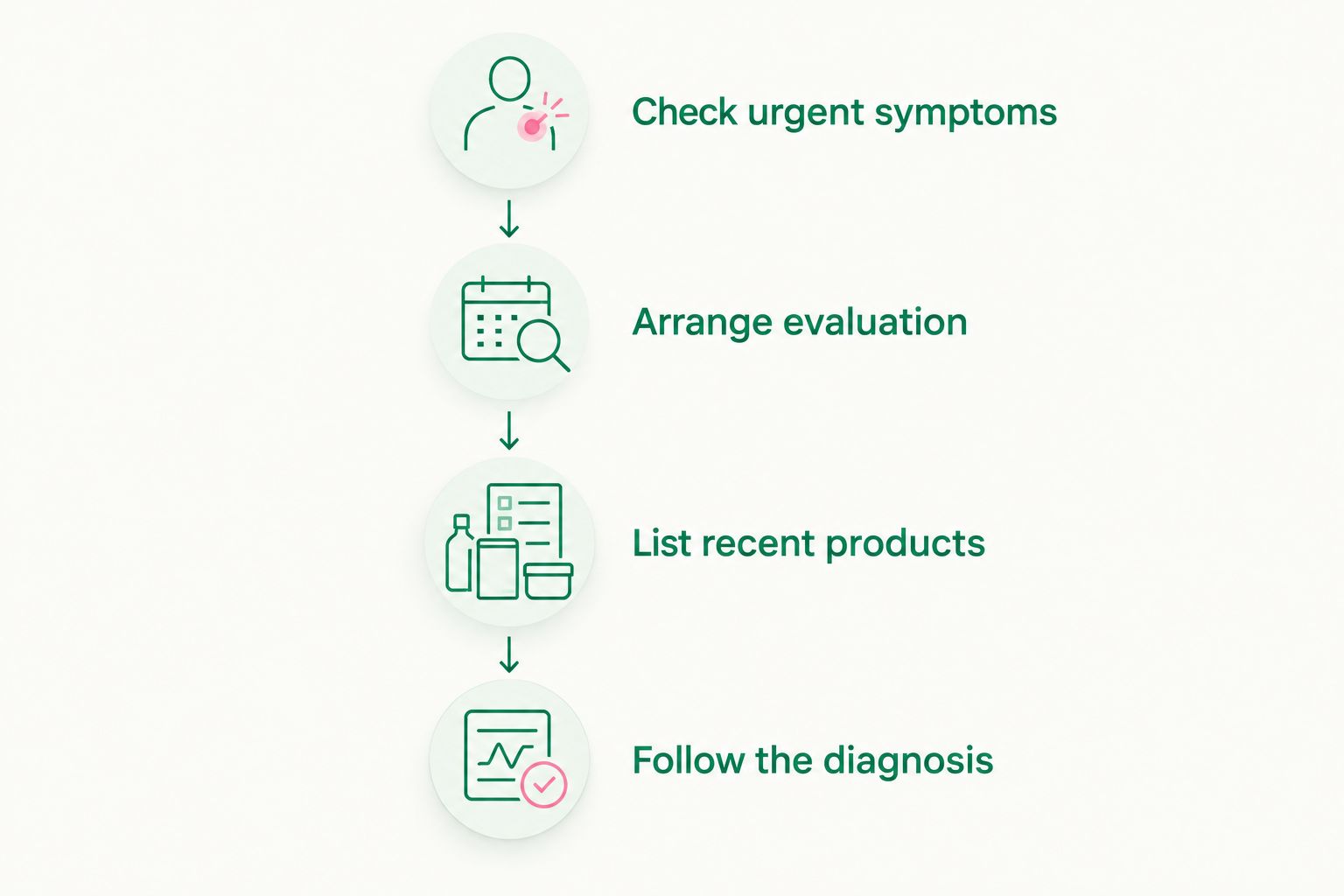
You do not need to arrive with a diagnosis. Describing where symptoms occur, what discharge has changed, and what you have already tried gives the clinician useful information without requiring you to identify the cause yourself.
How long does treatment take once yeast is confirmed?
Treatment length depends on the diagnosis, severity, medicine, and pregnancy status. Do not apply a medication schedule to an untreated infection or assume every vaginal antifungal has identical instructions.
CDC guidance includes short-course topical regimens for uncomplicated yeast infections. For severe vulvovaginal candidiasis, the guidance includes 7–14 days of topical azole treatment as an option. That longer course addresses a different clinical situation; it is not a reason to extend an over-the-counter product on your own.
During pregnancy, CDC recommends 7 days of topical azole therapy for vaginal yeast infections. Contact your prenatal clinician before treating suspected symptoms. Oral fluconazole and boric acid are not substitutes for that pregnancy-specific recommendation.
For this 2026 guide, these durations describe general clinical guidance—not evidence that any particular branded care formula cures yeast. Follow your prescribed or labeled course, even if discomfort eases earlier, and ask for reassessment if symptoms persist.
Is a shorter treatment course always better?
A shorter course is not automatically better for severe, recurrent, or complicated symptoms. The advantage is fewer treatment days when the medicine is appropriate; the limitation is that convenience cannot determine whether the treatment fits your diagnosis.
Ask the clinician or pharmacist how to use the exact formulation. Do not combine regimens or repeat treatment simply because another product advertises a different course length.
When do repeated symptoms count as recurrent yeast infections?
CDC defines recurrent vulvovaginal candidiasis as three or more symptomatic episodes in less than one year. Repeated symptoms deserve confirmation because not every episode of itching represents another yeast infection.
If symptoms persist after an over-the-counter treatment, or return within two months after treatment, CDC recommends clinical evaluation and testing. That threshold is a reason to seek care, not permission to wait two months while uncomfortable.
Bring a short record of prior diagnoses, medicines, and symptom-free intervals. Include diabetes, recent antibiotic use, and medicines affecting your immune system. A clinician can use that history to decide whether testing or a maintenance treatment plan is appropriate.
Repeated antifungals have a clear limitation: they do not treat BV, sexually transmitted infections, or contact dermatitis. A familiar symptom is not always a familiar diagnosis.
Can sex or a partner explain why symptoms keep returning?
Vaginal yeast infections are not usually acquired through sexual intercourse. CDC guidance does not support routinely treating partners for uncomplicated vaginal yeast infections. That differs from infections for which partner testing and treatment are central to preventing reinfection.
A partner's symptoms still deserve attention. Redness, itching, or irritation of the penis can have several causes; penile yeast infections are one possibility, but symptoms alone cannot establish the diagnosis or prove that partners are passing an infection back and forth.
If sex hurts, stop until you are comfortable and have an appropriate care plan. Friction can aggravate inflamed tissue. Some vaginal antifungal creams and suppositories are oil-based and can weaken latex condoms or diaphragms, so check the medicine's instructions rather than assuming your usual barrier method is unaffected.
Avoid assigning blame. Tell the clinician about new partners, possible STI exposure, and any partner symptoms so testing decisions reflect your situation rather than assumptions about yeast.
Can boric acid, probiotics, or feminine wash replace treatment?
These products are not interchangeable with a diagnosis-directed antifungal regimen. External cleansing, intravaginal treatment, and symptom comfort each have different purposes. Buying more categories at once does not make a treatment plan more precise.
Boric acid has a limited place in clinical guidance for certain recurrent non-albicans yeast infections. It is not the default first treatment for unexplained itching. Never swallow boric acid, keep it away from children, and do not use vaginal boric acid during pregnancy; discuss use with a clinician if you are trying to conceive.
CDC states that substantial evidence does not support probiotics for treating vulvovaginal candidiasis. Evidence about a general ingredient or treatment approach also does not establish that a specific commercial formula treats an infection.
Kushae's OB/GYN-developed vulvovaginal care line includes the Gentle 2-N-1 Foaming Feminine Wash, an external cleansing option. Its role is separate from antifungal treatment: an external wash does not treat vaginal yeast or BV. Sensitive skin can react to care products, so stop use if irritation develops.
For purchasing decisions in 2026, choose by intended use rather than by the promise of feeling cleaner. Read the application site, ingredients, directions, and warnings. Do not insert an external product or assume an itching cream contains an antifungal medicine.
What can you do for comfort while arranging care?
Keep external care simple and avoid adding products that sting. Gentle care can reduce additional irritation, but it does not establish or treat the underlying diagnosis.
- Wash the external vulva gently with lukewarm water; do not scrub.
- Avoid douching or putting cleansing products inside the vagina.
- Change out of damp clothing when practical and choose comfortable clothing that does not rub.
- Avoid fragranced sprays or wipes on irritated tissue.
- Tell your clinician if a product causes burning, swelling, or worsening discomfort.
Do not insert yogurt, essential oils, garlic, or household remedies into the vagina. CDC guidance does not establish these as treatments for vaginal yeast infections, and unproven approaches can delay effective care.
If you already started treatment, record the product and dates rather than layering on something new. That history helps distinguish ongoing infection, a reaction to a product, and a different cause of symptoms.
FAQ
Will a vaginal yeast infection go away without treatment?
There is no dependable timeline for an untreated vaginal yeast infection to resolve. Symptoms sometimes settle, but persistent or unfamiliar symptoms need evaluation because itching and discharge do not identify yeast on their own.
Can I leave a suspected yeast infection untreated for a week?
A week is not a validated safe waiting period for an unconfirmed yeast infection. Arrange care for a first episode, persistent symptoms, pregnancy, or uncertainty; seek prompt care for fever or pelvic pain.
How long does a severe yeast infection need treatment?
CDC guidance includes 7–14 days of topical azole treatment for severe vulvovaginal candidiasis. A clinician should select the regimen; this is not an untreated recovery estimate.
When should I get checked if symptoms return after treatment?
Symptoms returning within two months after yeast treatment need clinical evaluation and testing under CDC guidance. Persistent symptoms after an over-the-counter treatment also warrant assessment.
Does vaginal odor mean I have a yeast infection?
Vaginal odor alone does not diagnose a yeast infection. A new strong or fishy odor, especially with changed discharge, needs assessment for BV and other causes rather than automatic antifungal treatment.
Can I use boric acid if I am pregnant?
Do not use vaginal boric acid during pregnancy. Contact your prenatal clinician about suspected yeast symptoms; CDC recommends seven days of topical azole therapy during pregnancy.
Can a feminine wash cure a vaginal yeast infection?
An external feminine wash cannot cure a vaginal yeast infection. External vulvar cleansing and treatment inside the vagina serve different purposes, and excessive washing can worsen irritation.
One last thing
Candida can be present without causing an infection. CDC guidance states that finding yeast without symptoms or signs is not an indication for treatment. A test result, symptoms, and examination need to be interpreted together.
The practical recommendation is simple: do not chase a completely odorless vagina or keep treating every change as yeast. Seek a clear diagnosis, use the appropriate treatment, and give irritated external skin fewer products to contend with.
Medical sources
Clinical references for this 2026 guide: CDC, STI Treatment Guidelines: Vulvovaginal Candidiasis, covering diagnosis, recurrence, treatment, pregnancy, probiotics, and partner management; and the American College of Obstetricians and Gynecologists, Vaginitis, covering symptoms, evaluation, and vulvovaginal care. These references support general education, not claims of effectiveness for a specific Kushae formula. This article does not diagnose your symptoms.


