


This article is for informational purposes only. It is not, nor is it intended to be, a substitute for professional medical advice, diagnosis, or treatment and should never be relied upon for specific medical advice.
There is no fixed number of hours or days for vaginal pH to rebalance; the timeline depends on whether the change is temporary or linked to BV, another infection, or lower estrogen. A temporary pH change and an infection need different care, and symptom relief does not prove that your vaginal microbiome has recovered. Persistent odor, discharge, burning, or itching needs an assessment—not a countdown.
TL;DR
- How long does it take for vaginal pH to rebalance? There is no universal recovery timeline.
- CDC guidance uses specific BV treatment courses, not a guaranteed deadline for vaginal pH recovery.
- Kushae external vulvar care does not diagnose or treat BV inside the vagina.
- Persistent vaginal odor, unusual discharge, or recurring irritation calls for medical evaluation.
Why this matters
Vaginal odor does not mean you are unclean. Trying to remove it with repeated washing, douching, or several new products can add irritation without addressing the cause.
The useful question in 2026 is not simply how quickly you can lower a pH reading. It is whether you have a temporary change, an infection requiring treatment, or sensitive external skin that needs a different routine. If you are choosing a feminine wash for sensitive skin, keep that decision separate from treating vaginal symptoms.
The vulva is external skin; the vagina is the internal canal. An external cleanser does not reach or treat an infection inside the vagina, and a product labeled pH-balanced does not establish that you need treatment.
How long does it take for vaginal pH to rebalance?
There is no medically established, universal recovery time after sex, menstruation, BV, or a change in products. A treatment schedule is not the same thing as a measured return to your usual vaginal environment.
CDC bacterial vaginosis guidance lists these commonly used prescription regimens. They illustrate why a blanket promise of overnight recovery is misleading; they are not instructions to select or start medication yourself.
| Situation or treatment | Established timeline | Best for | Important limit |
|---|---|---|---|
| Temporary change after semen or menstrual blood exposure | No universal recovery deadline | Observation when you have no symptoms | Persistent symptoms require assessment |
| Oral metronidazole for diagnosed BV | 7-day treatment course | Patients prescribed oral BV treatment | Completing treatment does not guarantee BV will never recur |
| Vaginal metronidazole gel for diagnosed BV | 5-day treatment course | Patients prescribed this vaginal treatment | Follow the prescribed formulation and instructions |
| Vaginal clindamycin cream for diagnosed BV | 7-day treatment course | Patients prescribed this alternative | Product-specific precautions matter, including effects on latex barriers |
| External cleansing | No established internal pH-recovery timeline | Cleaning external vulvar skin | Does not treat BV or rebalance the internal vaginal microbiome |
Medical reference for this 2026 comparison: CDC, STI Treatment Guidelines, Bacterial Vaginosis. Scope: recommended BV regimens, diagnosis, recurrence, and follow-up—not evidence for any particular retail formula.
If a clinician prescribes treatment, finish it exactly as directed even if odor improves sooner. If symptoms remain after treatment or return later, contact the prescriber rather than repeating leftover medication or adding suppositories on your own.
After sex or your period: symptoms matter more than the clock
Semen and menstrual blood can affect vaginal pH. That does not mean every change needs an acidifying product, an antibiotic, or an internal cleanse.
Notice what accompanies the change. An unfamiliar smell with discharge, burning, itching, or pain deserves a different response from a brief change without discomfort. You cannot reliably distinguish these situations with smell alone.
Avoid assigning yourself a deadline based on someone else's experience. The statement that another person's odor disappeared overnight tells you nothing about whether your symptoms have the same cause.
For this 2026 guide, the recommendation is straightforward: do not douche or wash inside the vagina to speed recovery. CDC guidance advises against douching and identifies it as a factor associated with BV and relapse.
If symptoms repeatedly follow sex or menstruation, record that pattern for your appointment. Timing helps a clinician assess the problem; it does not establish the diagnosis.
With BV: follow the treatment course, not a pH target
BV involves a shift in vaginal bacteria. An elevated pH can support the diagnosis, but clinicians also consider symptoms and findings from appropriate testing.
The 7-day oral metronidazole course is a treatment duration, not a promise that every symptom or microbiome change resolves on the same day. The same distinction applies to the 5-day vaginal metronidazole gel course.
Do not stop prescribed treatment because a home strip looks normal. A reading cannot establish that treatment has succeeded, and a higher reading does not tell you which medication you need.
CDC guidance states that routine follow-up is unnecessary when BV symptoms resolve, but recurrent or persistent symptoms warrant reassessment. That gives you a more useful endpoint than repeatedly testing until you see a preferred color.
If BV keeps returning, ask about a recurrence plan. The conversation should cover how the diagnosis was confirmed, previous treatments, symptom patterns, and whether another condition needs to be ruled out—not simply which product to add next.
With lower estrogen: the issue is not always a temporary disruption
Lower estrogen around menopause can change vaginal tissue and the vaginal environment. Dryness, burning, discomfort during sex, and urinary symptoms can accompany those changes.
This is not automatically BV, and repeatedly treating yourself for an infection can delay the right care. A clinician can assess whether symptoms reflect genitourinary syndrome of menopause, an infection, a skin condition, or more than one problem.
Ask about treatment matched to the cause. A wash cannot replace care for estrogen-related tissue changes, and an internal acidifying product is not a universal answer to dryness.
Medical reference for this 2026 section: the American College of Obstetricians and Gynecologists' patient guidance on vaginal dryness and vulvovaginal health. Scope: hormone-related symptoms and care options, not endorsement of a brand.
Why vaginal pH recovery varies
The cause matters more than a generic recovery estimate. These factors change how your symptoms should be interpreted and what care makes sense:
- The underlying condition. BV, trichomoniasis, yeast infection, and external irritation are different problems. They do not share a single treatment.
- Recent exposure. Semen and menstrual blood can affect the vaginal environment and the interpretation of a home pH result.
- Hormonal changes. Lower estrogen changes vaginal tissue and can contribute to symptoms that resemble infection.
- Douching and irritants. Internal cleansing and irritating products can complicate symptoms rather than correct their cause.
- Persistent or recurrent disease. Symptoms that never clear need reassessment; symptoms that return need a plan based on a confirmed diagnosis.
These factors are reasons to individualize care, not reasons to blame yourself. You do not need to achieve a particular smell or keep testing a symptom-free vagina to prove that it is healthy.
What should you do while you are waiting for answers?
Start by separating external discomfort from internal symptoms. Then simplify your routine so that new products do not obscure what is happening.
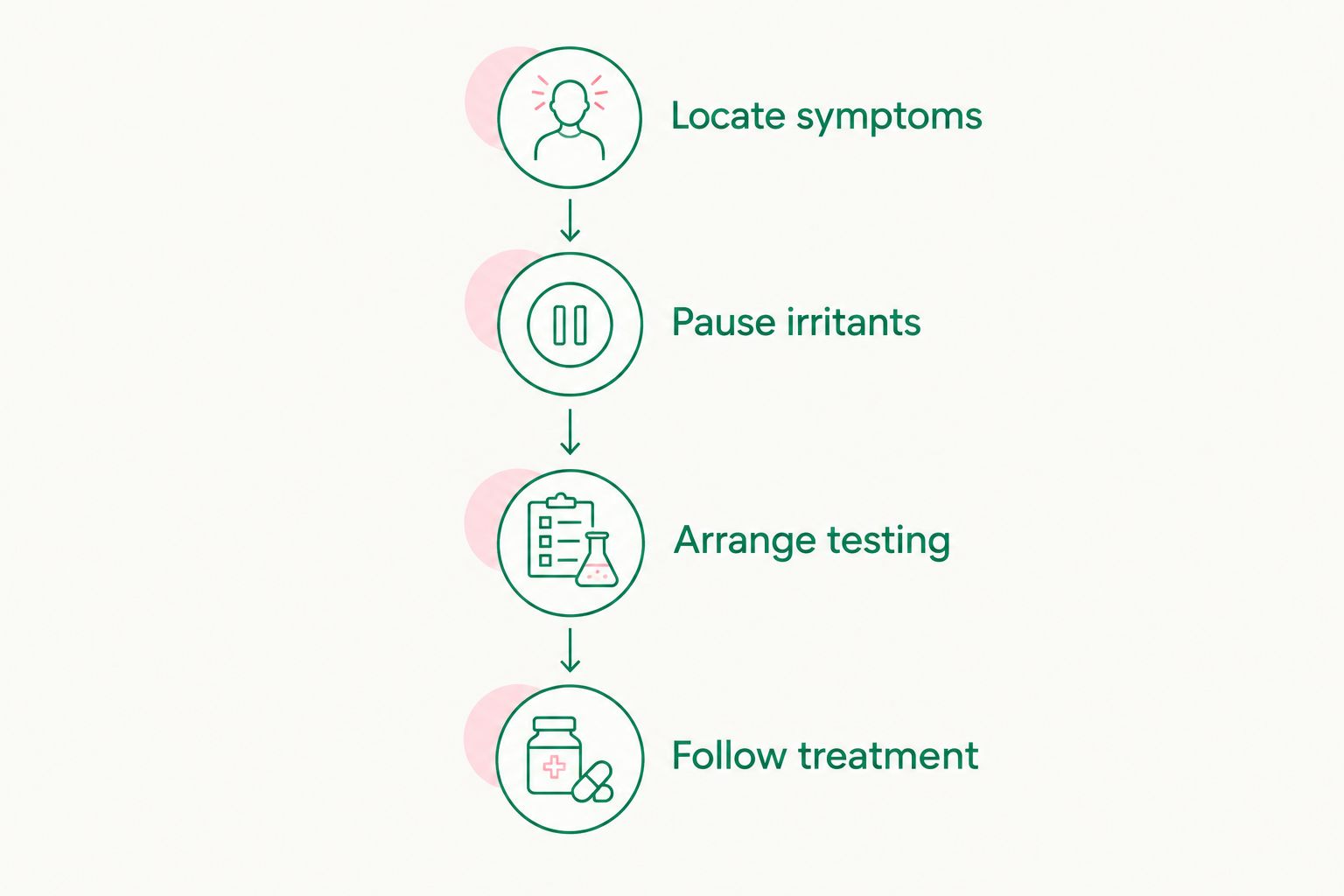
- Locate symptoms. Note whether burning or itching affects the vulvar skin, feels internal, or occurs during urination or sex.
- Pause irritants. Stop douching and discontinue newly introduced products that cause burning or irritation. Do not stop prescribed treatment without contacting your clinician.
- Arrange testing. Seek an assessment for persistent odor, unusual discharge, recurring symptoms, or possible STI exposure.
- Follow treatment. Use medication only as prescribed and ask what to do if symptoms remain or return.
Bring a list of everything you have used, including washes, suppositories, creams, and recent medications. Tell the clinician when you last used an intravaginal product and ask whether it affects the timing of testing. That information helps make the visit more useful.
Can a home pH test tell you what is wrong?
A home pH test cannot diagnose BV, yeast infection, or trichomoniasis by itself. It measures acidity, not the identity of the organism or the reason for your symptoms.
CDC diagnostic guidance uses a vaginal pH above 4.5 as one finding associated with BV. That cutoff is not a treatment target for everyone: menopausal status, recent exposures, and the broader clinical picture matter.
Yeast infections generally occur with a vaginal pH below 4.5. A reading in that range therefore does not rule out an infection or explain ongoing itching.
Trichomoniasis can also involve an elevated pH and symptoms that overlap with BV. The causes of trichomoniasis involve infection with a sexually transmitted parasite, not simply a pH imbalance that an external wash can correct. Possible exposure calls for testing and appropriate treatment.
Medical reference for these testing distinctions: CDC, STI Treatment Guidelines, sections on vaginal discharge, bacterial vaginosis, vulvovaginal candidiasis, and trichomoniasis. These are diagnostic principles referenced in this 2026 guide, not a substitute for individual testing.
Where do washes and boric acid fit?
Kushae is best for women seeking OB/GYN-developed vulvovaginal care products, not a substitute for diagnosing persistent symptoms. Product choice should follow the location and cause of the concern.
The Kushae Gentle 2-N-1 Foaming Feminine Wash belongs in external vulvar care, not inside the vagina. Its role is cleansing; it does not treat BV, establish your diagnosis, or provide a proven internal pH-recovery deadline. Stop using a cleanser if it causes irritation.
Kushae's boric acid suppositories are a separate intravaginal product category. CDC guidance includes vaginal boric acid in certain clinician-directed regimens for recurrent BV and specific recurrent yeast infections; that general clinical guidance does not prove the effectiveness of a particular retail formula.
Do not swallow boric acid. Keep it away from children and pets, and do not use vaginal boric acid during pregnancy. If you are trying to conceive or pregnancy is possible, ask your clinician before use.
Do not combine internal products to chase a faster result. Ask whether boric acid fits your confirmed diagnosis, whether it belongs alongside prescribed treatment, and what symptoms mean you should stop and seek care.
When should you stop waiting and get medical care?
Arrange an appointment for persistent or recurring odor, unusual discharge, itching, burning, or pain during sex. Seek assessment after possible STI exposure rather than assuming that pH is the whole explanation.
Get prompt medical attention for pelvic or lower abdominal pain, fever, or symptoms during pregnancy. Severe pain, fainting, or feeling acutely unwell needs urgent assessment.
If treatment has finished and symptoms remain, contact the prescriber. A different diagnosis, recurrence, or another condition can require a different approach; repeating the same self-treatment is not a reliable next step.
Before leaving an appointment, ask what improvement should look like and when to call back. That individualized plan is more actionable than a universal number of days.
FAQ
How long does it take for vaginal pH to rebalance naturally?
There is no universal timeline for vaginal pH to rebalance naturally. Temporary changes and infections require different responses; persistent odor, discharge, itching, or burning needs assessment.
How long does BV treatment take?
Common CDC-recommended BV regimens include a 7-day oral metronidazole course or a 5-day vaginal metronidazole gel course. Follow your own prescription; treatment duration is not a guaranteed pH-recovery deadline.
Can I have a yeast infection if my vaginal pH is normal?
Yes, a yeast infection generally occurs with a vaginal pH below 4.5. A home pH result cannot rule out yeast or identify the cause of itching.
Will a pH-balanced feminine wash fix BV?
No, an external feminine wash does not treat BV inside the vagina. External vulvar cleansing and treatment of a diagnosed vaginal infection serve different purposes.
Should I use boric acid whenever my vaginal pH is high?
No, a high pH reading alone is not a reason to start boric acid. Ask a clinician whether it fits your diagnosis, and never swallow it or use it during pregnancy.
Can sex change my vaginal pH?
Yes, semen exposure can affect vaginal pH. Persistent odor, discharge, or discomfort after sex still requires assessment rather than an assumption that the change is temporary.
How do I know whether my vaginal pH is back to normal?
A home pH reading alone cannot confirm recovery from an infection. Follow your treatment plan and seek reassessment if symptoms persist or return; repeated testing is not a substitute for diagnosis.
One last thing
A normal pH reading can coexist with a yeast infection. The number is one clue, not a clean bill of health.
Your next move is to match care to symptoms and diagnosis—not make the test strip change color. For your 2026 care routine, write down what changed, what you used, and whether symptoms returned; bring that history to your clinician instead of buying another product to chase a deadline.


