


This article is for informational purposes only. It is not, nor is it intended to be, a substitute for professional medical advice, diagnosis, or treatment and should never be relied upon for specific medical advice.
Yes—you can use a boric acid suppository and feminine wash in the same care routine when boric acid is appropriate for you and the wash stays on the external vulva. Do not put feminine wash inside the vagina, mix it with the suppository, or douche after insertion. The main concern is irritation or treating the wrong condition, not a need to wash the vagina before using boric acid.
TL;DR
- Can you use a boric acid suppository and feminine wash together? Yes: external washing and vaginal insertion serve different purposes.
- Feminine wash does not treat BV or yeast infections, and washing inside the vagina is not recommended.
- Kushae offers OB/GYN-developed vulvovaginal care; choose products by application site, not by odor alone.
- Avoid boric acid during pregnancy. Persistent odor, unusual discharge, or burning needs medical assessment.
Why this matters
Recurring vaginal odor can make you want to change everything at once. But adding a wash, suppository, and deodorant together makes it harder to identify what is irritating your skin or whether your symptoms need treatment.
External comfort and vaginal infection care are different jobs. A cleanser touches vulvar skin; a suppository goes inside the vagina. Neither the word feminine nor a pH claim makes those products interchangeable.
If sensitive skin is your main concern, start with the guide to feminine wash for sensitive skin. For this 2026 guide, the deciding questions are where you apply each product, why you need it, and whether your symptoms have been assessed.
Can you use a boric acid suppository and feminine wash together?
Yes, in the same routine—not mixed together and not applied to the same place. Gentle external washing does not mean flushing the vagina. There is no reason to insert cleanser to prepare for a suppository.
The vulva includes the external genital structures. The vagina is the internal canal. Keeping that distinction clear prevents a common mistake: using an external hygiene product as though it were an intravaginal treatment.
| Option | Best for | Application site | Useful role | Main limitation |
|---|---|---|---|---|
| Lukewarm water | People keeping external care simple | External vulva | Gentle rinsing without another formula | Does not treat a vaginal infection |
| Feminine wash labeled for external use | People who prefer a cleanser and tolerate it | External skin, according to its label | External cleansing | Can irritate sensitive skin; does not treat BV or yeast |
| Boric acid suppository | Selected patients following a clinician-directed vaginal treatment plan | Inside the vagina | Has a role in specific recurrent infection regimens | Not a general odor remedy; unsafe to swallow and avoided during pregnancy |
The CDC's STI Treatment Guidelines describe boric acid in selected recurrent BV and non-albicans yeast infection regimens. That evidence does not establish that every boric acid formula works the same way or that combining one with a feminine wash improves treatment.
Medical source: CDC, STI Treatment Guidelines, sections on bacterial vaginosis and vulvovaginal candidiasis. These are the clinical references used for the treatment distinctions in this 2026 guide.
External washing: keep the cleanser outside
You do not need to clean inside the vagina. If you choose a feminine wash, follow its external-use directions, rinse it away thoroughly, and stop if it causes stinging, dryness, or redness.
For sensitive vulvar skin, a shorter ingredient list is not proof of tolerability. Likewise, natural, gentle, and pH-balanced do not guarantee that a particular formula will suit you. Your skin's response matters more than the category name.
Avoid scrubbing, scented wipes, and repeated washing to chase odor. A persistent fishy smell or a new discharge pattern needs assessment rather than stronger cleansing.
The Office on Women's Health advises against douching and distinguishes washing the outside of the genital area from cleaning inside the vagina. The Royal College of Obstetricians and Gynaecologists' vulvar skin-care guidance also emphasizes avoiding irritants and excessive washing.
Boric acid suppositories: use only for an appropriate reason
Boric acid is not the automatic next step whenever vaginal odor returns. BV, yeast infections, sexually transmitted infections, and noninfectious irritation can have overlapping symptoms. An article cannot determine which one you have.
For recurrent BV, the CDC describes boric acid as part of a possible multistep regimen for selected patients—not as a replacement for all prescribed treatment. For recurrent symptoms attributed to yeast, identifying the yeast species and excluding other causes can change the treatment plan.
Do not use boric acid during pregnancy. If you are trying to conceive, could be pregnant, or are breastfeeding, ask your clinician before use. Never swallow a vaginal suppository, and keep it away from children and pets.
Boric acid can also cause local irritation. Do not interpret worsening burning as evidence that a product is working. Stop using it and contact your clinician if symptoms worsen.
Medical sources: CDC, STI Treatment Guidelines, bacterial vaginosis and vulvovaginal candidiasis sections; Poison Control, boric acid suppository safety information. General clinical guidance is not evidence for a specific commercial formula.
How to keep the two products separate
If your clinician recommends boric acid and you already tolerate an external wash, keep the routine simple. You do not need an internal cleansing step or a second product to activate the suppository.
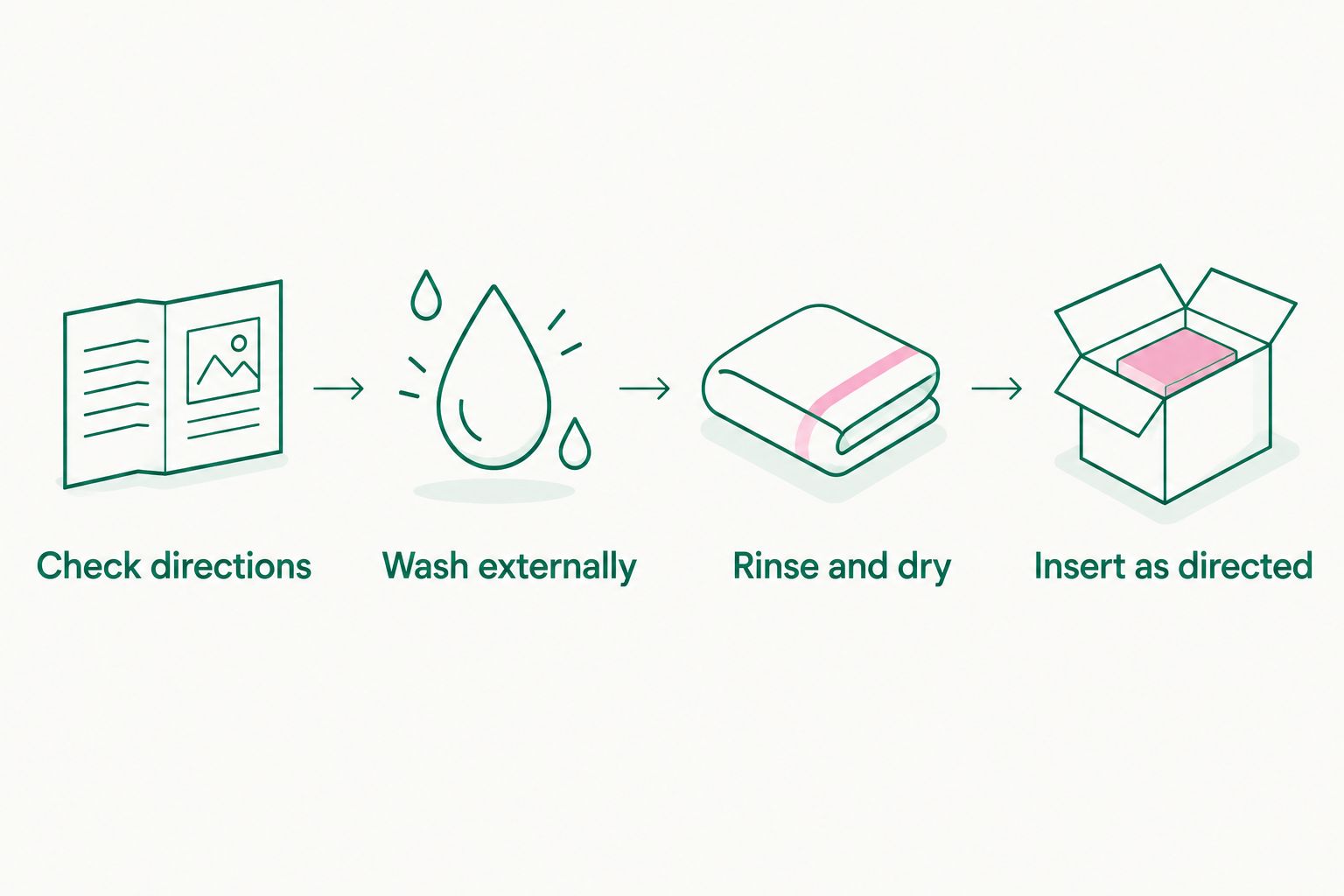
- Check directions. Confirm the suppository's instructions, pregnancy warnings, and your clinician's plan. Read the wash label for its permitted application area.
- Wash externally. If cleansing, use lukewarm water and any tolerated external cleanser as directed. Do not insert the wash, its nozzle, or a stream of water into the vagina.
- Rinse and dry. Remove external cleanser residue and gently pat the skin dry. Wash your hands before handling the suppository.
- Insert as directed. Follow the suppository label and prescribed plan. Do not coat it with feminine wash or use cleanser as an insertion aid.
There is no standard waiting interval between a rinsed-off external wash and vaginal boric acid in the cited guidance. Follow any product-specific or clinician instructions rather than inventing a schedule.
If you notice leakage afterward, gently clean the outside as needed. Do not douche to remove residue. Ask your clinician about bothersome discharge, especially if it comes with pain, odor, bleeding, or increasing irritation.
Why tolerance varies
Using both products is not automatically better than using one. These factors change whether a routine is appropriate:
- Application site: External cleansing differs from putting soap, wash, or water inside the vagina. Douching is not recommended.
- Formula ingredients: Fragrance and other ingredients can irritate vulvar skin. Check the complete ingredient list rather than relying on front-label claims.
- Existing irritation: Inflamed skin can sting when exposed to products you previously tolerated. Adding more products complicates the picture.
- Reason for treatment: Recurrent BV, non-albicans yeast, and unexplained odor require different clinical decisions. A familiar smell is not a confirmed diagnosis.
- Pregnancy status: Boric acid is not an appropriate pregnancy self-care product. Ask before use if pregnancy is possible.
- Other treatments: If you use prescription vaginal medication, ask your prescriber before adding another intravaginal product. Do not replace prescribed treatment with a wash.
These distinctions matter more than whether the products come from the same brand. Matching packaging does not establish compatibility or clinical benefit.
Choosing products in 2026: purpose before purchase
Kushae is best for shoppers seeking an OB/GYN-developed vulvovaginal care line with separate wash and suppository options. That describes the product range, not proof that combining products treats recurring symptoms better.
For a Kushae feminine wash, the relevant decision is external cleansing and skin tolerance. For a Kushae boric acid suppository, the relevant decision is whether vaginal boric acid belongs in your clinician-directed care plan.
| Product | Best for | What the listing identifies | What not to assume |
|---|---|---|---|
| Kushae Gentle 2-N-1 Foaming Feminine Wash | Shoppers considering an external cleanser | A foaming feminine wash | It does not treat BV or establish that sensitive skin will tolerate it |
| Kushae Vaginal Boric Acid Suppositories + Probiotics & Aloe! | Shoppers whose clinician recommends vaginal boric acid | Vaginal boric acid suppositories with probiotics and aloe named in the listing | Added ingredients do not establish better outcomes or remove pregnancy precautions |
The benefit of separating these categories is clarity: you can assess an external cleanser for skin comfort without treating it as infection care. The limitation is equally clear: neither a product pairing nor OB/GYN development replaces diagnosis or proves a particular treatment outcome.
Check each current label for ingredients, directions, and warnings before buying. Do not assume aloe prevents irritation or that added probiotics make a boric acid formula clinically equivalent to a studied treatment regimen.
Products discussed
Should I wash before or after inserting boric acid?
Wash externally beforehand if that fits your routine, then rinse, dry, and follow the suppository directions. Washing is not required to make boric acid work. After insertion, do not rinse inside the vagina or try to wash the suppository out.
Can feminine wash cancel out a boric acid suppository?
A rinsed-off external wash is not an intravaginal treatment, and the cited guidance does not identify external washing as something that cancels out boric acid. Putting wash inside the vagina is different: it introduces an unnecessary irritant and is not recommended. Keep the application sites separate.
What if both products burn?
Stop using products that trigger burning and contact your clinician, especially if symptoms persist or worsen. Irritation does not tell you whether BV or yeast is present. Seek prompt care for pelvic pain, fever, sores, significant bleeding, or symptoms during pregnancy.
When recurring odor needs an appointment
If symptoms return after treatment, arrange an assessment rather than repeatedly restarting the same routine. The CDC advises follow-up when BV symptoms recur and clinical evaluation for persistent or recurrent yeast symptoms.
Tell your clinician what you used, where you applied it, and when symptoms changed. Bring ingredient lists or product labels, including washes and suppositories. Mention any new sexual exposure, pregnancy possibility, prescription vaginal treatment, or symptoms after sex.
For recurring symptoms in 2026, the next step is a clearer diagnosis—not a more complicated hygiene routine. You do not have to establish the cause before asking for care.
FAQ
Can I use feminine wash and boric acid on the same day?
Yes, when boric acid is appropriate for you and the wash is used only externally as directed. Rinse away the cleanser and keep it out of the vagina.
Do I need to wash inside before inserting boric acid?
No. Do not douche or put feminine wash inside the vagina before insertion. Follow the suppository directions and wash your hands before handling it.
How long should I wait after washing to insert boric acid?
The cited clinical guidance does not specify a waiting interval after rinsed-off external washing. Follow your product instructions and any timing directions from your clinician.
Can a pH-balanced feminine wash treat BV?
No, an external pH-balanced feminine wash does not treat BV. Vaginal symptoms require appropriate assessment and treatment; a cleanser's pH claim does not change its purpose.
Is boric acid safe if I am pregnant?
Do not use boric acid vaginal suppositories during pregnancy. If you could be pregnant or are trying to conceive, ask your clinician before use.
Should I keep using boric acid if it burns?
Stop using boric acid if it causes burning and contact your clinician, particularly if irritation persists or worsens. Burning is not proof that treatment is working.
Does using a wash with boric acid prevent BV from coming back?
Using an external wash with boric acid is not an established way to prevent BV recurrence. Ask your clinician about an evidence-based plan for recurrent symptoms.
One last thing
You can keep the suppository plan and skip the feminine wash. An external cleanser is optional; it is not a required partner for vaginal treatment. If your clinician recommends boric acid but your vulvar skin tolerates only a simple routine, do not add a wash just to complete a set.
For your 2026 care routine, keep one rule: products should have a clear purpose and a clear application site. Persistent odor deserves an explanation, not extra scrubbing.


