

This article is for informational purposes only. It is not, nor is it intended to be, a substitute for professional medical advice, diagnosis, or treatment and should never be relied upon for specific medical advice.
Some vaginal itching creams are appropriate during pregnancy, but safety depends on the active ingredient, where you apply it, and what is causing the itching. For a diagnosed yeast infection, CDC guidance recommends a topical azole treatment used for 7 days during pregnancy—not oral fluconazole or an unspecified anti-itch cream. In 2026, the practical rule is unchanged: ask your prenatal clinician to confirm the cause and approve the exact product before treatment.
TL;DR
- Is vaginal itching cream safe to use during pregnancy? Some are; your clinician must approve the ingredient and treatment.
- CDC guidance recommends 7-day topical azoles for yeast infections during pregnancy, not oral fluconazole.
- External vulvar creams do not automatically treat vaginal yeast infections or BV.
- Kushae products require individual ingredient review during pregnancy; OB/GYN-developed does not establish pregnancy safety.
Why this matters
Itching does not tell you which treatment you need. Yeast, contact irritation, and other vulvovaginal conditions can cause overlapping symptoms, but they do not respond to the same care.
Pregnancy also changes treatment decisions. Use this answer alongside the feminine care for pregnancy guide, and bring the actual product label to your prenatal clinician rather than asking whether an entire category is safe.
Relieving an itch and treating its cause are different jobs. A cream that reduces discomfort on external skin is not necessarily an antifungal, and an antifungal does not treat bacterial vaginosis.
Is vaginal itching cream safe to use during pregnancy?
Yes, certain treatments are appropriate—but there is no blanket approval for every vaginal itching cream. The CDC's vulvovaginal candidiasis guidance specifies topical azoles for 7 days during pregnancy. The recommendation concerns yeast treatment, not every product marketed for intimate itching.
Use this 2026 comparison to separate the treatment categories before you shop. “Best for” describes each category's clinical role, not permission to start it without medical advice.
| Product or treatment category | Best for | Useful role | Important limit during pregnancy |
|---|---|---|---|
| Clinician-approved topical azole | Diagnosed vaginal yeast infection | Treats the fungal infection | CDC recommends a 7-day course during pregnancy; follow the prescribed route |
| External soothing cream or skin protectant | Clinician-identified external irritation | Supports comfort on vulvar skin when appropriate | Does not establish treatment for yeast or BV; ingredients need review |
| External steroid cream | A diagnosed inflammatory skin condition | Treats inflammation when prescribed appropriately | Strength, location, and duration require clinician instructions |
| External numbing anti-itch cream | Symptom relief when specifically advised | Temporarily reduces itching sensation | Does not treat an infection and can cause irritation |
| Oral fluconazole | Not a self-treatment choice during pregnancy | Used for yeast infections in some nonpregnant patients | CDC advises against its use for vaginal yeast infection during pregnancy |
| Boric acid suppository | Not appropriate during pregnancy | Has uses in selected nonpregnant treatment plans | Do not use during pregnancy |
The CDC recommendation is general clinical guidance. It is not evidence that a particular branded soothing cream, wash, or suppository is safe or effective during pregnancy.
Topical azoles: 7-day treatment for diagnosed yeast infections
For vaginal yeast infections during pregnancy, the CDC recommends only topical azole therapies applied for 7 days. Clotrimazole and miconazole are examples of medicines in this class; your prenatal clinician or pharmacist should identify the appropriate formulation and instructions.
A 1-day or 3-day treatment is not interchangeable with the pregnancy recommendation simply because it contains an antifungal. Do not select the shortest course based on convenience, and do not substitute an external-only cream for a prescribed intravaginal treatment.
Ask these questions before starting:
- Does the clinician think this is yeast, or is testing needed?
- Is this exact formulation suitable during pregnancy?
- Does the medicine go inside the vagina, on external skin, or both under specific instructions?
- What should you do if the treatment causes burning or symptoms continue?
Some vaginal antifungal products can cause local burning or irritation. Tell your clinician about worsening symptoms rather than adding a second anti-itch product to cover them up.
Source: CDC, STI Treatment Guidelines, “Vulvovaginal Candidiasis,” pregnancy and treatment sections. This recommendation addresses diagnosed yeast infections, not all causes of itching.
External vulvar creams: comfort is not infection treatment
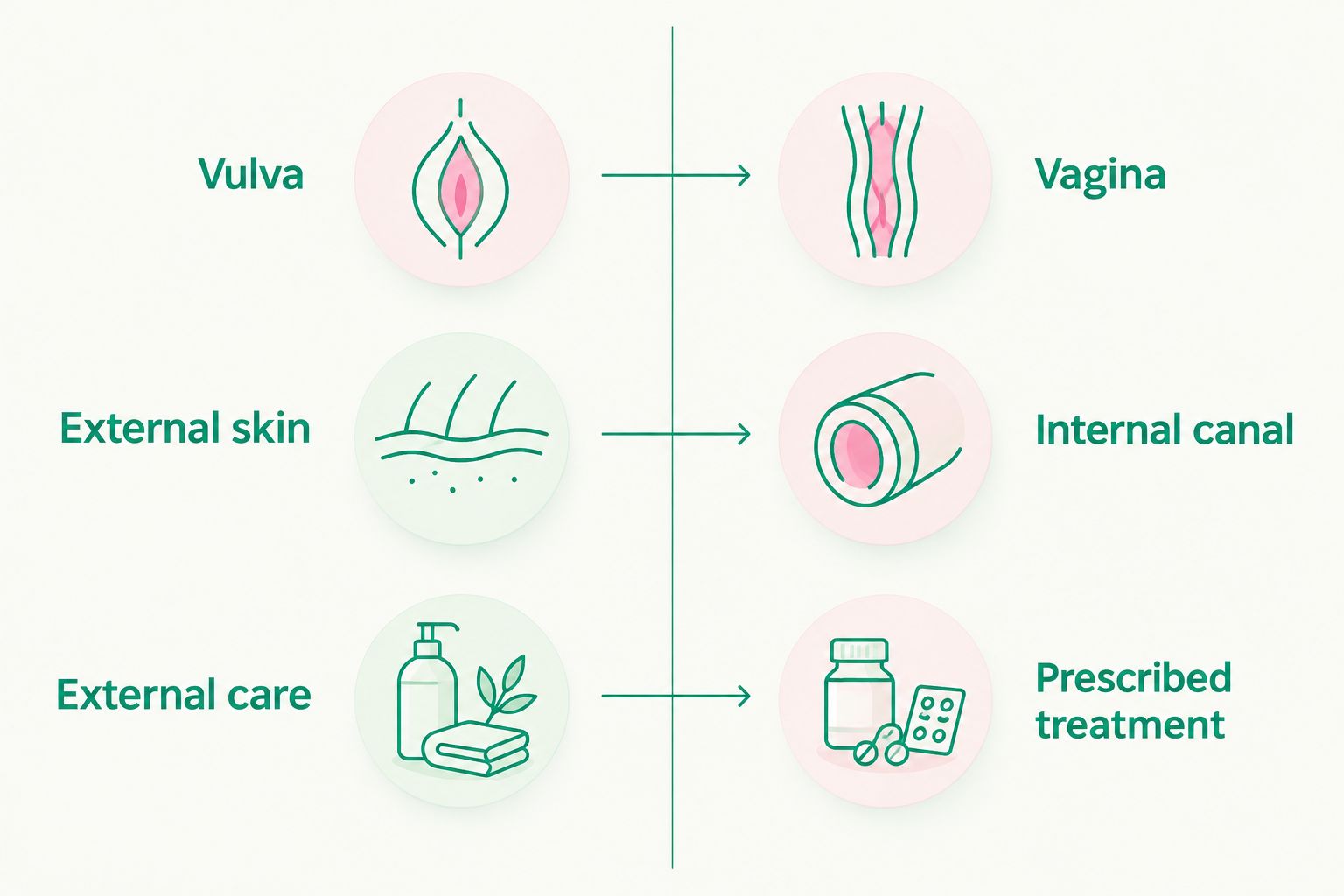
The vulva is the external genital area. The vagina is the internal canal. A product described casually as a vaginal itching cream might actually be intended only for external vulvar skin.
That distinction matters. External irritation from a product or friction needs a different assessment from an infection inside the vagina, even when both feel like itching near the vaginal opening.
A clinician-approved external skin product can have a role when the problem is irritation or a diagnosed skin condition. Its limit is equally important: an external soothing cream does not treat BV, and it does not replace prescribed treatment for a vaginal yeast infection.
Do not insert an external-use cream into the vagina. Avoid assuming that “natural,” “gentle,” or “feminine” on a label establishes pregnancy safety; those words do not identify the active ingredient or the correct application site.
ACOG's patient guidance on disorders of the vulva describes contact dermatitis and other skin conditions as causes of vulvar itching. The practical lesson for your 2026 routine is to identify the cause before adding more products.
Why pregnancy safety varies between itching creams
The word “cream” describes a format, not a safety profile. These factors determine whether a product fits your situation:
- Active ingredient: An antifungal, steroid, anesthetic, and moisturizer perform different jobs. Approval of one does not approve the others.
- Application site: External vulvar skin and the vaginal canal require different instructions. Follow the exact route on the approved treatment.
- Cause of symptoms: Yeast, BV, contact irritation, and skin disorders need different care. Itching alone cannot distinguish them.
- Treatment course: The CDC's pregnancy recommendation for yeast is a 7-day topical azole course, not a shorter-course substitution.
- Skin reaction: Fragrance and other ingredients can irritate sensitive vulvar skin. Stop a newly introduced nonprescription product that clearly worsens symptoms and contact your clinician.
- Pregnancy-specific assessment: Your clinician needs to know you are pregnant, your symptoms, allergies, and what you have already used before advising treatment.
A familiar brand name does not replace this review. Neither does having used the product successfully before pregnancy.
What should you do before using an itching cream?
Use this sequence for a new episode of itching during pregnancy in 2026. It keeps symptom relief separate from diagnosis and avoids treating several possible conditions at once.
- Contact your prenatal team. Describe the itching, discharge, odor, pain, skin changes, and when symptoms started. Explain whether this is a first episode or a recurring problem.
- Show the full label. Provide the active and inactive ingredients, intended application site, and directions. A photo of the packaging helps prevent confusion between similar products.
- Ask whether examination or testing is needed. A previous yeast infection does not prove the current symptoms have the same cause.
- Use only the agreed treatment. Follow the route and course exactly. Do not add boric acid, oral fluconazole, or another cream on your own.
- Report persistent or worsening symptoms. Contact your clinician if treatment does not resolve the problem or symptoms return. Do not keep repeating an unconfirmed treatment.
While you wait for advice, avoid douching and stop newly introduced scented intimate products. Wash external skin gently with lukewarm water, avoid scrubbing, and pat dry.
NHS guidance on thrush in pregnancy advises speaking to a midwife or doctor before treatment. ACOG's vulvar-care guidance also supports avoiding irritating products rather than escalating cleansing.
Can I use a Kushae soothing cream while pregnant?
Kushae is a vulvovaginal care option for women seeking OB/GYN-developed products, not a substitute for prenatal diagnosis. Pregnancy suitability still requires a review of the individual formula and your symptoms.
The Kushae Natural Feminine Soothing Cream is described for concerns involving ingrown hairs and bumps. That description does not establish that it treats vaginal yeast, treats BV, or is suitable for use during pregnancy.
Before choosing Kushae vulvovaginal care, show your prenatal clinician the complete current ingredient list and ask whether the product belongs in your external-care routine. Do not interpret the URL wording or an OB/GYN-developed label as instructions to insert a cream vaginally.
The same boundary applies to washes and balms: external care is not infection treatment. Do not use boric acid suppositories during pregnancy; the brand's supplied boric acid product information explicitly carries that warning.
When should you contact your prenatal clinician urgently?
Do not wait for an itching cream to work if you have vaginal bleeding, leaking fluid, fever, significant pelvic or abdominal pain, or feel seriously unwell. Contact your maternity team promptly for assessment.
New sores, painful urination, strong odor, or unusual discharge also deserve clinical advice. These symptoms do not establish a diagnosis, but they change what your clinician needs to evaluate.
If itching is widespread rather than limited to the vulva—especially on the palms or soles, or worse at night—tell your maternity team promptly. NHS guidance on intrahepatic cholestasis of pregnancy identifies this pattern as a reason for assessment; a genital cream does not address it.
Do not assume every itch in pregnancy is a yeast infection. The location and accompanying symptoms matter more than the product category you initially searched for.
Can a cream treat BV during pregnancy?
A 7-day topical azole course treats yeast, not BV. The CDC recommends treatment for symptomatic BV during pregnancy, but the appropriate antibiotic and formulation require a clinician's diagnosis and instructions.
Some prescribed BV treatments are vaginal preparations. That does not make an over-the-counter soothing cream or feminine wash an equivalent treatment.
Source: CDC, STI Treatment Guidelines, “Bacterial Vaginosis,” pregnancy section. The guidance concerns symptomatic BV and its treatment, not odor masking or external cleansing.
What if itching continues after yeast treatment?
After a 7-day topical azole course, persistent itching needs reassessment rather than automatic retreatment. The diagnosis, a reaction to the product, or another vulvar condition needs consideration by your clinician.
Bring the treatment name and explain whether symptoms improved, stayed unchanged, or worsened. That history is more useful than switching among several creams without a confirmed cause.
FAQ
Is vaginal itching cream safe to use during pregnancy?
Some creams are appropriate during pregnancy, but the active ingredient, diagnosis, and application site determine the choice. Ask your prenatal clinician to approve the exact product; CDC guidance recommends 7-day topical azoles for diagnosed vaginal yeast infections during pregnancy.
Can I use miconazole or clotrimazole while pregnant?
Miconazole and clotrimazole are topical azoles used for vaginal yeast infections, but your prenatal clinician should confirm the product and instructions. CDC pregnancy guidance recommends a 7-day topical azole course.
Can I use a 1-day yeast treatment during pregnancy?
Do not substitute a 1-day treatment for the CDC-recommended 7-day topical azole course during pregnancy. Confirm the formulation and duration with your prenatal clinician or pharmacist.
Can I take oral fluconazole for itching while pregnant?
CDC guidance advises against oral fluconazole for vaginal yeast infection during pregnancy. Ask your prenatal clinician about an appropriate topical treatment after confirming the diagnosis.
Can I put external anti-itch cream inside my vagina?
No—do not insert a product labeled for external use into the vagina. External vulvar care and intravaginal treatment have different purposes and instructions.
Is boric acid safe for vaginal itching during pregnancy?
Do not use boric acid vaginal suppositories during pregnancy. Contact your prenatal clinician for diagnosis and an appropriate treatment instead.
Does a feminine wash treat BV or yeast during pregnancy?
No—an external feminine wash does not treat BV or a vaginal yeast infection. Itching, odor, or unusual discharge needs assessment rather than stronger or more frequent cleansing.
What can I do for external itching while waiting for advice?
Avoid douching, scented intimate products, and scrubbing; gently rinse external skin with lukewarm water and pat dry. Contact your prenatal team about treatment, and seek prompt advice for bleeding, leaking fluid, fever, or significant pain.
One last thing
For your 2026 appointment, bring the tube—not just the product name. Similar packaging can contain different medicines or carry different application instructions.
Ask one specific question: Is this exact ingredient, in this exact formulation, appropriate for my symptoms and pregnancy? That question is more useful than asking whether vaginal itching cream is generally safe.


