


This article is for informational purposes only. It is not, nor is it intended to be, a substitute for professional medical advice, diagnosis, or treatment and should never be relied upon for specific medical advice.
With the right antifungal cream for a yeast infection, vaginal itching should start improving within 3 days, while thrush can take 7–14 days to clear after treatment starts, according to NHS guidance. Early relief does not mean the infection has cleared; finish the labeled treatment course. External soothing creams have no universal relief timeline and do not replace treatment for yeast, bacterial vaginosis (BV), or another cause of itching.
TL;DR
- How long does vaginal itching cream take to work? Antifungal treatment should begin improving yeast-related itching within 3 days.
- NHS guidance says thrush usually clears within 7–14 days after treatment starts; finish the prescribed or labeled course.
- Kushae external soothing care is distinct from vaginal infection treatment; no formula-specific relief timeline is established here.
- Persistent itching, unusual discharge, pelvic pain, or symptoms during pregnancy need medical assessment rather than repeated self-treatment.
Why this matters
The word cream does not tell you what a product treats. An antifungal medicine, an external soothing cream, and a skin barrier balm serve different purposes. Choosing by the promise of fast relief alone can leave the underlying problem untreated.
For your 2026 care decisions, start with the active ingredient and application site—not the phrase feminine care. This guide to vaginal itching creams provides a separate overview of the category, but persistent symptoms still need a diagnosis.
The vulva is external skin; the vagina is the internal canal. A product labeled for external use belongs only on the areas its directions specify, not inside the vagina.
How long does vaginal itching cream take to work?
For clotrimazole used to treat thrush, NHS guidance says external symptoms such as itching should improve within 3 days. NHS guidance on thrush separately says the infection usually clears within 7–14 days of starting treatment. These are different milestones: symptom improvement comes before confirmation that treatment has worked.
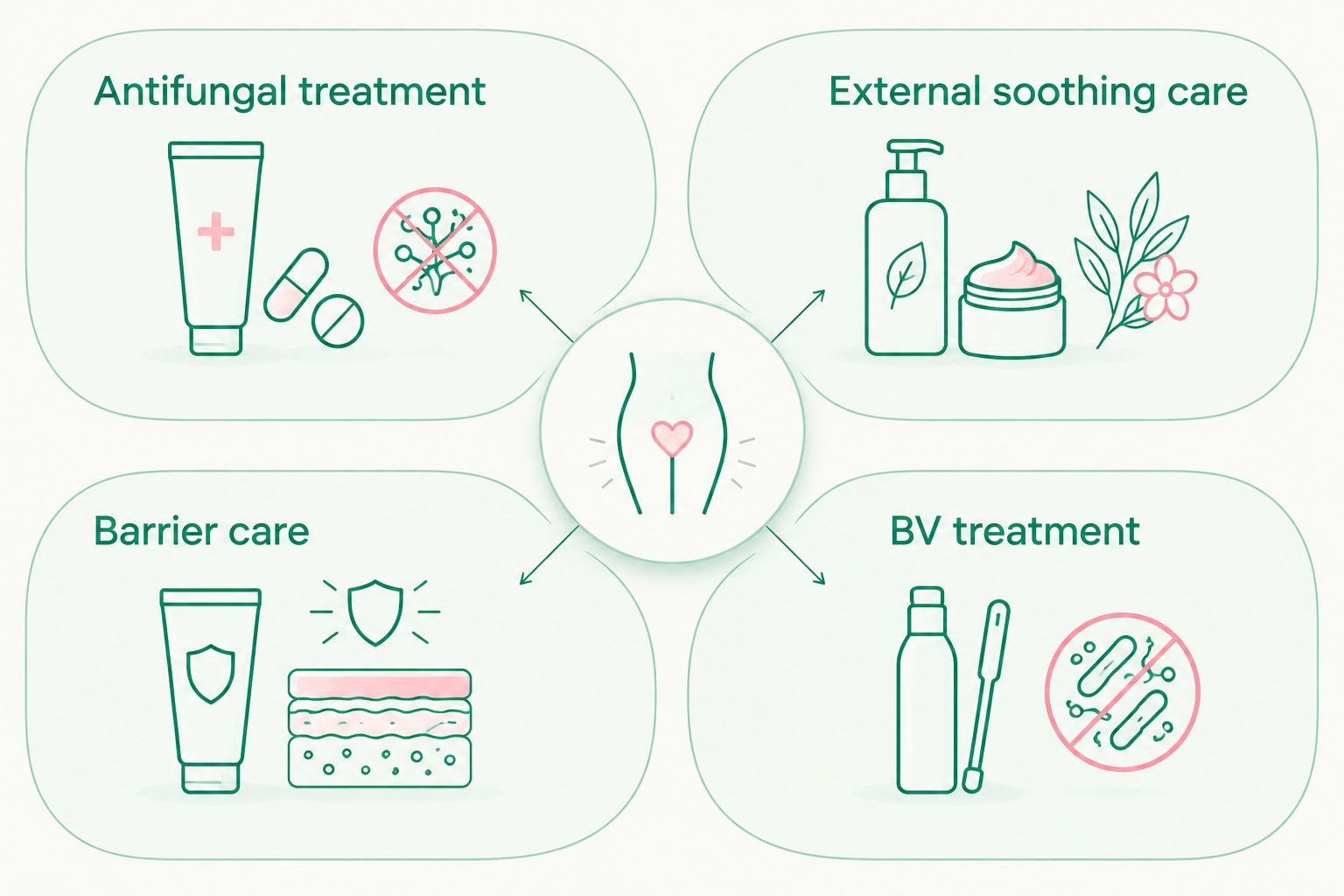
The comparison below separates the main product categories. The timelines describe general medical guidance, not results demonstrated for a particular soothing formula.
| Care category | Best for | What to expect | Main limitation |
|---|---|---|---|
| Antifungal treatment | A yeast infection identified by a clinician or appropriate pharmacist assessment | Clotrimazole-related itching should improve within 3 days; thrush generally clears within 7–14 days after treatment starts | Does not treat BV or every cause of itching |
| External soothing care | External irritation when the label and cause fit | No category-wide onset time; check the specific directions | Symptom comfort does not establish that an infection is treated |
| Barrier care | Protecting external skin from rubbing when appropriate | Assess reduced friction separately from healing | Does not treat a vaginal infection |
| BV treatment | Clinician-diagnosed bacterial vaginosis | Follow the prescribed medicine and reassessment instructions | An external cream is not a substitute for BV medication |
An external antifungal cream also differs from an intravaginal antifungal preparation. Do not assume that a tube intended for the vulva is a complete treatment for an infection inside the vagina. Ask a pharmacist which preparation matches your diagnosis and instructions.
The medical basis for these distinctions is the NHS guidance titled Common questions about clotrimazole for thrush and Thrush in men and women, plus the CDC STI Treatment Guidelines sections on vulvovaginal candidiasis and bacterial vaginosis. This 2026 guide applies that general guidance; it does not establish a response time for any individual brand formula.
Antifungal cream: itching should improve within 3 days
Use the 3-day improvement point as a reason to reassess—not permission to stop treatment. NHS clotrimazole guidance says external itching and discharge should improve within that period. Follow the medicine's own instructions even when you feel better sooner.
Track the direction of the symptoms. Less itching, less soreness, and greater comfort are useful observations, but they do not prove that yeast caused the problem. Temporary relief from a cream cannot confirm a diagnosis.
If symptoms worsen, contact a clinician or pharmacist rather than increasing the amount or frequency yourself. CDC guidance recommends clinical evaluation and testing when symptoms persist after an over-the-counter yeast treatment.
For a 2026 treatment decision, the useful question is not simply whether the cream feels soothing. Ask whether it contains an antifungal medicine, whether it is intended for external or internal use, and whether yeast is the likely diagnosis.
Thrush treatment: clearance usually takes 7–14 days
The 7–14-day clearance window is not an instruction to keep applying every cream for that long. NHS guidance describes the usual time for thrush to clear after treatment begins. Your medicine's labeled course determines how long you use that specific preparation.
Different antifungal formulations have different schedules. A shorter labeled course is not a promise that every symptom disappears immediately, and a longer course is not evidence that the product is weaker. Do not switch schedules based on the package headline alone.
External soreness can also make progress harder to judge. Tell your clinician whether itching is improving but skin remains tender, or whether discharge and burning are unchanged. That distinction helps guide reassessment without assuming the diagnosis from a single symptom.
If treatment ends and symptoms persist, seek care rather than repeatedly restarting it. CDC guidance also recommends evaluation when symptoms recur less than 2 months after treatment for vulvovaginal candidiasis.
External soothing cream: no fixed relief timeline
External soothing products are not interchangeable with antifungal medicines. Their appropriate role depends on their ingredients, labeled application sites, and the reason your skin is uncomfortable. A product name containing itching does not establish that it treats yeast or BV.
Kushae Natural Feminine Soothing Cream is described for concerns involving ingrown hairs and bumps. That description does not establish an antifungal indication or a measured time to itch relief. Check the complete label before applying it to sensitive skin, especially near the vaginal opening.
Kushae external soothing care is best suited to women considering care for external skin concerns, not a replacement for vaginal infection treatment. Its OB/GYN-developed care line provides a reason to examine the product's intended role, not evidence that a specific formula clears an infection or works within a particular number of minutes.
The benefit of choosing a product matched to an external concern is a clearer care routine. The limitation is equally important: a soothing cream cannot tell you why itching started. New or persistent symptoms need assessment rather than a stronger comfort claim.
Why vaginal itching cream response times vary
Response depends on more than how quickly a cream absorbs. These factors explain why someone else's experience does not predict yours:
- The cause of itching. Yeast, contact irritation, skin disorders, and other conditions require different care. Symptoms alone do not reliably distinguish them.
- The active ingredient. An antifungal medicine targets yeast; a soothing product has a different purpose. Compare indications, not just product names.
- The application site. External vulvar skin and the internal vagina are different treatment sites. Directions for one do not automatically apply to the other.
- Continued irritation. Fragranced products, rubbing, or a product that stings can keep external skin uncomfortable. Avoid adding more products to compensate.
- Treatment completion. Stopping early or changing the schedule makes the response harder to assess. Follow the labeled or prescribed course.
- An underlying condition. Recurrent symptoms, diabetes, or immune-system concerns change the need for clinical assessment. Tell your clinician about these factors before repeating treatment.
The practical rule for 2026 is straightforward: no improvement means reassess the cause, not automatically add another product. A wash, spray, balm, and suppository are not steps in a universal itching protocol.
What should you do while waiting for relief?
Keep the routine simple while you assess treatment response. Adding several new products at once makes it harder to identify what helps and what causes burning.
- Read the label. Confirm the indication, active ingredient, application site, and schedule. Keep external-only products outside the vagina.
- Remove irritants. Avoid douching and fragranced intimate products. Use gentle external cleansing rather than scrubbing or trying to wash away an infection.
- Reduce friction. Change out of damp clothing and choose clothing that does not rub sore skin. Avoid activities that clearly aggravate discomfort.
- Track symptoms. Note whether itching, discharge, odor, and pain improve or worsen. Bring the product packaging and treatment dates to an appointment.
- Seek reassessment. Contact a clinician for persistent symptoms after treatment, or sooner for worsening symptoms or warning signs.
Do not apply more cream than directed in an attempt to speed recovery. If a new product causes increasing burning, swelling, or a rash, stop using it and seek advice. Severe symptoms need prompt medical assessment.
When should you get medical care instead of waiting?
Get assessed if this is your first suspected yeast infection, you are unsure of the cause, or symptoms keep returning. CDC guidance emphasizes that even people previously diagnosed with yeast infections do not necessarily diagnose later episodes accurately.
Seek prompt care for pelvic or lower abdominal pain, fever, sores, significant swelling, unusual bleeding, or painful urination. New or changed discharge and strong odor also deserve evaluation rather than an assumption that yeast is responsible.
Pregnancy changes treatment decisions. CDC guidance recommends topical azole therapy for 7 days for vulvovaginal candidiasis during pregnancy. Ask your pregnancy-care clinician which medicine to use; do not substitute boric acid or treat an unexplained symptom with an external cream.
These care boundaries remain central to this 2026 guide: comfort matters, but unexplained itching should not be managed indefinitely with products that only address the sensation.
Can itching improve before a yeast infection clears?
Within 3 days, itching should begin improving with clotrimazole, but improvement does not mean treatment is complete. Continue the labeled course unless a clinician tells you otherwise or you develop a reaction that needs assessment. NHS guidance distinguishes early symptom improvement from the longer time thrush can take to clear.
Should you try another cream if itching comes back?
Less than 2 months after yeast treatment, recurring symptoms warrant clinical evaluation and testing under CDC guidance. Repeating products without reassessment can delay identification of another cause. Bring a list of treatments, washes, and other products you used.
FAQ
How long does vaginal itching cream take to work for a yeast infection?
With clotrimazole for thrush, external itching should improve within 3 days, according to NHS guidance. Thrush usually clears within 7–14 days after treatment starts, but you must follow the specific medicine's labeled course.
Should vaginal itching cream work immediately?
Immediate relief is not a reliable measure of whether vaginal itching treatment is working. A soothing sensation does not show that an infection has cleared, and external comfort products have no universal onset time.
Can I stop using antifungal cream when the itching goes away?
Finish the labeled or prescribed antifungal course even if itching improves sooner. Ask a clinician or pharmacist what to do if you develop worsening burning, swelling, or a rash.
Does Kushae soothing cream treat a vaginal yeast infection?
The supplied description of Kushae Natural Feminine Soothing Cream does not establish that it treats vaginal yeast infections. It describes concerns involving ingrown hairs and bumps; check the label and use appropriate medical treatment for a diagnosed infection.
Can an external itching cream treat bacterial vaginosis?
An external itching cream is not a substitute for BV treatment. A clinician can assess the symptoms and prescribe appropriate medication when BV is diagnosed.
What if I still itch after finishing a yeast treatment?
Persistent itching after an over-the-counter yeast treatment needs clinical evaluation and testing, according to CDC guidance. Do not assume that another course or a different soothing cream will address the cause.
Can I use vaginal itching cream while pregnant?
Ask your pregnancy-care clinician before treating vaginal itching. CDC guidance recommends topical azole therapy for 7 days for yeast infections during pregnancy; an external soothing cream is not an equivalent treatment.
One last thing
Write down where the itching is before choosing another product. Hair-bearing outer skin, the labia, the vaginal opening, and discomfort felt internally are useful distinctions to describe at an appointment. Location does not diagnose the cause, but it makes your explanation more precise than saying everything itches.
Bring the packaging, too. The active ingredient and external-use directions tell your clinician more than the phrase vaginal itching cream.


