


This article is for informational purposes only. It is not, nor is it intended to be, a substitute for professional medical advice, diagnosis, or treatment and should never be relied upon for specific medical advice.
Best overall for ongoing vaginal dryness: a vaginal moisturizer. Best for friction during sex: a water-based lubricant. Best for longer-lasting lubrication: a silicone-based lubricant. Best for menopause-related symptoms that persist: clinician-prescribed vaginal estrogen. This 2026 guide explains which option fits your symptoms and where Kushae external vulvar care belongs.
TL;DR
- The best products for vaginal dryness match the location and timing of your symptoms, not just the product label.
- Vaginal moisturizers support ongoing comfort; lubricants reduce friction during sexual activity.
- Kushae belongs in external vulvar care, not in place of intravaginal moisturizers or prescribed treatment.
- Persistent dryness, bleeding, unusual discharge, or pelvic pain needs medical assessment, not another hygiene product.
Why this matters
Vaginal dryness and dry vulvar skin are different problems. The vagina is the internal canal; the vulva is the external genital area. A product intended for one does not automatically belong on or inside the other.
You can also have dryness without an infection. Conversely, burning, discomfort during sex, or irritation can have causes that a moisturizer will not address. Choose by symptoms and intended use, not by promises about freshness or vaginal balance.
The medical framework for this 2026 guide comes from ACOG’s patient education on vaginal dryness, the NHS guidance titled Vaginal dryness, and The Menopause Society’s patient education on vaginal symptoms. These sources explain treatment categories; they do not establish that a particular brand formula works better than another.
What makes the best products for vaginal dryness?
Use these 5 criteria before choosing a product:
- Correct location: The label clearly identifies vaginal use, external vulvar use, or both. Never assume that a body product is suitable for insertion.
- Correct purpose: A moisturizer addresses ongoing dryness; a lubricant reduces friction. A cleanser serves neither purpose.
- Tolerable ingredients: Avoid fragrance and warming or tingling additives when your intimate skin is sensitive. Stop any product that causes burning or irritation.
- Barrier compatibility: Check compatibility with your specific condoms and sexual devices. Oil-based products can weaken latex condoms.
- Appropriate treatment level: Persistent symptoms, especially around menopause, deserve assessment rather than repeated product switching.
A short ingredient list does not guarantee comfort. Neither does an ingredient described as natural. Your response and the product’s intended use matter more than reassuring language on the packaging.
Vaginal dryness options at a glance
This ranking separates 5 options by purpose. It does not rank individual formulas or claim head-to-head testing.
| Option | Best for | Standout role | Key limitation |
|---|---|---|---|
| Vaginal moisturizer | Ongoing internal dryness | Regular vaginal moisture support | Does not diagnose or treat every cause of discomfort |
| Water-based lubricant | Friction during sex or device use | Lubrication when you need it | Can require reapplication |
| Silicone-based lubricant | Longer-lasting lubrication | Stays slippery longer than water-based options | Compatibility with silicone devices needs checking |
| Prescription vaginal estrogen | Persistent menopause-related vaginal symptoms | Treats symptoms associated with low estrogen | Requires individualized medical assessment |
| Kushae Protective Feminine Skin Balm | Considering a separate external-care product | External skin-care category | Not a replacement for an intravaginal dryness treatment |
External care and internal treatment are separate decisions. A balm, wash, deodorant, or suppository should not enter a dryness routine simply because it is sold as feminine care.
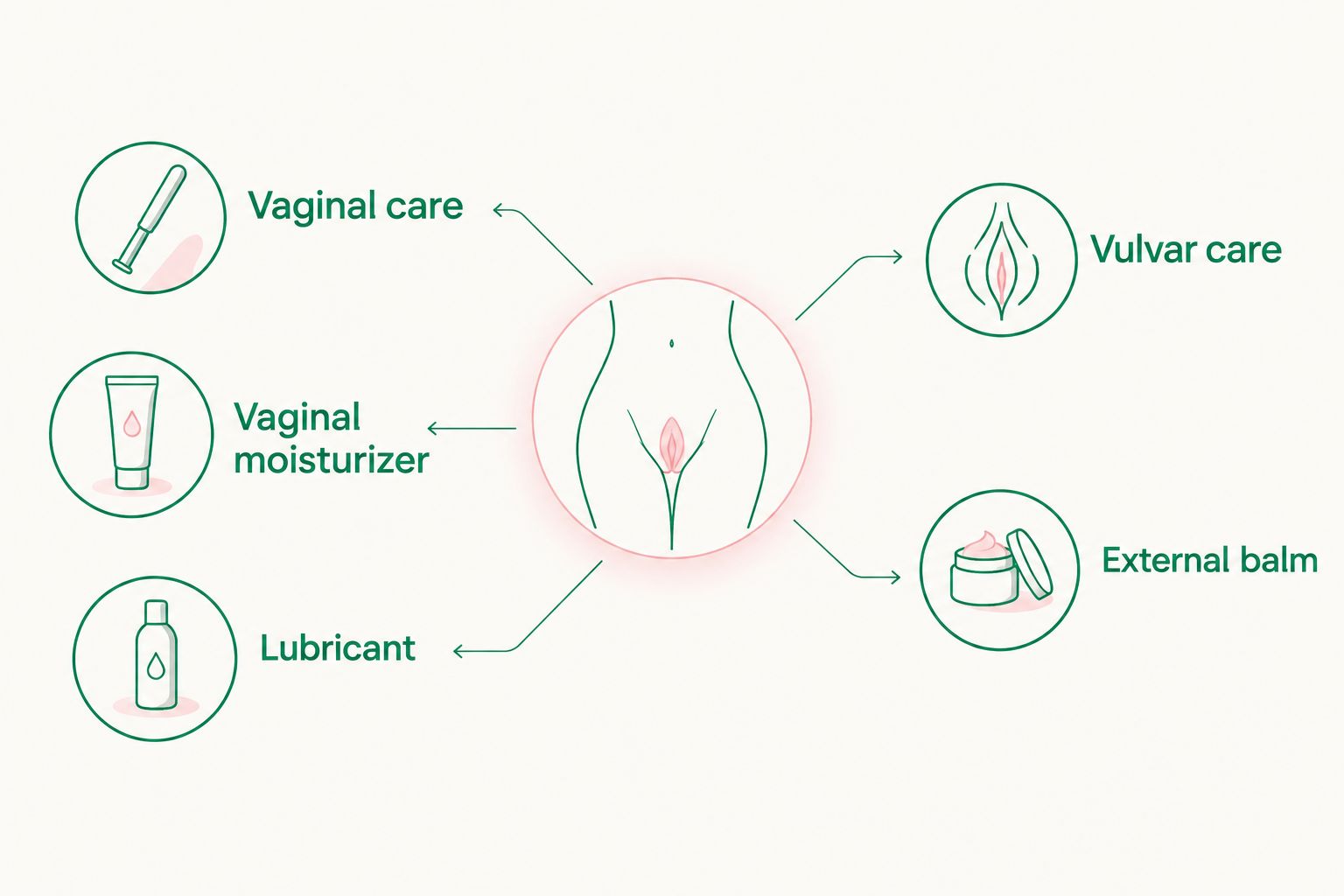
1. Vaginal moisturizer: best for ongoing internal dryness
A vaginal moisturizer is designed for regular use rather than only during sex. ACOG and NHS patient guidance identify vaginal moisturizers as a nonhormonal option for dryness. Follow the individual product’s directions instead of assuming every formula has the same schedule.
Choose a product explicitly labeled for vaginal use. Facial moisturizers, body lotions, and external intimate creams are not interchangeable with vaginal moisturizers.
Vaginal moisturizer pros:
- Addresses ongoing dryness rather than only friction during sex.
- Provides a nonhormonal option.
- Can fit a regular care routine according to its label.
Vaginal moisturizer cons:
- Ingredients can still irritate sensitive tissue.
- Does not replace treatment for infection or a vulvar skin condition.
- Persistent menopause-related symptoms can need additional treatment.
Best for: Internal dryness that occurs outside sexual activity, without symptoms requiring prompt assessment.
Verdict: Buy a vaginal-use moisturizer for ongoing dryness; seek care if symptoms persist.
2. Water-based lubricant: best for friction during sex
A water-based lubricant reduces friction during sexual activity or insertion of a compatible device. It is an on-demand aid, not a treatment for the underlying cause of persistent dryness. ACOG distinguishes this role from the regular use of vaginal moisturizers.
Choose a simple formula intended for intimate use. Check the label for condom and device compatibility, and avoid added fragrance or sensation-producing ingredients if you are sensitive.
Water-based lubricant pros:
- Fits use when friction occurs.
- Is generally compatible with latex condoms.
- Is generally compatible with a range of sexual-device materials, subject to their instructions.
Water-based lubricant cons:
- Can need reapplication as it dries.
- Some formulas cause stinging or irritation.
- Does not address dryness between sexual encounters.
Best for: Discomfort associated with friction during sex or device use, rather than persistent daily dryness alone.
Verdict: Buy for friction relief; do not use lubricant to push through pain.
3. Silicone-based lubricant: best for longer-lasting lubrication
Silicone-based lubricants remain slippery longer than water-based options. They suit readers who find repeated reapplication disruptive. Like other lubricants, they reduce friction without establishing why the tissue feels dry.
Device compatibility is the main extra check. Some silicone devices are not compatible with silicone-based lubricants, so follow the device manufacturer’s directions rather than assuming the materials work together.
Silicone-based lubricant pros:
- Provides longer-lasting slipperiness.
- Reduces the need for repeated application compared with water-based lubrication.
- Offers another option if a particular water-based formula feels uncomfortable.
Silicone-based lubricant cons:
- Requires a compatibility check with silicone devices.
- Can take more effort to wash away.
- Still does not treat an infection or low-estrogen tissue changes.
Best for: Sexual activity where a water-based lubricant dries too quickly for your comfort.
Verdict: Buy when longer-lasting lubrication is the priority and compatibility is confirmed.
4. Prescription vaginal estrogen: best for persistent menopausal symptoms
Lower estrogen around and after menopause can contribute to vaginal dryness, irritation, and pain with sex. ACOG and The Menopause Society identify vaginal estrogen as a treatment option for these symptoms. A clinician can determine whether it fits your symptoms and medical history.
Vaginal estrogen is not interchangeable with an over-the-counter moisturizer. It addresses estrogen-related tissue changes, and its suitability requires an individual discussion, particularly if you have a history of hormone-sensitive cancer or unexplained bleeding.
Prescription vaginal estrogen pros:
- Addresses a recognized cause of menopause-related dryness.
- Offers local vaginal treatment rather than relying only on lubrication.
- Can be considered when nonhormonal measures do not provide enough relief.
Prescription vaginal estrogen cons:
- Requires clinical assessment and a prescription.
- Is not appropriate for every cause of vaginal discomfort.
- Needs discussion of your health history and treatment instructions.
Best for: Persistent symptoms associated with menopause or another clinician-confirmed low-estrogen state.
Verdict: Hold the purchase decision for a clinician discussion; do not self-diagnose estrogen deficiency.
5. External protective balm: best for a separate vulvar-care decision
Kushae’s OB/GYN-developed care line includes a Protective Feminine Skin Balm. Its place in this guide is the external-care category, not as a substitute for a vaginal moisturizer, lubricant, or prescription treatment.
Before choosing any external balm, read its current ingredient list and application directions. Do not insert an external skin product into the vagina, and do not assume that its ingredients are compatible with latex condoms.
External protective balm pros:
- Keeps external skin care separate from internal vaginal care.
- Provides a distinct product category to discuss when dryness affects vulvar skin.
- Allows you to assess external application instructions rather than improvising with body products.
External protective balm cons:
- Does not address internal vaginal dryness simply by being applied externally.
- Is not a treatment for BV, yeast infection, or an undiagnosed skin disorder.
- Still requires ingredient-tolerance and barrier-compatibility checks.
Best for: Considering an external product after identifying that the discomfort involves vulvar skin, not the vaginal canal.
Verdict: Hold until you confirm the application area and label directions; skip it as an internal dryness treatment.
How this ranking works
The 2026 ranking prioritizes symptom fit, intended location, irritation precautions, compatibility, and the need for medical assessment. Vaginal moisturizers lead for ongoing internal dryness; lubricants lead for friction. Prescription treatment belongs in a separate clinical decision.
This is a category-level buying guide, not evidence that one commercial formula outperforms another. General evidence for moisturizers or vaginal estrogen does not establish clinical results for a specific Kushae product.
Choose your next step without adding unnecessary products
Start by describing the problem in plain language. These 3 questions make your next purchase—or appointment—more focused:
- Where is it? Separate internal vaginal dryness from discomfort on external vulvar skin.
- When does it happen? Note whether symptoms occur throughout the day, during sex, after washing, or after starting a product.
- What comes with it? Record unusual discharge, odor, bleeding, urinary symptoms, sores, or pelvic pain.
Bring that description and your current product list to a clinician if symptoms persist. Include washes, wipes, deodorants, suppositories, lubricants, and medications. Introducing several products together makes it harder to identify what causes irritation.
Do not add boric acid for dryness. CDC guidance discusses intravaginal boric acid in selected recurrent-infection treatment situations, not as a general vaginal moisturizer. It should not be swallowed, and pregnancy requires medical guidance rather than self-treatment.
An external wash does not treat BV or internal dryness. Deodorant does not identify the cause of odor. If odor returns alongside dryness or burning, testing is more useful than covering the symptom.
Which vaginal dryness product should you choose?
For ongoing internal dryness without warning symptoms, start with a vaginal moisturizer. Choose a lubricant when friction is the immediate problem. You can discuss both categories with a clinician if dryness affects daily comfort and sex.
If menopause-related symptoms continue despite nonhormonal care, ask about prescription vaginal treatment. If symptoms are external, keep the decision focused on vulvar skin rather than inserting another product.
The best 2026 purchase is the one matched to the symptom—not the largest routine. Stop products that worsen discomfort and arrange medical care for persistent or recurring symptoms.
FAQ
What's the best product for vaginal dryness in 2026?
A vaginal moisturizer is a practical first option for ongoing internal dryness without warning symptoms. A lubricant fits friction during sex, while persistent menopause-related symptoms deserve a discussion about prescription treatment.
Is a vaginal moisturizer better than a lubricant?
Neither is better for every situation: vaginal moisturizers address ongoing dryness, while lubricants reduce friction during activity. Choose by when symptoms occur, and follow each product's directions.
Can I put an external feminine balm inside my vagina?
No. Do not insert a product labeled only for external use into the vagina. Internal vaginal care and external vulvar care require different application instructions.
Does Kushae feminine wash treat vaginal dryness or BV?
An external feminine wash does not treat internal vaginal dryness or BV. Use an external cleanser only as directed, and seek assessment for persistent odor, unusual discharge, or irritation.
Are boric acid suppositories good for vaginal dryness?
Boric acid suppositories are not a general treatment for vaginal dryness. CDC guidance discusses boric acid in selected recurrent-infection situations; that is different from moisturizing dry vaginal tissue.
Can I use oil as a vaginal lubricant with latex condoms?
Do not use oil-based products with latex condoms because oil can weaken latex. Choose an intimate lubricant labeled compatible with the barrier you use.
When should vaginal dryness be checked by a doctor?
Arrange medical assessment when dryness persists, recurs, or causes pain during sex. Unusual discharge, sores, bleeding, or urinary symptoms also need evaluation; severe pelvic pain or fever requires prompt care.
One last thing
More cleansing is not a dryness treatment. If your 2026 routine now includes several washes, wipes, sprays, or suppositories, review their purpose before adding another item. Keep necessary prescribed treatment in place, stop products that irritate you, and ask a clinician to assess symptoms that do not settle.


