


This article is for informational purposes only. It is not, nor is it intended to be, a substitute for professional medical advice, diagnosis, or treatment and should never be relied upon for specific medical advice.
Boric acid suppositories can irritate vaginal tissue, and insertion can cause minor injury, so light spotting after use is possible. But bleeding does not prove the suppository caused it, and spotting is not a sign that treatment is working. Stop using the suppository and contact a healthcare professional about new, unexplained bleeding; seek urgent care for heavy bleeding, severe pain, or faintness.
TL;DR
- Can boric acid suppositories cause spotting? Irritation or insertion-related injury can explain light bleeding, but other causes need consideration.
- Stop boric acid when unexplained spotting starts; do not insert another dose to test your reaction.
- Heavy bleeding, severe pelvic pain, faintness, or bleeding with possible pregnancy needs prompt medical attention.
- Kushae vulvovaginal care does not replace evaluation of unexplained vaginal bleeding.
Why this matters in 2026
Blood mixed with discharge deserves a different response from ordinary suppository leakage. Dissolved product can leave watery residue, but pink, red, or brown staining suggests blood is present. You cannot identify its source from color alone.
The distinction matters when you are already treating recurring odor, itching, or suspected BV. Adding another vaginal product can complicate the picture rather than explain the bleeding. For the difference between leakage and other symptoms, read about discharge after a boric acid suppository.
The 2026 safety takeaway: treat unexpected bleeding as a symptom to assess, not a treatment milestone. You do not need to feel embarrassed about reporting it.
Can boric acid suppositories cause spotting?
Yes, spotting after boric acid use is possible through local irritation or insertion-related injury. However, timing alone cannot establish the cause. Cleveland Clinic's medication information for vaginal boric acid identifies vaginal irritation and vaginal bleeding as symptoms that warrant attention from a healthcare professional.
Use the pattern below to decide what to report, not to diagnose yourself.
| What you notice | What it can mean | Your next move |
|---|---|---|
| A small blood streak after painful insertion | Friction or a surface injury is possible | Stop insertion and report unexplained bleeding |
| Pink discharge with burning | Blood mixed with discharge; irritation is possible | Stop the suppository and contact your clinician |
| Brown staining near an expected period | Older blood or menstrual timing is possible | Track the timing; report an unusual or recurring pattern |
| Bleeding with pelvic pain or fever | A condition requiring medical assessment is possible | Seek prompt medical care |
| Heavy bleeding with dizziness or faintness | Potentially significant blood loss | Seek emergency care |
A small amount does not establish that bleeding is harmless. Pregnancy possibility, menopause status, pain, recurrence, and the reason you started treatment all affect the next step.
Irritation and injury are different
Chemical irritation can cause burning, soreness, or inflamed tissue. Mechanical injury involves friction or pressure from a finger, fingernail, or applicator. Either possibility calls for stopping an insertion that hurts.
Do not force an applicator, repeat insertion to check the area, or assume deeper placement will solve discomfort. If a prescribed regimen causes bleeding, contact the prescriber before continuing it. Pausing the suspected irritant is different from abandoning the underlying diagnosis or treatment plan.
What should you do if spotting starts after insertion?
Stop the boric acid and assess the bleeding before using another vaginal product. You do not need to determine the cause yourself before asking for help.
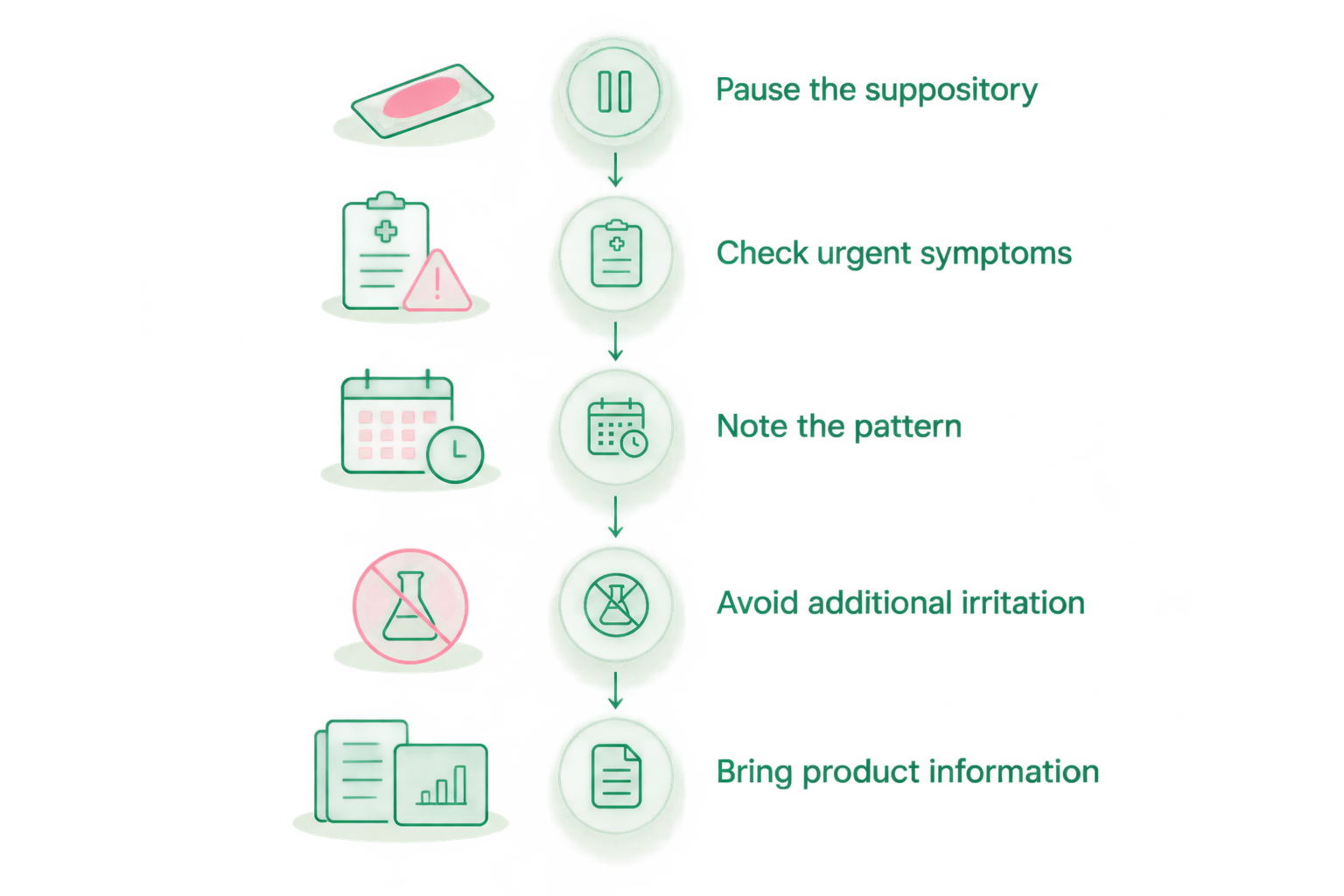
- Pause the suppository. Do not take another dose to see whether the bleeding happens again. If a clinician prescribed it, contact that clinician for instructions.
- Check for urgent symptoms. Heavy bleeding, severe pelvic pain, fainting, or possible pregnancy changes the urgency. Do not wait for a routine appointment when these are present.
- Note the pattern. Record when the bleeding began, whether insertion hurt, whether you have burning or discharge, and where you are in your menstrual cycle.
- Avoid additional irritation. Do not douche or try to wash product out of the vagina. Avoid inserting other nonprescribed products while seeking advice.
- Bring the product information. Keep the package, ingredient list, and dosing instructions available. Tell your clinician about other vaginal treatments, contraception, and medications.
You can describe the symptom plainly: bleeding started after using a vaginal suppository, and you want to know whether to stop the course or be examined. Include the amount, associated symptoms, and pregnancy possibility. Those details help the clinician triage the concern.
Why spotting after boric acid varies
Bleeding after a suppository is not a single diagnosis. MedlinePlus guidance on bleeding between periods describes several potential causes, including hormonal changes, injury, infection, and pregnancy-related conditions.
- Local irritation. Sensitive or inflamed tissue can react to an intravaginal product. Burning and soreness are reasons to stop and ask for advice, not reasons to increase use.
- Insertion friction. Painful insertion, pressure, or a scrape can injure tissue. Bleeding after a difficult insertion still needs attention if it continues or recurs.
- Vaginal dryness. Dry, fragile tissue is more vulnerable to friction. Dryness can occur with hormonal changes, including menopause and breastfeeding.
- Menstrual or contraceptive timing. A period or breakthrough bleeding can overlap with suppository use. Coincidence does not confirm a medication reaction.
- Infection or cervical inflammation. Some infections and cervical conditions cause bleeding, particularly after sex. Odor or discharge does not identify which condition is present.
- Pregnancy or other gynecologic conditions. Pregnancy-related bleeding, polyps, and other uterine or cervical conditions require a different assessment from product irritation.
Your clinician can decide whether you need an examination, pregnancy testing, or testing for infection. A home vaginal pH result cannot establish where bleeding came from or rule out these causes.
When does spotting need urgent medical care?
Get emergency help for heavy bleeding with faintness, shortness of breath, chest pain, or severe weakness. Severe pelvic or abdominal pain also needs urgent assessment, particularly when pregnancy is possible.
ACOG's guidance on abnormal uterine bleeding advises emergency care when you are changing pads or tampons every hour for more than 2 hours and also have chest pain, shortness of breath, lightheadedness, or dizziness. Do not wait to reach that threshold if you feel seriously unwell.
Seek prompt medical advice for bleeding with fever, worsening pelvic pain, or persistent unusual discharge. These symptoms need assessment rather than another attempt to treat presumed BV or yeast at home.
Any vaginal bleeding after 12 months without a period due to menopause needs evaluation, even if it is only a small spot. ACOG's guidance on bleeding after menopause makes clear that light bleeding still counts.
What if pregnancy is possible?
Do not use boric acid vaginal suppositories during pregnancy. If you are pregnant, might be pregnant, or are trying to conceive, ask your healthcare professional about appropriate treatment instead.
Bleeding with possible pregnancy needs prompt advice. Severe one-sided pelvic pain, shoulder pain, dizziness, or fainting can signal an emergency, including ectopic pregnancy. A recent suppository does not make pregnancy-related bleeding less urgent.
Can you keep using boric acid if the spotting is light?
Do not continue through unexplained spotting without clinical advice. Light bleeding does not show that another dose is safe, and it does not establish that the original problem was BV or yeast.
If your clinician prescribed boric acid for a confirmed condition, contact the prescriber about the bleeding and the next dose. Tell them whether symptoms started immediately after insertion or later. They can decide whether to change the treatment, examine the tissue, or investigate another cause.
Boric acid has a role in selected clinician-directed treatment regimens. That does not make it the right treatment for every episode of odor, itching, or discharge. General evidence for boric acid also does not establish the safety or effectiveness of every commercial formula.
How can you manage spotting while arranging care?
Use an external menstrual product that lets you notice whether bleeding is increasing. A pad or liner makes changes easier to observe; change it as needed and stop using any material that irritates your skin. Avoid inserting a tampon simply to check the source of bleeding.
Choosing period underwear for spotting changes how you contain light bleeding, not how you assess its cause. Absorbent fabric does not show that a suppository is safe to restart, and it should not delay care if bleeding increases or pain develops.
Keep external care simple. The vulva is the external genital area; the vagina is the internal canal. Gently clean the outside with lukewarm water, avoid scrubbing, and do not douche or insert cleanser.
Avoid vaginal penetration while bleeding or soreness remains unexplained. There is no need to repeatedly inspect internally or use another product to remove residue. If symptoms worsen while you are waiting for advice, seek care sooner.
Choosing vulvovaginal care in 2026
Kushae is best for women seeking OB/GYN-developed vulvovaginal care, not a substitute for evaluating unexplained bleeding. The useful distinction is each product's intended role: external cleansing, external skin care, or intravaginal use.
For example, Kushae Vaginal Boric Acid Suppositories + Probiotics & Aloe! are an intravaginal product, and the product information states not to use boric acid suppositories during pregnancy. The presence of probiotics or aloe does not establish that bleeding is harmless or that you should continue through irritation.
Kushae's OB/GYN-developed positioning describes the line's development. It does not diagnose your symptoms, establish a cause for spotting, or replace individualized prescribing advice.
An external feminine wash serves a different purpose from a suppository. It does not treat BV inside the vagina, resolve unexplained bleeding, or correct a cervical problem. When spotting starts, the next purchase is not the priority; identifying the cause is.
What should you tell your clinician about recurring odor and spotting?
Explain both symptoms together, even if odor began first and spotting appeared only after treatment. Mention previous BV or yeast diagnoses, recent treatments, sex-related bleeding, and any new pelvic discomfort. Do not leave out nonprescription suppositories or intimate-care products.
Bring dates rather than conclusions. The day you used a product, the day bleeding started, and whether it recurred are more useful than assuming your vaginal pH caused everything. If symptoms keep returning, ask what testing is appropriate before repeating the same treatment.
Recurring symptoms deserve a plan based on a diagnosis. They are not evidence that you are unclean or that you need a stronger cleansing routine.
Medical sources for this 2026 guide
The clinical distinctions above draw on Cleveland Clinic's Boric Acid Vaginal Suppositories medication information, MedlinePlus guidance on Vaginal Bleeding Between Periods, and ACOG patient guidance on Abnormal Uterine Bleeding, Bleeding After Menopause, and Ectopic Pregnancy. These sources address medication precautions, possible bleeding causes, and warning signs—not clinical testing of a particular commercial formula.
This is general health education, not a diagnosis or a personalized dosing plan. A clinician who knows your symptoms and medical history should guide whether and when you restart an intravaginal treatment.
FAQ
Is spotting after boric acid normal?
Spotting is not something to assume is normal after boric acid. Local irritation or insertion-related injury is possible, but new unexplained bleeding warrants stopping the product and contacting a healthcare professional.
Does pink discharge mean boric acid is working?
Pink discharge does not mean boric acid is working. It can indicate a small amount of blood mixed with discharge, and the cause cannot be established from appearance alone.
Can a boric acid applicator cause bleeding?
An applicator can cause a scrape or friction-related injury, especially if insertion is painful or forced. Stop if insertion hurts, and seek advice about bleeding that continues or returns.
Should I use another boric acid suppository after spotting?
Do not insert another dose while unexplained spotting is being assessed. If boric acid was prescribed, contact the prescriber for instructions about the treatment course.
Can I use boric acid if I might be pregnant?
Do not use boric acid vaginal suppositories if you are pregnant or might be pregnant without discussing an appropriate alternative with your healthcare professional. Bleeding with possible pregnancy needs prompt medical advice.
Can feminine wash stop bleeding caused by a suppository?
Feminine wash does not treat unexplained vaginal bleeding. External cleansing is separate from intravaginal treatment, and cleanser should not be inserted into the vagina.
When is bleeding after a suppository an emergency?
Heavy bleeding with faintness, shortness of breath, chest pain, or severe weakness requires emergency care. Severe pelvic pain, especially with possible pregnancy, also needs urgent assessment.
One last thing
The most useful detail is often whether bleeding also happens when you are not using the suppository. Note episodes after sex, between periods, or after menopause, and share that pattern with your clinician. A symptom that starts after a product still deserves an explanation beyond the product.


