


This article is for informational purposes only. It is not, nor is it intended to be, a substitute for professional medical advice, diagnosis, or treatment and should never be relied upon for specific medical advice.
You can use boric acid suppositories with an IUD when a clinician recommends them for a diagnosed vaginal condition; having an IUD does not automatically rule them out. The bigger questions are whether boric acid is the right treatment, whether pregnancy is possible, and whether your symptoms need an examination. An IUD is not a reason to skip diagnosis or treat recurring odor on your own.
TL;DR
- Can you use boric acid suppositories with an IUD? Yes, when your clinician confirms they are appropriate.
- Kushae boric acid suppositories are intravaginal products, not external cleansers or a substitute for diagnosis.
- Avoid vaginal boric acid during pregnancy, and never swallow a suppository.
- Pelvic pain, fever, unusual bleeding, or changed IUD strings need medical assessment, not another suppository.
Can you use boric acid suppositories with an IUD?
Yes, with a clinician-directed reason for using them. The CDC’s STI Treatment Guidelines discuss vaginal boric acid for selected recurrent vaginal infections and separately address IUD management. They do not identify IUD use alone as a reason to avoid boric acid.
Before choosing boric acid suppositories, separate the contraceptive question from the treatment question. Your IUD prevents pregnancy; it does not tell you whether odor comes from bacterial vaginosis, yeast, an STI, or something else.
| Question | Hormonal IUD | Copper IUD |
|---|---|---|
| Does the device sit inside the vagina? | No. The device sits in the uterus; strings extend through the cervix. | No. The device sits in the uterus; strings extend through the cervix. |
| Does the IUD establish that boric acid is appropriate? | No. Diagnosis and pregnancy status still matter. | No. Diagnosis and pregnancy status still matter. |
| Does BV automatically require IUD removal? | No. Treatment decisions belong with your clinician. | No. Treatment decisions belong with your clinician. |
| What needs assessment? | Pelvic pain, fever, unusual bleeding, or changed strings. | Pelvic pain, fever, unusual bleeding, or changed strings. |
For your 2026 care decisions, use clinical guidance rather than a product’s general freshness claims. Neither IUD type turns an over-the-counter suppository into the correct treatment for every vaginal symptom.
Why this matters
Recurring vaginal odor is frustrating. It is not proof that you are unclean, and washing more aggressively does not diagnose or treat an infection.
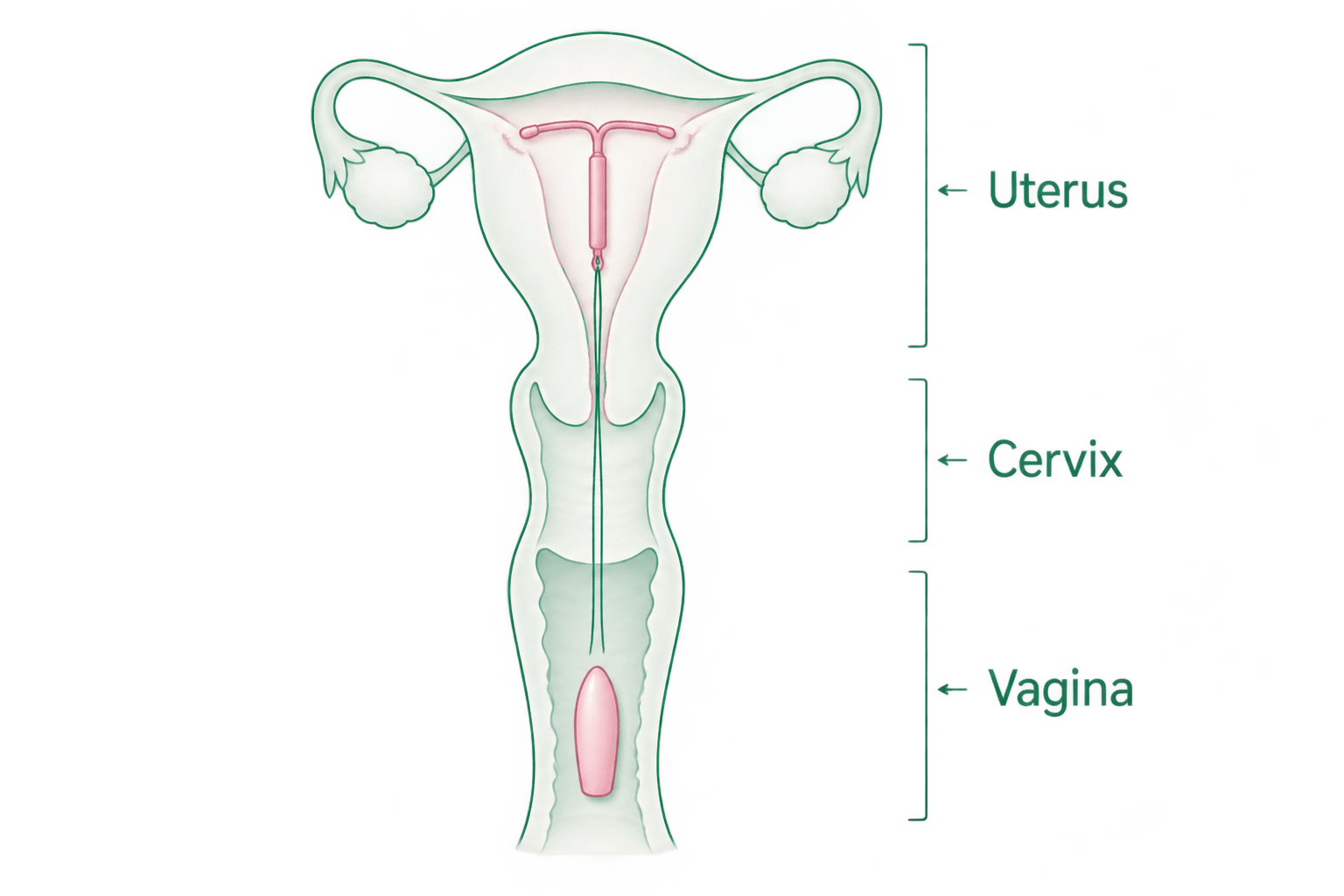
The vagina is the internal canal. The vulva is the external genital skin. An IUD sits beyond the cervix in the uterus, while a vaginal suppository is inserted into the vagina—not into the cervix or uterus.
That anatomical separation matters, but it is not proof that every vaginal product is suitable for you. Pregnancy precautions, irritation, recent procedures, and the cause of your symptoms still determine the next move.
Where does a suppository go if you have IUD strings?
A vaginal suppository stays in the vaginal canal as it dissolves. IUD strings pass through the cervix into the upper vagina; they are not a route for inserting medication into the uterus.
Do not pull, trim, or repeatedly manipulate your IUD strings while inserting a product. You do not need to move the strings aside. If insertion hurts, stop rather than forcing an applicator farther.
If your strings feel different from usual, you cannot feel previously noticeable strings, or you feel the hard device itself, contact your clinician. Use backup contraception until the IUD’s position and contraceptive protection are clarified. Seek prompt assessment if those changes occur with pain or bleeding.
Why the recommendation varies
The answer depends on your symptoms and medical circumstances—not simply the presence of IUD strings. These are the factors to discuss before starting or repeating treatment:
- Diagnosis: BV, yeast infections, STIs, and contact irritation need different care. Similar symptoms do not mean identical treatment.
- Pregnancy possibility: Avoid vaginal boric acid during pregnancy. A positive pregnancy test with an IUD needs prompt medical assessment because the pregnancy’s location must be established.
- Recent insertion: New pain, fever, or concerning discharge after IUD placement requires assessment rather than self-treatment.
- Recurrence: Repeated episodes deserve confirmation of the diagnosis and a prevention plan, not an indefinite cycle of suppositories.
- Skin and tissue sensitivity: Burning, soreness, or damaged tissue changes whether a product is tolerable. More discomfort is a reason to stop, not increase use.
- Other vaginal treatments: Tell your clinician about prescription medication, nonprescription suppositories, lubricants, and other products you use internally.
Bring the actual product label to your appointment. Ingredient lists and instructions are more useful than describing something as a pH product or a vaginal reset.
Is boric acid the right treatment for BV with an IUD?
Boric acid is not the CDC’s standard first-line treatment for BV. The CDC’s Bacterial Vaginosis guidance lists prescription antibiotic regimens for symptomatic BV. It discusses boric acid as one possible part of a clinician-managed approach for multiple recurrences, based on limited data.
The distinction matters in 2026: evidence for a particular treatment sequence is not evidence that boric acid alone treats every episode of odor. It also does not establish that a specific commercial formula produces the same results.
For context, the CDC describes a recurrent-BV approach involving 600 mg of vaginal boric acid daily for 21 days, after an oral antibiotic course and before suppressive metronidazole gel for 4–6 months. Those figures describe a multistep clinical regimen, not instructions to start treatment yourself.
Ask your clinician which part of the plan addresses the active infection and which part addresses recurrence. Do not copy only the boric acid step from a longer treatment protocol.
Does a copper IUD change the BV conversation?
The CDC’s Bacterial Vaginosis guidance reports increased BV prevalence among copper-IUD users. That association does not prove your IUD caused your symptoms, and it does not mean everyone with recurrent BV needs the device removed.
If episodes started or changed after insertion, tell your clinician when that happened. Bring any previous test results and treatment history. A pattern of confirmed infections is more useful than assuming that every odor change is another episode of BV.
For contraceptive decisions in 2026, discuss infection management and birth control together. Do not remove an IUD yourself or stop relying on it without arranging an alternative method when pregnancy prevention matters to you.
What should you do before inserting a suppository?
Use a short safety check rather than treating an unfamiliar symptom automatically. This is especially important if your IUD was recently inserted or your usual symptom pattern has changed.
- Confirm the reason. Ask whether your symptoms require testing for BV, yeast, or an STI before using another vaginal product.
- Check pregnancy concerns. If pregnancy is possible, test and contact your clinician. Do not use boric acid during pregnancy.
- Review warning signs. Pelvic pain, fever, unusual bleeding, and changed strings take priority over an odor-control routine.
- Read the instructions. Follow your clinician’s treatment plan and the specific product directions. Never swallow vaginal boric acid.
- Keep insertion gentle. Wash your hands, avoid pulling strings, and stop if insertion causes pain. Do not force an applicator.
- Know the follow-up plan. Ask what to do if symptoms persist, return, or worsen. Repeating treatment without reassessment can delay the correct diagnosis.
Keep suppositories away from children, pets, and anyone who could mistake them for oral capsules. If boric acid is swallowed, contact Poison Control or emergency services immediately.
Where does Kushae fit into an IUD care routine?
Kushae is best suited to women seeking OB/GYN-developed vulvovaginal care with a clear distinction between external and intravaginal products. That distinction helps you choose the right product category; it does not replace a medical assessment.
Kushae Vaginal Boric Acid Suppositories + Probiotics & Aloe! are an intravaginal option to discuss with your clinician when boric acid has a place in your treatment plan. The product’s pregnancy warning says not to use boric acid vaginal suppositories during pregnancy.
The limit is equally clear: OB/GYN-developed does not mean appropriate for every infection or every IUD user. General clinical evidence about boric acid does not establish the effectiveness of the added ingredients or this specific formula for IUD-related concerns.
External washes, balms, and deodorants serve a different role. An external cleanser does not treat BV, and no external product belongs inside the vagina unless specifically intended for that route. You do not need to add several products to make a clinician-directed treatment work.
When should you get medical care instead?
Seek urgent assessment for severe or worsening pelvic pain, fever, fainting, or a positive pregnancy test with an IUD. These symptoms need evaluation rather than another suppository.
Arrange an appointment for persistent odor, recurrent itching, pain during sex, burning with urination, unusual discharge, or bleeding that differs from your expected pattern. Tell the clinician about new partners or possible STI exposure without assuming BV is the explanation.
If a suppository causes significant burning or swelling, stop using it and contact a healthcare professional. Do not add another internal product to neutralize the reaction. Keep the packaging so the ingredients can be checked.
What medical guidance supports this answer?
For this 2026 guide, the relevant medical references are the CDC STI Treatment Guidelines: Bacterial Vaginosis, covering BV treatment, recurrence, and IUD considerations; CDC STI Treatment Guidelines: Vulvovaginal Candidiasis, covering selected uses of vaginal boric acid; and CDC U.S. Selected Practice Recommendations for Contraceptive Use, covering IUD management and pregnancy concerns.
These references support general clinical education. They do not establish product-specific results, certify a commercial formula, or provide an individual diagnosis. Your clinician applies that guidance to your symptoms, examination, test results, and contraceptive needs.
FAQ
Will boric acid make my IUD stop working?
Boric acid is not identified in CDC guidance as a medication that reduces IUD contraceptive effectiveness. That does not establish that every suppository formula has been specifically studied with every IUD; confirm that treatment is appropriate with your clinician.
Can a boric acid suppository move my IUD?
A suppository sits in the vagina, while the IUD sits in the uterus. Do not pull the strings or force an applicator, and get assessed if you notice changed strings, pain, or unusual bleeding.
Can I use boric acid right after getting an IUD?
Follow your inserting clinician’s instructions before using vaginal boric acid after IUD placement. New pelvic pain, fever, or concerning discharge needs assessment rather than self-treatment.
Should I remove my IUD if I keep getting BV?
Recurrent BV does not automatically require IUD removal. Confirm the diagnosis and discuss your infection history and contraceptive preferences with your clinician, particularly if you have a copper IUD.
Can I use boric acid if I might be pregnant despite my IUD?
Do not use vaginal boric acid if you are pregnant or suspect pregnancy. Take a pregnancy test and contact your clinician; a positive test with an IUD requires prompt assessment of the pregnancy’s location.
Is Kushae boric acid automatically safe because it is OB/GYN-developed?
OB/GYN-developed does not establish that a product is appropriate for your symptoms or medical circumstances. Review the product label with your clinician, including its warning against use during pregnancy.
Can feminine wash treat BV while I have an IUD?
An external feminine wash does not treat BV, with or without an IUD. Keep external cleansing separate from clinician-directed treatment for a diagnosed vaginal infection.
One last thing
Feeling better and having the right diagnosis are not the same thing. A change in odor after using a suppository does not confirm that you had BV or that an infection has cleared.
If symptoms keep returning, write down when they happen, what testing showed, and which treatments you used. Bring that record and your IUD details to your appointment. For recurring symptoms in 2026, a documented pattern is more useful than another guess at the pharmacy shelf.


