


This article is for informational purposes only. It is not, nor is it intended to be, a substitute for professional medical advice, diagnosis, or treatment and should never be relied upon for specific medical advice.
You should not combine vaginal itching cream and boric acid on your own; an external cream is sometimes used alongside a prescribed vaginal treatment, but the cream’s ingredients, application site, and diagnosis determine whether that combination is appropriate. Do not insert both products or assume that separating them by a few hours makes the combination safe.
TL;DR
- Can you use vaginal itching cream and boric acid together? Get the exact products checked before combining them.
- External vulvar creams and intravaginal medicines have different uses; application site matters as much as ingredients.
- Kushae offers OB/GYN-developed vulvovaginal care, but product selection cannot diagnose recurring itching or BV.
- Avoid boric acid during pregnancy, never swallow it, and seek care for persistent or worsening symptoms.
Why this matters
Itching is a symptom, not a diagnosis. Yeast, contact irritation, skin conditions, and other causes can overlap, so adding another product can complicate the picture rather than address the cause.
For your 2026 care decisions, start by separating symptom relief from infection treatment. Products described as vaginal itching creams do not all contain the same ingredients or belong in the same place.
Can you use vaginal itching cream and boric acid together?
Only use the combination after a clinician or pharmacist has checked the exact products and their intended application sites. An external cream applied to vulvar skin is different from a cream inserted into the vagina. Neither arrangement establishes that boric acid is appropriate for your symptoms.
The vulva is the external genital area. The vagina is the internal canal. A product labeled for external use does not become suitable for vaginal insertion because its name includes the word vaginal.
| Product type | Best for | What it does not establish | Combination decision |
|---|---|---|---|
| External soothing cream | Label-directed relief of external skin discomfort | Whether yeast, BV, or another condition is present | Check ingredients and skin condition before adding it |
| External antifungal cream | Clinician- or label-directed treatment of external yeast symptoms | Whether internal treatment or boric acid is needed | Confirm the diagnosis and treatment plan |
| Intravaginal antifungal | Treatment of an appropriate vaginal yeast infection | Whether adding boric acid improves that treatment | Do not add another intravaginal product independently |
| Boric acid | Selected clinician-directed vaginal treatment regimens | Whether unexplained odor or itching requires boric acid | Use only when appropriate for the diagnosed condition |
The CDC’s STI Treatment Guidelines, in its vulvovaginal candidiasis section, explains that yeast symptoms are not specific to yeast. Its vaginal-discharge guidance also states that history alone is insufficient for an accurate diagnosis of vaginitis.
These distinctions guide this 2026 article. They are general clinical guidance, not evidence that a particular cream-and-suppository combination has been studied.
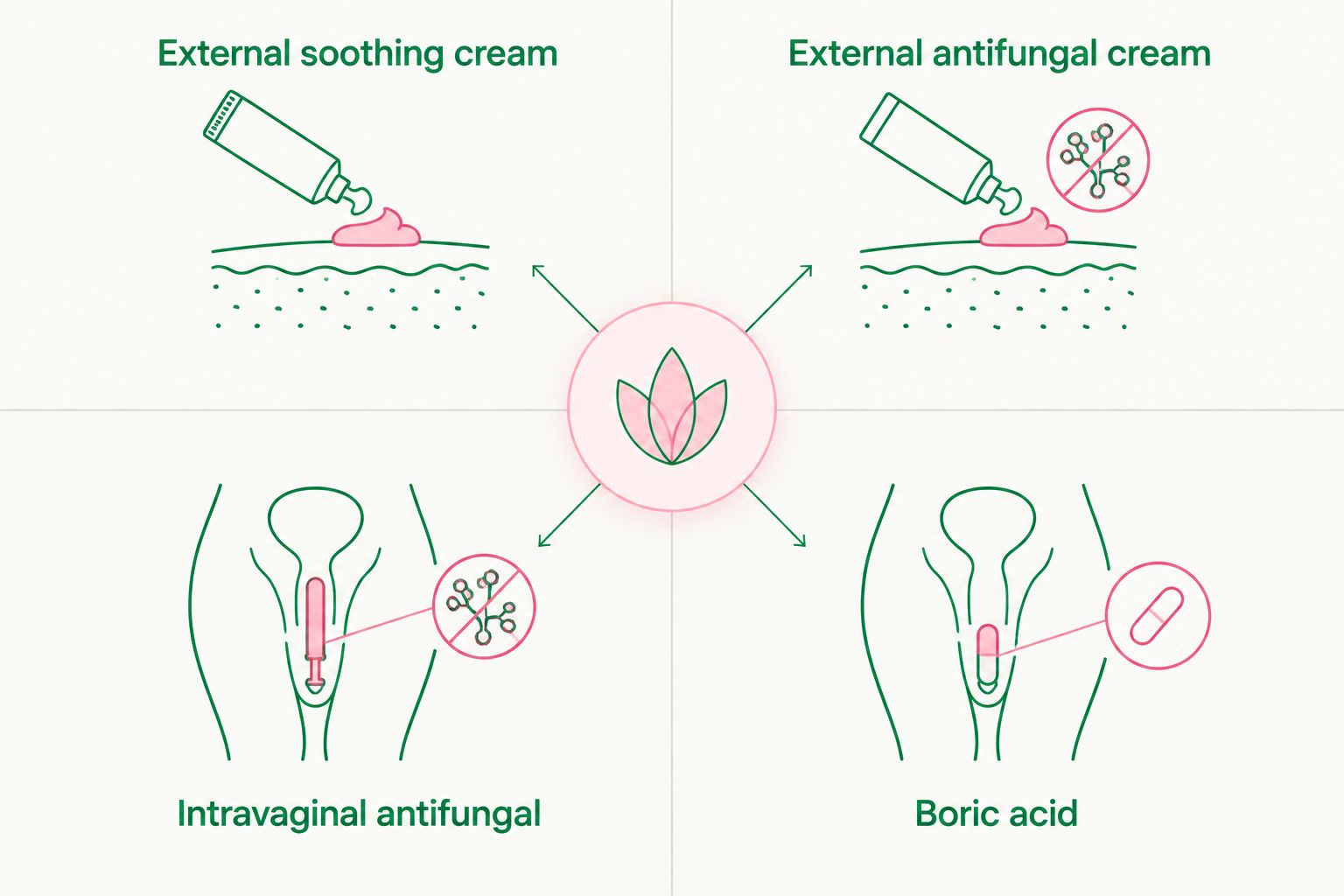
External soothing cream: skin comfort is not infection treatment
An external soothing cream belongs only on the skin permitted by its label. It is not interchangeable with an antifungal, and relief from itching does not prove that an infection has cleared.
The benefit is targeted care for an appropriate external concern. The limitation is equally important: a soothing product does not diagnose or treat an internal infection simply because the discomfort is near the vaginal opening.
Check whether the cream contains a medicine, such as an antifungal, steroid, or local anesthetic, or is a nonmedicated skin-care product. Those categories have different instructions and precautions. Ask about the actual ingredient list rather than the phrase itching cream.
Do not apply a new cream over raw, blistered, or worsening skin without medical advice. Burning after application is a reason to stop and reassess, not to layer on more products.
Antifungal cream: confirm where it belongs
An antifungal cream can be formulated for external application or vaginal insertion. Follow the instructions for that exact formulation; do not transfer directions from a different package.
The benefit of an appropriate antifungal is treatment directed at yeast. Its limitation is that it will not address every cause of itching, and unnecessary treatment can delay diagnosis of another condition.
The CDC’s vulvovaginal candidiasis guidance recommends clinical evaluation and testing when symptoms persist after an over-the-counter treatment or return soon afterward. Repeating treatments based only on familiar symptoms is not a reliable diagnostic strategy.
Tell your clinician whether you have already used an antifungal. Include the product, application route, and whether symptoms changed. That information helps distinguish an incomplete response from irritation or a different diagnosis.
Boric acid: a selected treatment, not a universal add-on
Boric acid has a role in selected vaginal treatment regimens. It is not a routine addition to every yeast treatment, an external anti-itch cream, or a general solution for unexplained vaginal odor.
For example, the CDC’s non-albicans vulvovaginal candidiasis guidance describes 600 mg of boric acid administered vaginally daily for 3 weeks when recurrence occurs after the recommended initial treatment. That is a condition-specific regimen, not an instruction to self-treat itching or combine products.
The CDC’s recurrent BV guidance discusses boric acid as part of a sequential regimen for selected patients with multiple recurrences, while noting limited supporting data. This does not make boric acid a replacement for standard BV treatment.
Never swallow boric acid. Keep suppositories away from children and anyone who could mistake them for an oral medicine. Contact Poison Control promptly after accidental ingestion.
Why the combination decision varies
There is no universal answer based on the product names alone. These factors determine what needs checking:
- Application site: External vulvar skin and the vaginal canal require different instructions.
- Active ingredients: An antifungal, steroid, anesthetic, and soothing skin-care formula are not equivalent.
- Diagnosis: Yeast, BV, contact irritation, and vulvar skin conditions require different management.
- Current irritation: A product that stings or worsens symptoms needs reassessment before another product is added.
- Pregnancy status: Boric acid should not be used during pregnancy.
- Treatment sequence: A clinician-directed sequence is different from using multiple products simultaneously.
Spacing products apart does not resolve these questions. Neither does using less than the labeled amount or choosing a product described as natural.
What should you check before using either product?
Take the packaging or clear label photos to your pharmacist or clinician. Include everything applied to the area, not just the products you consider medicines.
- Identify the site. Describe whether itching affects the outer skin, vaginal opening, internal area, or several locations.
- Identify the formula. Show the active ingredients, warnings, and external or intravaginal directions.
- Describe the symptoms. Include odor, discharge changes, pain, sores, bleeding, and urinary symptoms.
- Explain the history. Mention previous diagnoses, recent treatments, and whether symptoms returned after treatment.
- Confirm the plan. Ask which product to use, where to use it, what to avoid, and when to seek reassessment.
For a 2026 medication check, a photograph of the actual label is more useful than a remembered product name. Similar names do not guarantee matching formulas or directions.
Does white discharge mean you need both treatments?
White discharge alone does not establish yeast, BV, or an STI. Normal discharge varies, and infections can have overlapping symptoms. Appearance cannot tell you which products are safe to combine.
Questions about white discharge and STIs require attention to sexual exposure, associated symptoms, examination, and appropriate testing—not color alone. The CDC’s vaginal-discharge guidance supports identifying the cause rather than diagnosing from history alone.
Tell your clinician about a new partner, possible STI exposure, pain with urination, or bleeding after sex. These details change the evaluation; they are not reasons to add boric acid while waiting for a diagnosis.
Avoid trying to mask a new odor before deciding whether it needs medical assessment. An external cleanser or deodorant does not treat BV or exclude an STI.
What if you are pregnant or might be pregnant?
Do not use boric acid during pregnancy. If pregnancy is possible or you are planning pregnancy, ask your clinician before starting it.
The CDC recommends topical azole treatment for 7 days for vulvovaginal candidiasis during pregnancy. That recommendation concerns diagnosed yeast infection; it does not justify choosing a treatment based on itching alone.
For pregnancy-related decisions in 2026, use your obstetric clinician’s plan rather than combining products independently. If you have already used boric acid before realizing you might be pregnant, stop and contact your clinician for individualized advice.
Where do Kushae products fit?
Kushae is an option for women seeking OB/GYN-developed vulvovaginal care, not a substitute for diagnosing recurring symptoms. Choose by the product’s intended purpose and current label, not by assuming that products from the same brand belong together.
These products represent different care categories. Listing them together does not recommend using them together.
| Product | Best for | Relevant distinction | Limit |
|---|---|---|---|
| Kushae Natural Feminine Soothing Cream | Considering skin care for the external concerns described on its label | Its product description discusses ingrown hairs and uncomfortable bumps | That description does not establish treatment of vaginal yeast or BV |
| Kushae Vaginal Boric Acid Suppositories + Probiotics & Aloe! | Discussing a vaginal boric acid option with your clinician | This is a suppository product, not an external cream | Its pregnancy warning prohibits use during pregnancy; the name does not prove combination safety |
General clinical evidence about boric acid does not establish the effectiveness of a specific formula containing additional ingredients. Likewise, OB/GYN-developed does not mean that every possible combination has been clinically tested.
Before purchasing for recurring symptoms, establish whether you need external skin care, vaginal treatment, or an examination. Buying both categories is not a substitute for that decision.
When should you stop self-treatment and seek care?
Seek prompt medical assessment for pelvic pain, fever, genital sores, significant swelling, or unusual bleeding. Severe pain or rapidly worsening symptoms require urgent attention.
Arrange an appointment when symptoms persist after treatment, repeatedly return, or differ from a previously diagnosed episode. Also get advice if you have diabetes, immune suppression, or another condition that affects treatment decisions.
If a product causes new burning, stop using it and contact a clinician or pharmacist. Do not douche or insert another product to try to remove or neutralize it.
For your next appointment in 2026, bring a short record of symptoms and products used. A clear treatment history is more useful than adding another product before the cause is known.
FAQ
Can I use external itching cream while using boric acid suppositories?
Use an external itching cream alongside boric acid only after a clinician or pharmacist checks the exact products. External application does not automatically establish compatibility or confirm that boric acid is appropriate.
Can I insert antifungal cream and boric acid on the same night?
Do not insert antifungal cream and boric acid together unless your clinician specifically directs that regimen. Separating them by a few hours does not establish safety or added benefit.
How many hours should I wait between itching cream and boric acid?
There is no universal waiting interval that makes the combination appropriate. The ingredients, application sites, diagnosis, and prescribed treatment sequence determine the instructions.
Does boric acid treat every cause of vaginal itching?
No. Boric acid is used in selected vaginal treatment regimens, not for every cause of itching. External irritation, skin conditions, and different infections require different care.
Can I use boric acid if I am pregnant?
Do not use boric acid during pregnancy. Ask your obstetric clinician about appropriate treatment for your symptoms rather than substituting another product yourself.
Can a feminine wash treat BV while a cream stops the itching?
An external feminine wash does not treat BV. Itching relief also does not establish that BV or another infection has resolved; persistent symptoms need assessment.
What should I do if itching gets worse after using both products?
Stop the products and seek medical advice if itching or burning worsens after combining them. Seek urgent assessment for severe pain, marked swelling, fever, or pelvic pain.
One last thing
The word vaginal on a package does not tell you where to apply the product. Before your next use in 2026, read the route of administration and warnings on both labels. If either is unclear, leave the combination on hold until a pharmacist or clinician confirms the plan.


